Home › Tax & Finance › Salary Tax Calculator Pakistan 2026-27
Salary Tax Calculator Pakistan 2026-27
By Shehrooze Butt, independent publisher and researcher | Last updated | Sources checked 29 October 2026 | Unofficial tool
On a Rs 150,000 monthly salary, the 2026-27 slabs take Rs 6,000 a month in income tax. Your payslip can still show a different figure, usually because of a raise, a bonus or the month you joined. The calculator below works from the FBR’s own salary rate tables for 2026-27 and every year back to 2022-23.
Enter your pay to get your monthly deduction, take-home pay and yearly tax. You can add a raise, a bonus, a mid-year start, a medical allowance, Zakat, credits or tax already paid on your phone or car. It also works backwards, from the take-home you want to the salary to ask for, and covers business income.
Important: results are estimates for salary income only. Your employer’s payroll and your filed return are what count with the FBR.
Salary tax calculator for 2026-27 and past years
Total pay before tax, allowances included.
Salary options: part year, raise, bonus, medical allowance
Joined mid-year? Pick the months you are paid up to June.
Tax-free up to 10% of basic salary, only if your employer does not also reimburse medical bills. The calculator caps it for you.
Zakat, credits and tax you already paid
- Enter your income to see your result.
Show the slab-by-slab working
| Slab | Your income in it | Tax |
|---|---|---|
| No result yet. | ||
Month-by-month deductions (how payroll spreads it)
| Month | Salary paid | Tax deducted |
|---|---|---|
| No result yet. | ||
One common payroll method: each month the employer re-estimates your yearly salary and spreads the tax still due over the months left. Your employer may adjust differently. Zakat, credits and adjustable tax lower these amounts once payroll has your proof.
Salaried rates, full year, no tax-free allowances. Use this before asking for a salary or accepting an offer.
- Enter the take-home you want.
Unofficial estimate, not the FBR’s own tax calculator. It covers income tax only, not EOBI, provident fund or other payroll deductions.
Income tax slabs for salaried people in 2026-27
These are the salaried rates in the FBR’s Withholding Tax Rate Card for tax year 2027. The card was updated to 30 June 2026 under the Finance Act 2026. Each rate applies only to the part of your income inside that slab, and the middle column turns each yearly limit into a monthly one.
| Yearly taxable salary | Same limit per month | Tax for the year |
|---|---|---|
| Up to Rs 600,000 | Up to Rs 50,000 | Nil |
| Rs 600,001 to 1,200,000 | Up to Rs 100,000 | 1% of income above Rs 600,000 |
| Rs 1,200,001 to 2,200,000 | Up to Rs 183,333 | Rs 6,000 + 11% above Rs 1,200,000 |
| Rs 2,200,001 to 3,200,000 | Up to Rs 266,667 | Rs 116,000 + 20% above Rs 2,200,000 |
| Rs 3,200,001 to 4,100,000 | Up to Rs 341,667 | Rs 316,000 + 25% above Rs 3,200,000 |
| Rs 4,100,001 to 5,600,000 | Up to Rs 466,667 | Rs 541,000 + 29% above Rs 4,100,000 |
| Rs 5,600,001 to 7,000,000 | Up to Rs 583,333 | Rs 976,000 + 32% above Rs 5,600,000 |
| Above Rs 7,000,000 | Above Rs 583,333 | Rs 1,424,000 + 35% above Rs 7,000,000 |
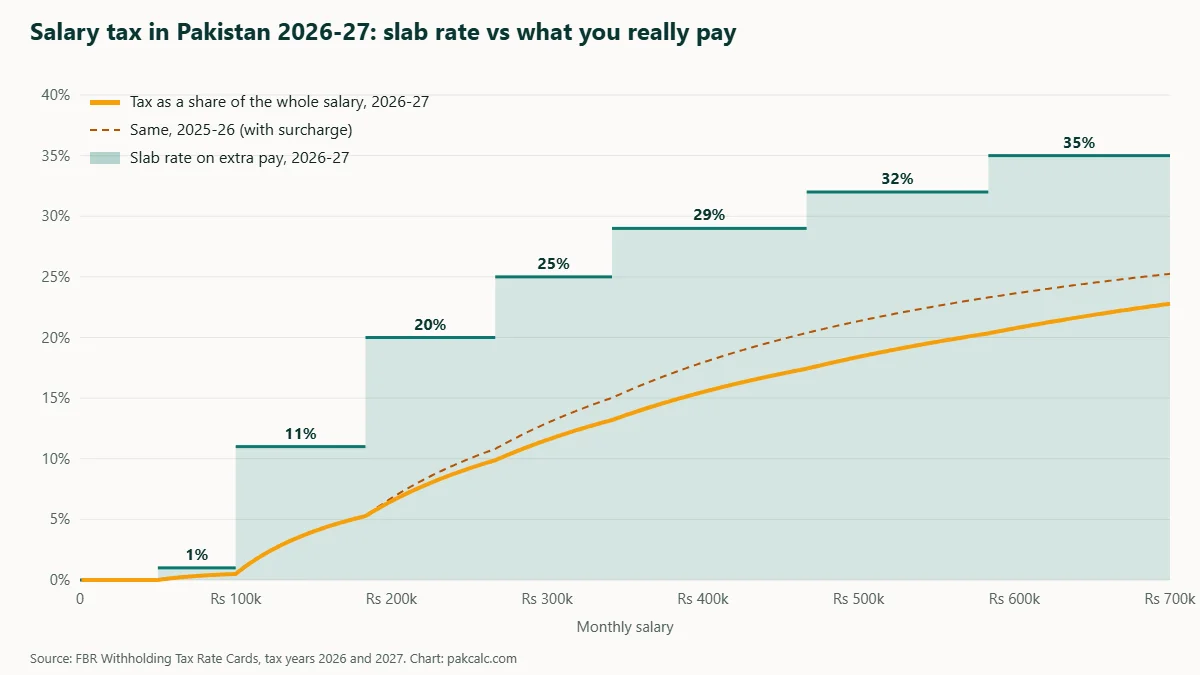
The fixed amount in each row is simply the full tax on all the slabs below it. That is why the table looks complicated but works like a staircase: you pay each step’s rate only on the rupees standing on that step.
This table is yours only if salary is more than 75% of your taxable income. If most of your income comes from a business, rent or freelancing, a different rate table applies.
Also note the naming. The “2026-27” in news headlines is the same 12 months the FBR calls tax year 2027. The FBR names each tax year after the June it ends in.
How to calculate tax on salary in Pakistan
You can check any result by hand in four steps. Take an illustrative salary of Rs 180,000 a month, paid for all 12 months of 2026-27.
- Turn it into a yearly figure. Rs 180,000 × 12 = Rs 2,160,000.
- Find the slab. Rs 2,160,000 sits between Rs 1,200,001 and Rs 2,200,000.
- Apply that row. The part above Rs 1,200,000 is Rs 960,000. 11% of that is Rs 105,600. Add the fixed Rs 6,000 and the year’s tax is Rs 111,600.
- Bring it back to a month. Rs 111,600 ÷ 12 = Rs 9,300 a month. Take-home is Rs 170,700.
This person is “in the 11% slab”, yet tax is only about 5.2% of the whole salary. The slab rate is the rate on your last rupees. The share of pay that goes to tax is always lower, because the first Rs 600,000 is tax-free and the next slabs are cheaper.
If you start the job mid-year, use only the months you are actually paid. Six months at Rs 180,000 is Rs 1,080,000 for the year, which falls in the 1% slab. The tax for those six months is Rs 4,800, or Rs 800 a month.
Monthly tax on common salaries in 2026-27
For a quick answer, find the salary closest to yours. These assume a full year of the same pay and no tax-free allowances.
| Monthly salary | Tax per month | Take-home per month |
|---|---|---|
| Rs 50,000 | Nil | Rs 50,000 |
| Rs 60,000 | Rs 100 | Rs 59,900 |
| Rs 75,000 | Rs 250 | Rs 74,750 |
| Rs 100,000 | Rs 500 | Rs 99,500 |
| Rs 125,000 | Rs 3,250 | Rs 121,750 |
| Rs 150,000 | Rs 6,000 | Rs 144,000 |
| Rs 200,000 | Rs 13,000 | Rs 187,000 |
| Rs 250,000 | Rs 23,000 | Rs 227,000 |
| Rs 300,000 | Rs 34,667 | Rs 265,333 |
| Rs 400,000 | Rs 62,000 | Rs 338,000 |
| Rs 500,000 | Rs 92,000 | Rs 408,000 |
| Rs 1,000,000 | Rs 264,500 | Rs 735,500 |
Notice the jump between Rs 100,000 and Rs 125,000. Up to Rs 100,000 a month you are only in the 1% slab. Every rupee above that is taxed at 11%, so the monthly tax rises from Rs 500 to Rs 3,250.
Gross salary to ask for a take-home you want
Job offers are quoted in gross pay, but you live on take-home. Here is the monthly gross that leaves a given amount after income tax in 2026-27. The “Gross for a take-home” tab in the calculator does this for any amount and any year.
| Take-home you want | Gross salary to ask for | Tax per month |
|---|---|---|
| Rs 100,000 | Rs 100,562 | Rs 562 |
| Rs 150,000 | Rs 156,742 | Rs 6,742 |
| Rs 200,000 | Rs 216,250 | Rs 16,250 |
| Rs 250,000 | Rs 279,556 | Rs 29,556 |
| Rs 300,000 | Rs 346,479 | Rs 46,479 |
| Rs 500,000 | Rs 637,693 | Rs 137,693 |
The gap grows faster than the take-home. Wanting Rs 50,000 more in hand, from Rs 250,000 to Rs 300,000, needs about Rs 67,000 more gross. That is because the extra pay falls in the 25% slab.
What a raise is really worth after tax
A common worry: “If my raise pushes me into the next slab, will the higher rate hit my whole salary?” It won’t. Only the rupees above the slab line pay the higher rate. Under the 2026-27 slabs, a raise always leaves you with more money in hand.
| Current monthly salary | Rate on the extra pay | You keep from Rs 10,000 more |
|---|---|---|
| Rs 80,000 | 1% | Rs 9,900 |
| Rs 150,000 | 11% | Rs 8,900 |
| Rs 250,000 | 20% | Rs 8,000 |
| Rs 300,000 | 25% | Rs 7,500 |
| Rs 400,000 | 29% | Rs 7,100 |
| Rs 500,000 | 32% | Rs 6,800 |
| Rs 750,000 | 35% | Rs 6,500 |
Use this before a salary talk or when comparing two offers. At Rs 250,000, an offer of Rs 20,000 more is worth about Rs 16,000 a month in hand. Our salary tax calculator shows this “you keep” figure for your own pay and for any year you pick.
How salary tax has changed since 2022-23
Salary tax went up sharply in 2024-25, eased in 2025-26 and eased again in 2026-27, mostly for higher earners. Here is the monthly tax on two salaries across the last five years, worked out from each year’s FBR rate card.
| Tax year | On Rs 100,000 a month | On Rs 350,000 a month |
|---|---|---|
| 2022-23 | Rs 1,250 | Rs 46,250 |
| 2023-24 | Rs 1,250 | Rs 50,000 |
| 2024-25 | Rs 2,500 | Rs 61,250 |
| 2025-26 | Rs 500 | Rs 54,250 |
| 2026-27 | Rs 500 | Rs 47,500 |
At Rs 200,000 a month the pattern is the same. Tax was Rs 13,750 in 2022-23 and 2023-24, then Rs 19,167 in 2024-25. It fell to Rs 13,500 in 2025-26 and is Rs 13,000 now.
What Budget 2026-27 changed
The Finance Act 2026 kept the first three slabs as they were. Anyone earning up to about Rs 183,333 a month pays exactly what they paid in 2025-26. The cuts start above that line: 23% became 20%, 30% became 25%, and the old 35% band was split into 29%, 32% and 35%.
Tax lawyer Waheed Shahzad Butt welcomed the cuts in Business Recorder. He said salaried people “cannot hide income and bear the full brunt of withholding tax”. The biggest percentage cut lands around Rs 5.6 million a year (about Rs 466,667 a month). There, yearly tax falls from Rs 1,141,000 to Rs 976,000, about 14.5% less.
| Monthly salary | Yearly tax: 2025-26 → 2026-27 | You save per year |
|---|---|---|
| Rs 150,000 | Rs 72,000 → Rs 72,000 | Nil |
| Rs 200,000 | Rs 162,000 → Rs 156,000 | Rs 6,000 |
| Rs 300,000 | Rs 466,000 → Rs 416,000 | Rs 50,000 |
| Rs 500,000 | Rs 1,281,000 → Rs 1,104,000 | Rs 177,000 |
| Rs 1,000,000 | Rs 3,685,290 → Rs 3,174,000 | Rs 511,290 |
The surcharge cliff that no longer exists
In 2024-25 and 2025-26, salaried people with taxable income above Rs 10 million paid a surcharge on their whole tax bill. It was 10% in 2024-25 and 9% in 2025-26. Because it applied to the entire bill, crossing the line by one rupee was expensive.
In 2025-26, tax on exactly Rs 10,000,000 was Rs 2,681,000. On Rs 10,000,001 it was Rs 2,922,290, about Rs 241,000 more for one extra rupee. A raise that pushed someone just past the line could leave them with less money. From 2026-27, the surcharge no longer applies to income taxed at the salaried rates, so that trap is gone.
Why your payslip may not match the calculator
Your employer does not just divide a yearly figure by 12. Under section 149 of the Income Tax Ordinance, it estimates your salary for the whole tax year. It works out your average tax rate on that estimate and deducts at that rate each month. It can then correct for any earlier over- or under-deduction.
That method explains most gaps people see:
- A mid-year raise. The yearly estimate goes up, so the remaining months may carry a little extra to catch up on the earlier months.
- A bonus month. A bonus adds to your yearly income. Some payrolls take the extra tax in that month, others spread it.
- Changing jobs. A new employer only knows what you earn there. Sharing the salary and tax figures from your previous employer usually helps it deduct the right amount. Any difference is settled when you file your return.
- Credits you claimed. Proof of approved donations or pension fund contributions, and tax you paid on bills (next section), can lower what your employer deducts.
Example: a raise in January
Say you earn Rs 150,000 a month from July and get a raise to Rs 200,000 from January. Your salary for 2026-27 is Rs 2,100,000 and the tax on it is Rs 105,000.
| Months | Monthly salary | Tax deducted each month |
|---|---|---|
| July to December | Rs 150,000 | Rs 6,000 |
| January to June | Rs 200,000 | Rs 11,500 |
| Year total | Rs 2,100,000 | Rs 105,000 |
A calculator that only sees your new salary shows Rs 13,000 a month. One that averages the year shows Rs 8,750. Your payslip shows Rs 11,500, and all three are “right” for what they measure. The month-by-month view in the calculator shows this for your own raise and bonus.
If the gap is large, ask payroll for the yearly salary estimate they used. Most differences come from that estimate, not from wrong rates.
Tax you already paid that lowers your salary tax
Many salaried people pay income tax twice without noticing. Your mobile, internet and landline bills carry advance income tax, and so do vehicle registration and token tax. That tax is adjustable, which means it counts towards your yearly income tax.
- Mobile phone, internet and prepaid cards: 15% advance tax for people on the Active Taxpayers List, under section 236.
- Landline bills: 10% of the bill above Rs 1,000.
- Vehicles: advance tax collected at registration and with the yearly token tax.
An FBR circular lets employers credit tax paid on a phone or vehicle in your own name against your salary tax. This applies where your income is salary only. Your employer must keep the proof and show the adjustment on your tax certificate. If your employer won’t do it, you can still claim it in your yearly return on IRIS.
Put the total you have paid this year in the “adjustable tax” box above. The salary tax calculator subtracts it from your yearly tax, so you can see what is really left to be deducted from your salary.
What counts as taxable salary
For tax, “salary” is broad. Basic pay, house rent, conveyance and most other allowances, bonuses and many perks all count unless the law exempts them. A few items lower the tax for most employees:
- Medical allowance: up to 10% of basic salary is tax-free, but only if your employer does not also reimburse medical bills.
- Medical reimbursement: money your employer repays for actual treatment or hospital costs is exempt.
- Zakat: Zakat deducted under the Zakat and Ushr Ordinance is subtracted from your taxable income.
- Donations: approved donations earn a tax credit at your average rate, on up to 30% of your taxable income. This is a credit, not a full deduction.
- Voluntary pension funds: contributions earn a credit at your average rate, on up to 20% of your taxable income (section 63). Fund managers add that the money must stay invested for at least a year.
This income tax calculator handles all five. Enter your basic pay and medical allowance, and it applies the 10% cap. Donations and pension fund contributions are turned into credits at your average rate, within the limits above.
Special cases
Government employees
Federal and provincial government employees use the same salaried slabs as private-sector staff. The 2026-27 budget gave federal employees a 7% pay rise, so recalculate with your new pay rather than last year’s.
Pensioners
Pension from a former employer is tax-free up to Rs 10 million a year. Above that, 5% applies to the excess if you are under 70. Pensioners aged over 70 are not taxed on it. If you still work for the same employer, or an associated company, your pension is taxed with your salary at the normal slabs.
Teachers and researchers
Full-time teachers and researchers at recognised non-profit institutions got a 25% cut in the tax on their salary for tax years 2023, 2024 and 2025 (July 2022 to June 2025). The law says this rebate stopped after tax year 2025, and the FBR’s circular on the Finance Act 2025 confirms it, so it does not apply to 2025-26 or 2026-27. This calculator does not apply it for any year. If you qualified and are checking 2022-23, 2023-24 or 2024-25, reduce the yearly tax shown by 25%.
Arrears paid late
Sometimes arrears would be taxed more heavily in the year you receive them. In that case the law lets you choose the rates of the year the work was done. Pick the earlier year in the calculator to compare.
Salary plus other income
If salary is 75% of your taxable income or less, the salaried table does not apply. Use the non-salaried rates in the next section, or pick “Business, profession or other” in the calculator.
Tax on business and other non-salaried income
Business owners, doctors in private practice, consultants and other individuals whose income is mostly not salary use a different table. It is much steeper than the salaried one. It has also stayed the same for three years: the Finance Act 2026 did not change it.
| Yearly taxable income | Tax for the year (2024-25 to 2026-27) |
|---|---|
| Up to Rs 600,000 | Nil |
| Rs 600,001 to 1,200,000 | 15% of income above Rs 600,000 |
| Rs 1,200,001 to 1,600,000 | Rs 90,000 + 20% above Rs 1,200,000 |
| Rs 1,600,001 to 3,200,000 | Rs 170,000 + 30% above Rs 1,600,000 |
| Rs 3,200,001 to 5,600,000 | Rs 650,000 + 40% above Rs 3,200,000 |
| Above Rs 5,600,000 | Rs 1,610,000 + 45% above Rs 5,600,000 |
The difference is large. On Rs 2,000,000 a year, salaried tax is Rs 94,000 while non-salaried tax is Rs 290,000. On Rs 6,000,000 it is Rs 1,104,000 against Rs 1,790,000.
Non-salaried individuals also still pay the 10% surcharge on their tax once taxable income passes Rs 10 million. The surcharge removal in 2026-27 was for salaried income only.
Some income is taxed outside this table. Rent from property has its own rates. IT and IT-enabled service exporters pay a reduced 0.25% rate, which the 2026-27 budget extended to tax year 2029. This calculator does not cover those cases.
How to calculate salary tax in Excel
If you keep your budget in Excel or Google Sheets, put your yearly taxable salary in cell A1 and paste this formula in another cell. It returns the tax for the year under the 2026-27 slabs.
=IF(A1<=600000,0,IF(A1<=1200000,(A1-600000)*1%,IF(A1<=2200000,6000+(A1-1200000)*11%,IF(A1<=3200000,116000+(A1-2200000)*20%,IF(A1<=4100000,316000+(A1-3200000)*25%,IF(A1<=5600000,541000+(A1-4100000)*29%,IF(A1<=7000000,976000+(A1-5600000)*32%,1424000+(A1-7000000)*35%)))))))
Divide the result by 12 for the monthly figure. For a monthly salary in A1, replace every A1 with A1*12. We tested the formula against the salary tax calculator above at every slab boundary.
Filing your return when tax is already deducted
The tax your employer deducts is an advance, not a final settlement. In most cases you still need to file a yearly return on the FBR’s IRIS portal, especially if your salary is above Rs 600,000. Filing is also what keeps you on the Active Taxpayers List, which gives you lower tax rates on banking, property and vehicle deals.
- Tax year 2026 (2025-26): the deadline was 30 September 2026. The FBR extended it twice, to 31 October 2026, and that date has now passed. A return filed now counts as a late return.
- Tax year 2027 (2026-27): filing opens after 30 June 2027. The normal deadline is 30 September 2027, unless the FBR extends it.
- Filing late: under the Finance Act 2026, an individual who files late must pay Rs 25,000 to get back on the Active Taxpayers List. It used to be Rs 1,000.
Keep your employer’s yearly tax certificate, your phone and vehicle tax records, and any Zakat or donation receipts. If your return shows you paid more than you owed, IRIS marks it as refundable.
Frequently asked questions
How do I calculate monthly tax on my salary?
Multiply your monthly salary by 12, find the slab the yearly figure falls in, apply that row’s fixed amount and rate, then divide by 12. For example, Rs 150,000 a month is Rs 1,800,000 a year. The tax is Rs 6,000 plus 11% of Rs 600,000, which is Rs 72,000, or Rs 6,000 a month.
Is the 9% surcharge still charged on high salaries?
Not from 2026-27. The Finance Act 2026 removed it for income taxed at the salaried rates. It still mattered for 2025-26 returns, and it can still apply to non-salaried individuals with taxable income above Rs 10 million.
Is a Rs 50,000 salary taxed?
No. Rs 50,000 a month is Rs 600,000 a year, the tax-free limit. Tax starts on the first rupee above it at 1%, so a Rs 60,000 salary pays Rs 100 a month.
Do non-filers pay more tax on salary?
No. The FBR rate card lists one set of salary rates and no separate rate for people outside the Active Taxpayers List. Non-filers pay more on other things, such as bank withdrawals, property and vehicles, which is why filing still pays off.
Do government employees have different tax slabs?
No. Government and private employees use the same salaried slabs. What differs is the pay itself, so use your revised 2026-27 salary when you calculate.
I changed jobs this year. How is my tax worked out?
Your tax is based on all the salary you receive in the tax year, from both employers together. Choose “Per year” in the calculator and enter the total from both jobs. Your return on IRIS settles any difference between the two employers’ deductions.
Is my bonus taxed at a higher rate?
A bonus is taxed at the same slabs as the rest of your salary. It can push part of your income into a higher slab, and some payrolls take the whole extra tax in the bonus month. Over the year, the total is the same.
Checks we ran on the salary tax figures
Against the FBR’s own tables. We read the section 149 salary rows in the FBR Withholding Tax Rate Cards for tax years 2023, 2024, 2025, 2026 and 2027. Every fixed amount was re-derived from the slab below it, and all five years add up without gaps.
Where FBR documents disagree. The FBR circular on the Finance Act 2025 prints Rs 345,000 and Rs 615,000 for two 2025-26 slabs. The FBR rate card for the same year shows Rs 346,000 and Rs 616,000, which is also what the slabs below add up to. We follow the rate card.
Against published figures. For 2025-26 and 2026-27, our results matched all 22 yearly figures in a published salary table from Rs 200,000 to Rs 1,000,000 a month. For 2024-25 we matched published figures at Rs 100,000, Rs 200,000 and Rs 350,000 a month.
The new tools. The non-salaried tables for 2022-23 to 2026-27 pass the same add-up check. The “gross for a take-home” tab returns Rs 100,562 for Rs 100,000 in hand, the same figure a separate published reverse calculator gives. In the month-by-month view, the deductions always add up to the yearly tax.
Against other calculators. In October 2026 we ran the same salaries through tools ranking on Google. Several used old tables, applied the surcharge in 2026-27, or gave wrong worked examples. One showed Rs 6,000 a year in tax on Rs 70,000 a month; the correct figure is Rs 2,400.
Not done yet: a check against a real 2026-27 payslip. If you can share your monthly salary and tax deducted (no name or CNIC needed), please send it through our contact page.
The research and first draft used AI tools. Each slab, rate and rule was checked against the FBR sources below.
FBR rate cards and other sources
- FBR Withholding Tax Rate Card, tax year 2027 (updated to 30 June 2026, Finance Act 2026): salaried slabs, pension rows, section 236 rates.
- FBR rate cards for tax years 2023 to 2026: salaried slabs and the 2025-26 surcharge row.
- FBR Income Tax Circular No. 01 of 2025-26: pension rules and the end of the teachers’ rebate.
- FBR Circular No. 18 of 2004: employer adjustments under section 149, phone and vehicle tax credit.
- FBR: Income Tax Ordinance, 2001, amended up to 30 June 2026: section 63, the pension fund credit and its 20% limit. Older versions are on the FBR ordinance page.
- KPMG Taseer Hadi & Co: A Brief of Finance Act, 2026 and Brief on Finance Act, 2024: surcharge history, late-filer surcharge.
- PwC Worldwide Tax Summaries, Pakistan deductions (reviewed 24 August 2026): medical allowance, Zakat, donations.
- Express Tribune: return deadline extended to 31 October 2026.
- PkRevenue: FBR rates for business individuals and AOPs, tax year 2027, and Usman Rasheed & Co tax rates card 2026-27: non-salaried rates and surcharge.
- PkRevenue: business rates for tax years 2023 and 2024.
- MCB Funds: voluntary pension scheme tax credit: the one-year holding period.
- Business Recorder: surcharge on salaried taxpayers to go (13 June 2026).
- Dawn: Budget 2026-27 tax measures, including the IT exporters’ rate.
Update log
29 October 2026: Page published. Salaried slabs for 2022-23 to 2026-27 checked against FBR rate cards; non-salaried rates, pension, rebate and adjustment rules checked against the sources listed. Calculator includes a reverse mode, month-by-month view, business income, medical allowance cap and tax credits.
14 November 2026: Return deadline line updated. The extended 31 October 2026 date has passed, and we found no further FBR extension.
We recheck this page when each Finance Act takes effect on 1 July, and sooner if the FBR changes a rate or deadline. See our accuracy process. Spotted a difference from your payslip? Tell us.
About the author
Disclaimer: this salary tax calculator gives estimates for information only, not tax or financial advice. Your actual tax depends on your employer’s payroll, your exemptions and credits, and your filed return. For decisions, check with the FBR or a qualified tax adviser. See our Disclaimer.