Home › Education › Bahria University GPA Calculator and Grading System 2026
Bahria University GPA Calculator and Grading System 2026
By Shehrooze Butt, independent publisher and researcher | Last updated | Sources checked 22 November 2026 | Unofficial tool
A BS Computer Science student at Bahria has 8 of 10 in quizzes, 17 of 20 in assignments and 14 of 20 in the mid. That’s 39 of the first 50 marks. To end the course on an A- (3.67), the final has to bring 41 out of 50.
The Bahria University GPA calculator below does that sum for any course, using the marks split in Bahria’s Spring 2026 Student Handbook. It also gives your semester GPA and CGPA on the 11-grade table. It checks probation at 2.00, 2.50 or 3.00, and shows what a repeat would really change.
Bahria University GPA calculator for BS, MBA and MS
PakCalc made this calculator. Bahria University didn’t build or review it, so the result on your CMS and your transcript always come first.
Still blank after a few seconds? Do it by hand with Bahria’s table below: grade points times credit hours for each course, the total of those, then that total over your credit hours.
Pick your programme level first. A 57 is a C- (1.67) for a BS student but an F for an MS student. So the level changes the table the calculator uses.
The four tabs answer four different questions. Semester GPA works from letters or from marks out of 100. CGPA and probation adds semesters and tells you where you stand. The final-exam tab and the repeat tab are for planning before results come out. As a Bahria CGPA calculator it also shows the Cum Laude range once your CGPA reaches 3.60.
Bahria University grading system: 11 grades, two pass marks
Bahria grades on fixed marks. Your letter depends only on your own total, not on how the class did. This is the bachelor’s table from clause 5.3.1 of the Spring 2026 handbook. Each lower limit counts; each upper limit doesn’t.
| Marks out of 100 | Grade | Grade points |
|---|---|---|
| 85 and above | A | 4.00 |
| 80 to under 85 | A- | 3.67 |
| 75 to under 80 | B+ | 3.33 |
| 71 to under 75 | B | 3.00 |
| 68 to under 71 | B- | 2.67 |
| 64 to under 68 | C+ | 2.33 |
| 60 to under 64 | C | 2.00 |
| 57 to under 60 | C- | 1.67 |
| 53 to under 57 | D+ | 1.33 |
| 50 to under 53 | D | 1.00 |
| Below 50 | F | 0.00 |
The bands aren’t even. A B covers only four marks, 71 to 74, and B-, C- and D cover three each. One or two marks in the final can move you a whole step. That’s why the calculator tags any course within one mark of the next grade.
MBA, MS, MPhil and PhD use the same table with two changes (clause 5.3.2). Anything below 60 is an F, and the C-, D+ and D grades don’t exist. So the lowest pass for a graduate course is a C at 60.
Latin honours, the Rector’s list and the 3.60 line further down are written for bachelor’s students. For MBA and MS students the number that matters is 2.50. The handbook doesn’t limit the repeat and summer rules to undergraduates, so those apply to you too.
MS and MBA students, watch this one. A C passes the course, but it’s worth only 2.00, and your CGPA has to stay at 2.50 or above (clause 5.5.1). Two Cs and two Bs in four equal courses give exactly 2.50. One more C and you’re on probation, even though you passed everything.
A W means you withdrew from the course. It carries no grade points, so the calculator leaves it out of the GPA. The handbook defines W this way but doesn’t spell out its GPA effect. If a W matters for a scholarship line, confirm it with your exams office.
One gap in the rules: the 2026 handbook prints the limits but says nothing about rounding. If your total is 84.5, it isn’t clear from the handbook whether that’s an A or an A-. CMS normally shows a whole-number total, so go by the total your teacher posts.
Four Bahria grade tables online, and the one that counts
Search for a Bahria GPA calculator and you’ll soon meet a second table. In it an A starts at 87, a B+ is worth 3.50 and a D is worth 1.50. On 22 November 2026, three of the first ten Google results still used it. Google’s own summary box at the top was quoting it too.
That table isn’t invented. It sat on the Academic Rules page of Bahria’s old website, which also said totals were rounded to a whole number. That page now redirects to the main Bahria site. A few old grading pages on campus sub-sites still show up in Google too, but they return an error when you open them. The current handbook, Spring 2026, has the 11-grade table, and so does the Spring 2025 edition.
| Marks | Spring 2026 handbook | Old table still online |
|---|---|---|
| 86 | A, 4.00 | B+, 3.50 |
| 79 | B+, 3.33 | B, 3.00 |
| 74 | B, 3.00 | B, 3.00 |
| 70 | B-, 2.67 | C+, 2.50 |
| 58 | C-, 1.67 | D, 1.50 |
| 52 | D, 1.00 | D, 1.50 |
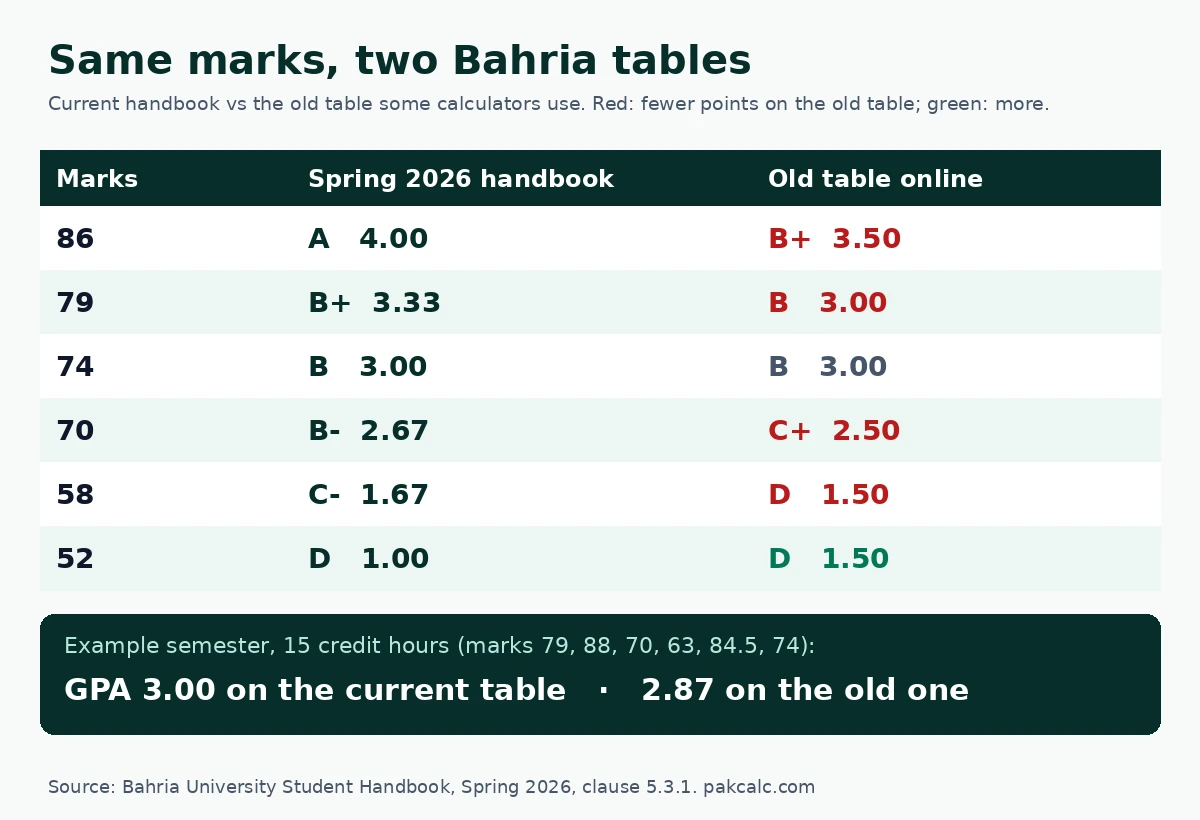
The difference isn’t always in your favour on the old table. A 52 earns more on it, but most marks from 75 to 86 earn less. On the example semester further down, the same marks give 3.00 on the current table and 2.87 on the old one.
Two more versions turn up in blogs and student forums. Neither matches any handbook I could find:
- A table with an A+ at 90 to 100 and a D at 45 to 49. Bahria has no A+, and nothing under 50 passes a bachelor’s course.
- A table with the bands moved by a mark, such as C at 61 to 63 and D+ at 54 to 57. On the handbook, C starts at 60 and D+ at 53.
Quick test for any calculator: if it has no A-, or its B+ is 3.50, it’s on the old table. I also found a page claiming a Dean’s List at a 3.50 semester GPA. The handbook has no Dean’s List at all. Its semester-by-semester honour is the Rector’s Honours List, and that needs a CGPA of 3.90, not a semester GPA. Another page multiplies CGPA by 25 to get a percentage (2.53 becomes 63.25%). Bahria publishes no such formula; more on that further down.
How 100 marks split in a Bahria course
Clause 5.1 gives two splits, depending on your programme. Labs and some courses can follow their own outline, so check yours, but most theory courses use one of these.
| Part of the course | Engineering and CS | All other programmes |
|---|---|---|
| Quizzes (at least three) | 10 | 15 |
| Assignments, projects, presentations | 20 | 20 |
| Mid-semester exam | 20 | 25 |
| Final exam | 50 | 40 |
The final weighs more for engineering and CS students: half the course. A BBA or psychology student has 60 marks in hand before the final, against 50 for a CS student. So a weak mid hurts a BBA student more, and a strong final rescues a CS student more.
Back to the CS student from the top of the page, with 39 of 50 before the final. Here’s what each target grade asks of the final, worked out on clause 5.1 and the grade table:
| Target | Course total needed | Final marks needed (of 50) |
|---|---|---|
| A | 85 | 46 |
| A- | 80 | 41 |
| B+ | 75 | 36 |
| B | 71 | 32 |
| D (pass) | 50 | 11 |
Same idea for a BBA or psychology student on the 15/20/25/40 split. Say you have 12 of 15 in quizzes, 16 of 20 in assignments and 17 of 25 in the mid. That’s 45 of 60 before the final. A B needs 26 of 40, a B+ needs 30, and a pass needs just 5.
If the planner shows a half mark, such as 40.5, and your teacher marks in whole numbers, treat it as the next whole mark up.
None of that matters if you can’t sit the paper. Clause 1.27.1 needs 75% attendance in each course to sit the final, and it states plainly that no shortfall is excused.
One Bahria semester added up on paper
The formula is in clause 5.3.3. Each course earns quality points (its grade points times its credit hours), and the GPA is all of them divided by the semester’s credit hours. Here’s an illustrative BS Computer Science semester, the same one the calculator’s example button loads.
| Course (credit hours) | Marks and grade | Quality points |
|---|---|---|
| Data Structures and Algorithms (3) | 79, B+ | 3 × 3.33 = 9.99 |
| Data Structures Lab (1) | 88, A | 1 × 4.00 = 4.00 |
| Discrete Structures (3) | 70, B- | 3 × 2.67 = 8.01 |
| Digital Logic Design (3) | 63, C | 3 × 2.00 = 6.00 |
| Technical Writing (3) | 84.5, A- | 3 × 3.67 = 11.01 |
| Pakistan Studies (2) | 74, B | 2 × 3.00 = 6.00 |
| Total (15) | 45.01 |
GPA = 45.01 ÷ 15 = 3.00. Notice Technical Writing. If that 84.5 gets rounded up to 85, it’s an A, the semester gains 0.99 quality points and the GPA becomes 3.07. Half a mark, seven hundredths of a GPA.
For your CGPA, do the same sum across every course since admission, not just this semester (clauses 1.1.7 and 5.3.3). Adding semester GPAs weighted by credit hours gives the same answer, until you repeat a course. A repeat swaps the old grade’s points out without adding credit hours, so after a repeat, start from the CGPA on your latest result.
Probation at 2.00, 2.50 and 3.00: the two-strike rule
Clause 5.5.1 sets one line per level: 2.00 for the associate degree, BBA, BEE and BS; 2.50 for MBA, MS and MPhil; 3.00 for PhD. In your first semester it’s your GPA that’s checked. From the second semester on, it’s your CGPA.
- First time under the line: you’re on probation, and your HoD issues a formal warning letter (5.5.2).
- Second semester in a row under it: another warning. You can’t register for a new course or semester without the Principal’s approval through your HoD (5.5.5).
- Still under it in the next semester: you’re dropped (5.5.3). Coming back means applying again as a new student and qualifying the entry test on merit (5.5.6).
Older rules still float around online, copied from Bahria’s previous website: probation only between 1.50 and 2.00, a “chance status” after three probations, and relegation to a lower semester. None of that is in the 2026 handbook. Today it’s two warnings, then a drop.
Climb back to the line at any point and the count resets to zero (5.5.4). A summer session can help with that, since a better grade replaces a failed or weak one in the CGPA.
The GPA you need is simple arithmetic. Say your CGPA is 1.85 over 30 credit hours and you take 15 next semester. Reaching 2.00 over 45 hours takes 90 quality points; you have 55.5. So the semester has to bring 34.5 ÷ 15 = 2.30.
The CGPA tab does this sum for you once you pick how many probations you’ve had. The same 2.00, 2.50 and 3.00 are also the CGPAs you need for the degree (clause 2.21.1).
Repeat a C+ now, or keep Cum Laude in reach?
Clause 1.17.1 lets you repeat a course if your grade was C+ or lower, with your HoD’s approval. Every attempt stays on the transcript, but only the higher grade goes into your CGPA. A worse second attempt can’t pull you down.
Summer is wider. Clause 1.18.1 opens the summer session to failed courses and to any grade below B, B- included, two courses at most. The course runs only if at least ten students register, and the same ten-student condition applies to a regular-semester repeat.
Here’s the trade-off. Clause 5.6 bars anyone with a repeated, withdrawn or summer course from Latin honours. Summer improvers also lose any shot at a Gold or Silver medal (clause 1.8).
So a repeat that lifts you from 2.41 to 2.47 is an easy call. That’s a D turned into a C+ on a 3-credit course, with 64 credit hours behind you: 3.99 extra quality points over the same 64 hours. One that nudges a 3.55 towards 3.60 can cost you the very honour you were chasing.
| Your situation | Usually the better move |
|---|---|
| On probation, with a C, D or F on record | Repeat it. Honours aren’t in play, and one course can clear the line. |
| CGPA near 3.60 with no repeats yet | Don’t repeat. Let the target box tell you what next semester has to bring. |
| A B- you want to improve | Only a summer session takes it, and it ends honours eligibility. |
| Final year, short of degree requirements | Summer is allowed in the last year (clause 1.18.1b), unless you’re on probation for low CGPA. |
One slip worth knowing: clause 1.17.1 describes C+ as “Grade Point 2.5”, while the handbook’s own tables give C+ 2.33. The letter is what decides whether you can repeat, so the calculator goes by C+.
3.60, 3.80, 3.90: honours, the Rector’s list and medals
| Recognition | CGPA | Clause |
|---|---|---|
| Cum Laude | 3.60 to under 3.80 | 5.8 |
| Magna Cum Laude | 3.80 to under 3.90 | 5.8 |
| Summa Cum Laude | 3.90 and above | 5.8 |
| Rector’s Honours List | CGPA 3.90 or above, checked every semester | 5.9 |
| Gold and Silver medal | 1st and 2nd highest CGPA in the batch | 5.7 |
Latin honours also need the rest of clause 5.6. That means the regular programme duration and a full load every semester. It also means no incomplete credit hours, no migration or credit transfer, and no disciplinary penalty. When two graduates tie on CGPA for a medal, the aggregate percentage decides.
The Rector’s list is harder than it looks, because it goes on CGPA. One 3.50 semester early on can keep you off it for a while. A student at 3.95 over 34 credit hours who gets 3.50 in an 18-hour semester drops to 3.79, and even a perfect 4.00 in another 18-hour semester only brings that back to 3.85.
Be careful with the long-range targets. A student at 3.50 over 100 credit hours who wants 3.60 after one more 17-hour semester would need a 4.19, which isn’t possible. The target box shows this and gives the best CGPA a perfect semester would reach.
W, course load, retakes and freezing a semester
- How much you can take: up to 18 credit hours a semester in non-engineering programmes, and up to six courses in engineering (clause 1.10.2).
- One extra course: an undergraduate with a CGPA of 3.50 or more can add one course beyond the normal load, with the HoD’s approval (clauses 1.11.1 and 1.11.2). That can pull a 3.60 target closer without a repeat.
- Pass/Fail electives: up to 9 credit hours can be taken pass/fail. They don’t count in your GPA or CGPA (clause 1.20.14), so leave them out of the calculator.
- Withdrawing: in weeks 1 and 2 nothing goes on your record. From week 3 to week 7 the course shows a W. After week 7 you can’t withdraw (clause 1.14). Simply stopping attending isn’t a withdrawal. Mids usually come back close to that deadline, so if a mid went badly, run the final-exam tab the same week. Withdrawing also rules out Latin honours, so don’t do it for a small GPA gain.
- Fee back: for a dropped course, the full fee is carried to the next semester in week 1, half within the first 15 days, nothing after that (clause 1.14.4). The fee-refund section (1.21.3) prints a different day-by-day table, so confirm with your accounts office before you count on it.
- Missed a mid or final: a retake is allowed only for your own hospitalisation or a death in your immediate family. It costs Rs 3,000 per course per exam (clause 5.2).
- Freezing: allowed for illness or circumstances beyond your control, on the prescribed form. You must rejoin the next semester or be struck off (clause 1.15).
Bahria CGPA as a percentage
The handbook gives no formula to turn a CGPA into a percentage, and Bahria transcripts carry the CGPA. When a job or scholarship form wants a percentage, follow the formula printed on that form. The marks percentage calculator compares the common CGPA-to-percentage methods side by side.
Three things to do now
- Below 2.00 (or 2.50 on an MS) with a D or F behind you: try that course in the repeat tab before anything else. Replacing one grade often clears the line.
- Sitting at 3.4 or 3.5 and hoping for Cum Laude: stay clear of repeats, W and summer courses, and ask your HoD about the extra course clause 1.11.1 allows at 3.50.
- Mids just came back and one paper went badly: enter quizzes, assignments and the mid in the final-exam tab this week, before the week-7 withdrawal date passes.
Bahria GPA questions
Is the grading system the same at Bahria Islamabad, Karachi and Lahore?
Yes. One Student Handbook covers every campus and constituent unit, so BUIC, BUKC and BULC students all use the 11-grade table above. Bahria’s MBBS and BDS programmes are the exception; they’re annual programmes with their own honours and medal rules (clauses 5.10 and 5.11).
What is the passing grade at Bahria University for BS and for MS?
For a BS, BBA or other bachelor’s course it’s a D, which means 50%. For MBA, MS, MPhil and PhD courses it’s a C at 60%, because those programmes have no D grades.
Does a W lower my Bahria GPA?
Not directly, because a W has no grade points. It still shows on your transcript, and any withdrawn course rules you out of Cum Laude and the other Latin honours.
Which grade counts if I repeat a course at Bahria?
The higher one. Both attempts appear on the transcript, but only the better grade goes into your CGPA, and your total credit hours don’t grow.
Is 3.0 a good CGPA at Bahria?
It clears the degree line for every level, PhD’s 3.00 included. It sits well under the 3.60 where Cum Laude starts, though.
Bahria Student Handbook clauses this page relies on
- Bahria University Student Handbook, Spring 2026 (amendment 16, January 2026): 5.1 marks split, 5.2 retakes, 5.3 grading and GPA formula, 5.4 pass marks, 5.5 probation and drop, 5.6 to 5.9 honours and medals, 1.10 and 1.11 course load, 1.14 withdrawal, 1.15 freezing, 1.17 repeats, 1.18 summer session, 1.20.14 pass/fail electives, 1.27 attendance, 2.21 degree CGPA. Linked from Bahria’s downloads page, where it was the newest edition on 22 November 2026.
- Student Handbook, Spring 2025: same grading table and marks split, used to check the table hasn’t changed between editions.
Testing
143 automated checks, covering:
- Both sides of all ten Bahria cut-offs on the bachelor’s table (84.99 against 85, 70.99 against 71, down to 49.99 against 50), plus 59.99 and 60 on the MS table, where C-, D+ and D must be refused.
- The example semester (3.00, and 3.07 with Technical Writing rounded up), W and F rows, a 1-credit lab, and bad input such as 105 marks or an empty row.
- Probation and drop for each level and probation count, the first-semester case, rounding at a line, and targets that can’t be reached.
- The final-exam planner on both splits, every repeat route (regular, summer, B-, lower second attempt), and the buttons, tabs, saved entries, 30-day wipe and Clear button in a simulated browser.
- Not covered: a real Bahria result card, since I couldn’t find a recent one shared publicly. Result doesn’t match? Send the grades and credit hours through the contact page, leaving out your name and registration number, and I’ll find where the two figures part ways.
I had AI help with the drafting; the Bahria rules on this page were read from the handbook itself.
Update log
- 22 November 2026: Page and calculator built from the Spring 2026 Student Handbook, cross-checked with the Spring 2025 edition. Added the four grade tables in circulation, older probation rules, course-load and pass/fail clauses, and a how-to video.
Next review: 31 January 2027. Bahria has updated this handbook three times since January 2025 (amendments 14 to 16), so a Spring 2027 edition is likely; if a newer one appears earlier, the page gets checked then. The calculator accuracy page explains how PakCalc keeps its tools current.
This calculator uses Bahria’s table only. Comparing Bahria’s 3.67 A- with another university, or studying at two places? The GPA calculator for Pakistani universities covers COMSATS, FAST, UET, IIUI and others.
About the author
Disclaimer: results on this page are estimates for information only, not official results or advice. Your university’s record and transcript are final. See our Disclaimer. Spotted an error? Contact us.