Home › Education › UOG CGPA Calculator 2026 (University of Gujrat Grading Rules)
UOG CGPA Calculator 2026 (University of Gujrat Grading Rules)
By Shehrooze Butt, independent publisher and researcher | Last updated | Sources checked 8 November 2026 | Unofficial tool
Score 79 in a University of Gujrat course this semester and your result shows a grade point of 3.60. Before Fall 2025, the same 79 was a B+ worth 3.40.
UOG’s Revised Semester Rules 2025, still current in November 2026, give almost every mark from 50 to 84 its own grade point. The UOG CGPA calculator below uses that table, and also accepts old A+, B+ or C+ letters.
Short answer: UOG CGPA = total quality points ÷ total credit hours. A course’s quality points are its grade point × its credit hours. On the 2025 table, 85 or more earns 4.00, 70 earns 3.00, 60 earns 2.00 and 50 earns 1.00. Below 50 is an F.
Official record: your UOG result card and transcript. What you see here is an estimate from the university’s published rules.
UOG CGPA calculator: marks, grade points or old letters
The calculator is loading. If it does not respond, refresh the page. You can still work out your GPA manually with the grading table and steps below.
Use marks if you have your course totals. Pick letters only if your card shows A+, B+, B- or C+. Leave W and I courses out, or pick them in the letters list.
Your entries stay saved on this device for 30 days after your last change, then clear themselves. On a shared computer, press Clear all when you finish.
Count every graded course so far, including an F you haven’t repeated yet. Leave the previous boxes empty in your first semester.
Built on rule 13.3: midterm 25, sessional 25 (assignments 10, quizzes 5, presentation 10) and final 50. Affiliated colleges on the Term System split marks 40 and 60 instead.
UOG lets you repeat or improve F, D and C grades, and the higher attempt counts (rules 16.1 and 16.3).
A regular student can take up to 19 credit hours a semester, or 22 when repeating courses (rules 9.3 and 9.4).
Result look wrong? Tell us what you entered and we will look into it.
UOG grading system from Fall 2025: a grade point for every mark
UOG’s Academic Council approved the revised undergraduate rules on 8 October 2025, and the Syndicate followed on 16 October. The notification, issued from the Hafiz Hayat Campus in Gujrat, is dated 11 November 2025 and applies the rules from Fall 2025. The table below is section 13.6, the UOG grading system as it now stands.
| Marks (out of 100) | Grade point | Letter |
|---|---|---|
| 85 to 100 | 4.00 | A |
| 84 | 3.93 | A |
| 83 | 3.87 | A |
| 82 | 3.80 | A |
| 81 | 3.73 | A |
| 80 | 3.67 | A |
| 79 | 3.60 | B |
| 78 | 3.53 | B |
| 77 | 3.47 | B |
| 76 | 3.40 | B |
| 75 | 3.33 | B |
| 74 | 3.27 | B |
| 73 | 3.20 | B |
| 72 | 3.13 | B |
| 71 | 3.07 | B |
| 70 | 3.00 | B |
| 69 | 2.90 | B |
| 68 | 2.80 | B |
| 67 | 2.70 | B |
| 66 | 2.60 | B |
| 65 | 2.50 | B |
| 64 | 2.40 | C |
| 63 | 2.30 | C |
| 62 | 2.20 | C |
| 61 | 2.10 | C |
| 60 | 2.00 | C |
| 59 | 1.90 | C |
| 58 | 1.80 | C |
| 57 | 1.70 | C |
| 56 | 1.60 | C |
| 55 | 1.50 | C |
| 54 | 1.40 | D |
| 53 | 1.30 | D |
| 52 | 1.20 | D |
| 51 | 1.10 | D |
| 50 | 1.00 | D |
| Below 50 | 0.00 | F |
Each letter now covers a wide range. A runs from 80 to 100, B from 65 to 79, C from 55 to 64 and D from 50 to 54. The grade point carries the detail: inside the same B, a 65 earns 2.50 and a 79 earns 3.60.
Look at the step size too. From 50 to 69, each extra mark adds 0.10. From 70 up to 85, each mark adds about 0.07. So a mark gained in the 60s moves your GPA more than one gained in the high 70s.
HEC’s Undergraduate Education Policy sets no grading scale, so each university writes its own.
Most universities covered by our GPA tools still group marks into letter bands. UAF’s quality point table is the exception that also moves with every mark. So a UOG 3.13 and a 3.13 elsewhere can rest on different marks. Our GPA calculator for Pakistani universities holds those other scales side by side.
Which scale is your result card on?
Check the letters. The 2025 table uses only A, B, C, D and F, and only for single courses. A CGPA such as 2.62 has no letter of its own in UOG’s rules. If your card shows A+, B+, B- or C+, those courses were graded on the older scale, and the calculator’s letters option matches them.
The notification makes the new rules effective from Fall 2025. It doesn’t say whether students admitted before that move to the new table for their remaining semesters. Your department or the Controller of Examinations can confirm which one your batch is on.
To check the table against a real result, I asked a UOG student for one course from their 2025-26 result card. Their name and roll number were left out. The marks and grade point on it matched the 2025 table.
Same marks, two scales: what changed in 2025
I ran every whole mark from 50 to 84 through both tables. Of those 35 marks, 27 now earn more points, 6 earn the same and only 2 earn less.
| Marks | Before Fall 2025 | From Fall 2025 |
|---|---|---|
| 84 | A, 3.70 | 3.93 |
| 80 | A, 3.70 | 3.67 |
| 79 | B+, 3.40 | 3.60 |
| 75 | B+, 3.40 | 3.33 |
| 74 | B, 3.00 | 3.27 |
| 69 | B-, 2.50 | 2.90 |
| 64 | C+, 2.00 | 2.40 |
| 59 | C, 1.50 | 1.90 |
| 54 | D, 1.00 | 1.40 |
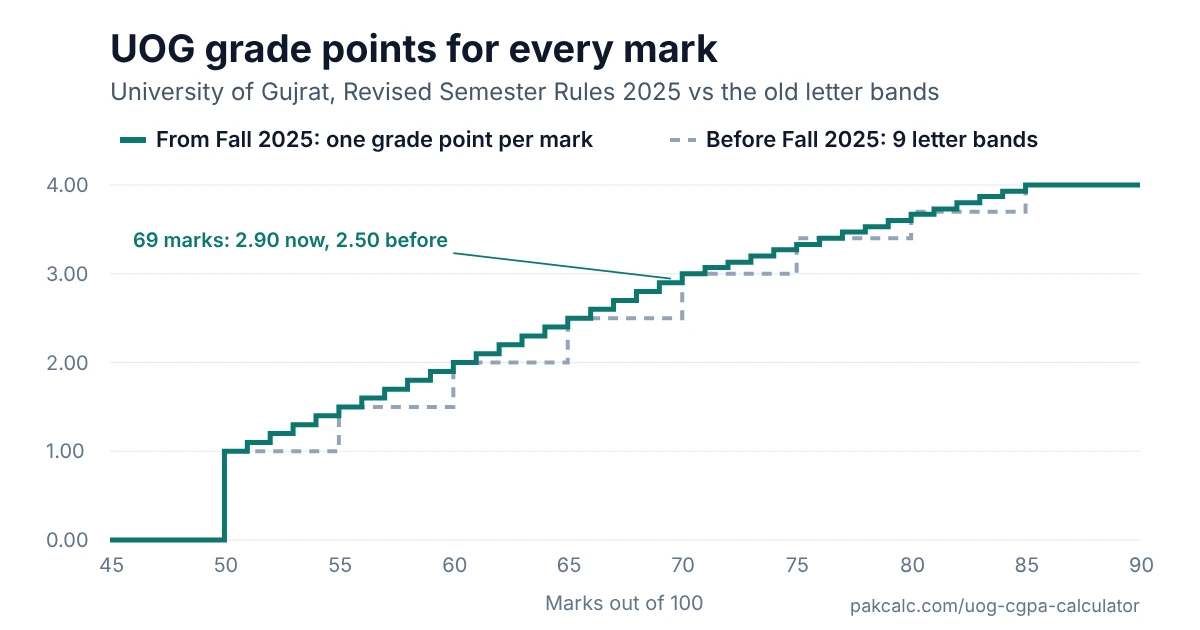
The biggest gains, 0.40 points, sit one mark below each old band edge: 69, 64, 59 and 54. Under the old table, a 69 was pulled down to a B- worth 2.50. It now earns 2.90.
The two marks that lose are 75 (3.40 down to 3.33) and 80 (3.70 down to 3.67). Every mark from 85 up still earns 4.00.
Over a semester the change adds up. Take four 3-credit courses at 79, 72, 66 and 58, plus a 1-credit lab at 85. The old bands give a GPA of 2.71. The 2025 table gives 2.88 for exactly the same marks.
From course marks to a UOG GPA and CGPA
Rule 13.3 marks every course out of 100:
- Midterm: 25 marks
- Sessional work: 25 marks (assignments 10, quizzes 5, presentation 10)
- Final term: 50 marks
You pass a course with 50 in total (rule 13.5.7). The rules set this aggregate as the pass mark and give no separate one for the final paper.
Your scheme of studies lists each course’s credit hours as, for example, 3(2-1). That means three credits: two of theory and one of lab (rule 7).
The course total gives a grade point from the table. Multiply it by the course’s credit hours to get quality points. Add the semester’s quality points and divide by its credit hours. Here is the semester from the comparison above:
| Course | Marks, credit hours | Quality points |
|---|---|---|
| Course 1 | 79, 3 | 3.60 × 3 = 10.80 |
| Course 2 | 72, 3 | 3.13 × 3 = 9.39 |
| Course 3 | 66, 3 | 2.60 × 3 = 7.80 |
| Course 4 | 58, 3 | 1.80 × 3 = 5.40 |
| Lab | 85, 1 | 4.00 × 1 = 4.00 |
| Total | 13 credit hours | 37.39 |
37.39 ÷ 13 = 2.876, so the semester GPA is 2.88.
The CGPA uses the same sum across all your semesters. If you only have last term’s CGPA, multiply it by the credit hours it covers to rebuild its quality points. Say your CGPA is 2.85 over 33 credit hours and the new semester is 3.17 over 15. The sum is (94.05 + 47.55) ÷ 48 = 2.95.
A failed course stays in both totals with zero points until you pass it again. W and I have no grade point on UOG’s tables, so they stay out of the sum.
Three slips that give the wrong UOG GPA
Dr. Muhammad Abid Dar teaches in UOG’s Department of Mathematics. In a September 2026 video for new students, he explains the 2025 table and names three slips he sees often:
- Averaging the marks first. Students add their course marks, divide by the number of courses and read one grade point off the table. The table applies to each course on its own.
- A plain average of grade points. A 1-credit lab and a 3-credit course don’t weigh the same. Your GPA is a credit-weighted average.
- Rounding too early. Keep about four decimals while you work and round to two only at the end. Degrees show the CGPA to two decimals.
Here is what the first two slips do to the semester above. Averaging the five marks gives 72, which reads as 3.13. Averaging the five grade points gives 3.03. The correct, credit-weighted figure is 2.88, so both shortcuts overstate it.
His other tip is simple: after every result, note your total credit hours and total quality points. With those two numbers, the next CGPA is a one-line sum.
Final-term marks you still need
Teachers upload midterm and sessional marks before the end-term exams (rule 13.4.3). Once you know them, the final paper is the only unknown.
Say you have 17 out of 25 in the midterm and 21 out of 25 in sessionals, so 38 of 50. You need 12 out of 50 in the final to pass, 32 for a 3.00 and 47 for a full 4.00.
The final-term marks tab works as a UOG grade calculator for one course and builds this list for your own marks.
Don’t plan on a second chance at the paper. Rule 13.5.9 says a student who misses the final gets no separate or makeup exam and is treated as absent. The medical exception is the I grade, covered below.
Fall 2026 and Spring 2027 dates that touch your GPA
These come from UOG’s Academic Calendar 2026-27, which covers all degree programmes.
| Event | Fall 2026 | Spring 2027 |
|---|---|---|
| Last date to withdraw (W) | 30 Oct 2026 | 22 Mar 2027 |
| Midterm exams | 2 to 11 Nov 2026 | 24 to 31 Mar 2027 |
| Midterm marks uploaded by | 20 Nov 2026 | 12 Apr 2027 |
| Last day of classes and sessional marks | 24 Dec 2026 | 14 May 2027 |
| Final term exams | 30 Dec 2026 to 14 Jan 2027 | 25 May to 9 Jun 2027 |
| Result announced | 1 Feb 2027 | 29 Jun 2027 |
The Fall 2026 withdrawal date has passed, so a course that is going badly this term can no longer become a W. Use the final-term tab instead to see what the paper has to give you.
Summer 2027 classes start on 14 June, with finals on 9 to 13 August and results on 20 August 2027. Marks reach you through UOG’s student portal: rule 11.6 asks teachers to upload attendance, assignments, quizzes and midterm marks there. In June 2026 UOG launched the MY UoG app, which brings the student, faculty and admission portals onto one platform.
Improving an F, D or C at UOG
- Which grades: only F, D and C can be repeated or improved (rule 16.1). On the 2025 table, that means a course total below 65. The University of Lahore is stricter: its undergraduates can repeat only a D+, D or F, as our UOL GPA calculator explains.
- Which attempt counts: the higher of the two (rule 16.3).
- A failed course: you sit the midterm and final again and submit new sessional work (rule 16.2).
- Summer semester: 8 weeks, for failed or improvement courses, up to three courses, if your department offers it (rule 5.2).
- Credit limit: up to 22 credit hours in a semester when you’re repeating, instead of 19 (rules 9.3 and 9.4).
- The cost: any repeat or improvement makes you ineligible for a gold medal or merit position (rule 22.2).
Pick the course that adds the most quality points: the gain is (new grade point − old grade point) × credit hours. Retaking a 3-credit F and scoring 60 adds 6.00 quality points. Lifting a 3-credit 54 to 60 adds only 1.80.
Here’s a typical case. A D at 52 earns 1.20. Score 68 on the repeat and it becomes 2.80. With a CGPA of 2.10 over 60 credit hours, that one 3-credit course lifts the CGPA to 2.18.
Promotion, drop-out and the 2.00 degree minimum
- Semester GPA under 1.50: you are not promoted and are dropped from the rolls (rules 14.1 and 14.2).
- CGPA under 1.50: you are dropped straight after the end-term result (rules 17.2 and 17.3).
- Re-admission: once in the whole degree, in the next semester, with all dues plus Rs 5,000. The dropped semester’s results don’t count (rule 18). The 2026-27 calendar asks departments to re-admit such students within ten working days of each result.
- Degree: a CGPA of 2.00. Finish below it without any repeats, and you may repeat your lowest-grade courses to reach 2.00. If you can’t, no degree is awarded (rule 14.4).
- Migration into UOG: a CGPA of 2.00 with no failed subject, in the 3rd or 5th semester only (rule 21).
Between 1.50 and 1.99 you can keep studying, but you can’t graduate yet. At 1.85 after 30 credit hours, you’d need a 2.25 next semester over 18 credit hours to reach 2.00.
Repeats often close the gap faster. Take a 1.90 CGPA over 45 credit hours with one 3-credit F. Pass that course at 60 and the CGPA moves to 2.03, with no new credit hours added.
W, I, freeze and gap: how each shows on your record
| Situation | Rule | What happens |
|---|---|---|
| W: withdrawn from a course | 10.2: before the midterm, with the Chairperson’s or HOD’s approval | Shown as W on the transcript, with no grade point |
| I: incomplete on medical grounds | 12: midterm and sessional done, final missed | Sit the final when the course runs again; Rs 4,000 per course |
| Attendance below 75% | 11.3 and 11.4 | Dropped from the course and must repeat it. The Vice Chancellor can excuse up to 10% in hardship cases |
| Semester freeze | 19: not in the 1st semester; up to two semesters, once | No fee if you apply within 15 days of classes starting; Rs 5,000 after that |
| Semester gap | 20: up to two semesters without a freeze | Rejoining fee Rs 2,000 plus regular fees; the gap is noted on your transcript |
Affiliated colleges and Term System students
UOG’s undergraduate rules also bind its affiliated colleges, with one change for the Term System. There, the college awards 40 marks for classroom work and the midterm. UOG’s Term System Branch sets and marks the 60-mark end-term paper (section 1 of the rules).
Everything else, including the grading table, is shared. So the semester GPA and CGPA tabs work for college students once you have each course’s total out of 100. The final-term tab assumes the university’s 25/25/50 split, so skip it.
Does UOG convert CGPA to a percentage?
UOG’s rules contain no CGPA-to-percentage formula. The university does keep percentages alongside CGPA, though: rule 22.4 breaks a tie for a gold medal by percentage.
When a form asks for a percentage, get an official figure from the Controller of Examinations. You can also compare the common methods on our marks percentage calculator. The per-mark table also works backwards. Each course grade point from 1.00 to 3.93 matches exactly one mark, so a 3.13 on your card means 72.
Frequently asked questions
Is this the official UOG CGPA calculator?
No. PakCalc is independent and has no link to the University of Gujrat. The calculator follows UOG’s Revised Semester Rules 2025, section 13.6. Your result from UOG and your transcript remain the official record.
Does UOG round 84.5 up to 85?
The rules don’t say. The grading table lists whole marks only. The calculator uses the lower whole mark and also shows what the next mark would give. At 84.5 that is 3.93, or 4.00 if your department rounds up.
When will the UOG Fall 2026 result come out?
UOG’s 2026-27 academic calendar sets 1 February 2027 for Fall 2026 results, after finals from 30 December 2026 to 14 January 2027. Spring 2027 results are due on 29 June 2027.
What is the minimum CGPA for a degree at UOG?
2.00, under rule 14.4. You must also keep your CGPA at 1.50 or more to stay enrolled while you study.
Can I improve a B grade at UOG?
No. Rule 16.1 lets you repeat or improve only F, D and C grades. On the 2025 table that covers totals below 65, so a course at 65 or above stays as it is.
Do MS and MPhil students use this table?
Not necessarily. The 2025 rules book covers undergraduate programmes only. UOG’s earlier semester rules asked MS and MPhil students for a first-semester GPA of 2.50 and a 2.50 CGPA for an MPhil degree. Confirm the current graduate rules with your department.
The rulebook behind this page
Both UOG rule books are scanned images, not text. I read them page by page on 8 November 2026, so every rule and number here was checked against the printed page.
- UOG Semester Rules and Regulations for Undergraduate Programs, Revised 2025 (PDF): notification UOG/DAC/ACD/AC-27/07/6672 of 11 November 2025. Used for the grading table (13.6), marks split (13.3), pass mark, promotion, repeats, drop-out, re-admission, W and I grades, attendance, summer semester, migration and medals.
- UOG Rules and Regulations for Semester System of Examinations, earlier edition (PDF): signed in March 2018. Used for the old letter table, the GPA and CGPA formula and the MS and MPhil lines.
- UOG Examination, Semester Downloads page: where UOG lists both files, with the 2025 one marked as the revised rules.
- UOG Academic Calendar 2026-27 (image): withdrawal, midterm, final and result dates for Fall 2026, Spring 2027 and Summer 2027, and the re-admission note.
- UOG in Press, 2 June 2026: launch of the MY UoG app and UoG SmartAssist.
- HEC Undergraduate Education Policy V1.1 (PDF): sets no grading scale of its own; 2.00 CGPA for an associate degree.
- Dr. Muhammad Abid Dar, UOG Department of Mathematics: How to Calculate SGPA and CGPA at University of Gujrat (26 September 2026). Used for the three common slips and the rounding advice.
- A GPA calculator made by UOG software engineering students (Batch 25): a student project, not an official source. It uses the same per-mark table, which fits with 2025 entrants being graded on it.
What I checked
I live in Gujranwala, about an hour from UOG, and kept seeing students rely on calculators built on the old letter bands. This page uses the university’s own 2025 table instead.
- Every mark from 0 to 100 was run through the calculator’s code and matched against the 2025 table, including the 49/50 and 84/85 edges.
- On 8 November 2026 I also ran sample semesters through the calculator on my phone and worked each one out manually from UOG’s table. Every result matched.
- Every figure on this page came out of that same code. That covers the 2.88 and 2.71 semesters, the 3.13 and 3.03 shortcuts and the 2.95 CGPA. It also covers the final-term targets, the 6.00 and 1.80 gains, the 2.18 and 2.03 repeats and the 2.25 target.
- In November 2026 I read the UOG calculators ranking on Google in Pakistan. They used generic A-, B+ and C- bands, an A+ starting at 90, or CGPA × 25, none of which appear in UOG’s rules.
- I read the full transcript of Dr. Abid Dar’s September 2026 video. His table, his 82 = 3.80 example and his note that grade points now change with every mark all match the 2025 rules.
- I have checked one course from a real 2025-26 result card so far. If you can share a full semester, send us the course marks and GPA with your name and roll number removed.
This page was drafted with help from AI tools, then each grade point was checked against UOG’s 2025 rules listed above.
Update log
- 8 November 2026: Page written from the Revised Semester Rules 2025, the 2018 rules and the 2026-27 academic calendar. Calculator tested against the 2025 grading table.
Next review: after the Fall 2026 result on 1 February 2027, and sooner if UOG posts a new rules notification on its examination downloads page. Our accuracy page covers how corrections are handled.
When your result arrives, put each course total into the UOG CGPA calculator at the top and send the GPA to the CGPA tab. Then open the improve tab for any course under 65 to see whether retaking it is worth a summer slot.
About the author
Disclaimer: this UOG CGPA calculator gives estimates for information only, not official results or advice. See our Disclaimer. Spotted an error? Contact us.
Related calculators
- EducationAir Uni Aggregate Calculator 2027 (Air University Merit)Your Air University aggregate on both AU formulas, the AU-CBT score you need, and each campus’s exemption rules.Open calculator →
- EducationBahria University GPA Calculator and Grading System 2026GPA, CGPA and probation on Bahria’s Spring 2026 handbook, with the MS scale, a final-exam planner and repeat versus honours.Open calculator →
- EducationIIUI GPA Calculator for BS, MS and PhD StudentsGPA, CGPA and probation lines on IIU Islamabad’s rules for BS, MS and PhD, with a terminal-marks planner and repeat outcomes.Open calculator →
- EducationUET GPA Calculator for Lahore, Taxila and PeshawarGPA, CGPA, repeats and probation on UET Lahore, Taxila and Peshawar rules, tested on a real 140-credit-hour UET Lahore transcript.Open calculator →