Home › Education › UAF CGPA Calculator (Based on UAF’s Official Quality Point Table)
UAF CGPA Calculator (Based on UAF’s Official Quality Point Table)
By Shehrooze Butt, independent publisher and researcher | Last updated | Sources checked 28 October 2026 | Unofficial tool
Two UAF students can both finish a course with “a B” and still end up with different GPAs. That’s because UAF doesn’t grade on letters. Its Controller of Examinations publishes a quality point table where every single mark changes your points, so 40 out of 60 and 46 out of 60 are both a B but not the same result on your transcript.
The calculator here works straight off that table. It gives your semester GPA and CGPA, tells you what you need in the final, shows which course is worth your study time, and checks theory and practical separately, since UAF makes you pass each one on its own.
Just so you know: this is an estimate. Your official GPA is the one on the UAF LMS and your transcript.
UAF GPA and CGPA calculator
Pick each course’s credit hours as printed, e.g. 3(2-1). Total marks are set for you at 20 per credit hour. Leave out non-credit (NC) courses. For courses with a practical, UAF also needs a pass in theory and practical separately: use the link under the course to check.
Your marks stay saved on this device for 30 days after your last change, then clear themselves. On a shared or lab computer, press Clear all when you finish.
Mid and assignment marks are in, the final is still to come? Enter what you have so far to see what the final needs to bring. Under UAF rules the theory final is 60% of the theory marks and the practical final is 60% of the practical marks.
Add each semester’s GPA and credit hours, including summer sessions. CGPA is weighted by credit hours, not a plain average of GPAs.
Or check what any CGPA means
Show the full table for this course
How UAF turns marks into quality points
Every UAF course carries 20 marks per credit hour. UAF’s own course registration form lists a 3(3-0) course at 60 marks and a 2(1-1) course at 40. The numbers in brackets split those hours between theory and practical, so a 4(3-1) course is 60 marks of theory plus 20 of practical.
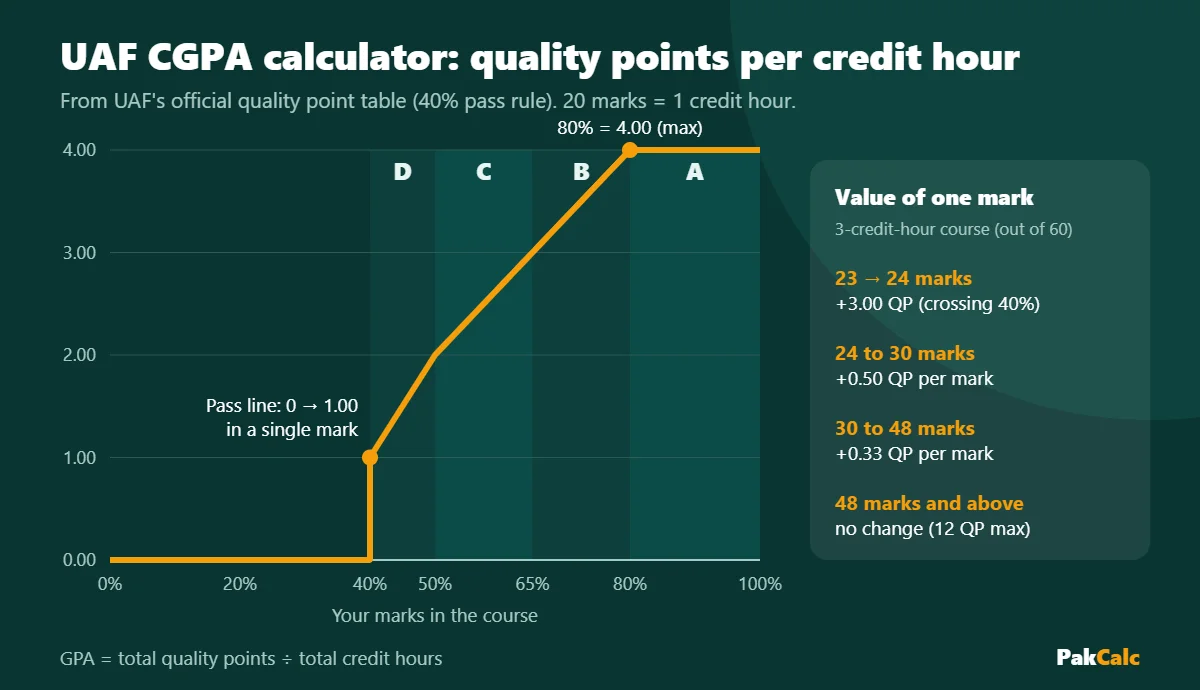
The Controller of Examinations then converts your total into quality points (QP) using its official quality point table. Per credit hour, it works like this:
| Your marks | QP per credit hour | Grade |
|---|---|---|
| Below 40% | 0 | F |
| 40% to under 50% | 1.00, rising 0.50 per mark* | D |
| 50% to under 65% | 2.00, rising 0.33 per mark* | C |
| 65% to under 80% | 3.00, rising 0.33 per mark* | B |
| 80% and above | 4.00 (maximum) | A |
*Per mark on a 1-credit-hour course. On bigger courses the steps per mark are the same size but run for longer. A 3-credit-hour course climbs from 3.00 QP at 24/60 to 12.00 QP at 48/60.
As a formula, with m = total marks and CH = credit hours:
8×CH to under 10×CH: QP = CH + 0.5 × (m − 8×CH)
10×CH to under 16×CH: QP = 2×CH + (m − 10×CH) ÷ 3
16×CH and above: QP = 4×CH
GPA = semester QP ÷ semester credit hours
CGPA = QP of all semesters ÷ credit hours of all semesters
We wrote this formula from the official table, then checked it against every value we could read on the table and 83 values in an independent open-source UAF calculator. All of them match to two decimals. The GPA and CGPA lines are worded the same way on the Controller’s page.
Worked example: one 3(2-1) course
You score 45 out of 60 (75%). That’s between 50% and 80%, so QP = 2×3 + (45 − 30) ÷ 3 = 6 + 5 = 11.00. Your grade is B, but your points are 11, not the 9.00 you’d get if every B counted as a flat 3.00.
A detail on the official table worth knowing: its colour key labels C as “50-59%”, but the table itself grades 60% to 64% as C. For example, 12 out of 20 (60%) is marked C. If a site tells you 60% is a B at UAF, it copied the label rather than the table.
A real UAF semester, worked through
Here is semester I of B.Sc. (Hons.) Agricultural and Resource Economics, using the course list UAF publishes for the 2024 intake. The courses and credit hours are UAF’s. The marks are illustrative.
| Course (credit hours) | Marks | QP |
|---|---|---|
| ARE-301 Principles of Agri. & Resource Economics 3(3-0) | 48/60 (A) | 12.00 |
| ARE-303 Introduction to Pakistan’s Economy 3(3-0) | 41/60 (B) | 9.67 |
| AGR-301 Basic Agriculture 3(1-2) | 44/60 (B) | 10.67 |
| CS-305 Application of ICT 3(2-1) | 36/60 (C) | 8.00 |
| ENG-313 Functional English 3(3-0) | 39/60 (B) | 9.00 |
| MATH-301 Elementary Mathematics 3(3-0) | 27/60 (D) | 4.50 |
| TGM-301 Tutorial Group Meeting (non-credit) | Not counted | none |
| Total: 18 credit hours | 53.84 → GPA 2.99 |
Three things this one semester shows:
One mark would have changed the headline. A single extra mark in MATH-301 (27 → 28) adds 0.50 QP and lifts the GPA to 3.02. The same mark in ARE-301 adds nothing, because 48/60 is already full points. The UAF CGPA calculator’s “where one more mark helps most” box finds this for you.
A 3(1-2) course is mostly practical. AGR-301 is 20 marks of theory and 40 of practical. A weak practical hurts far more here than in a 3(2-1) course.
The split rule can wipe out a C. If CS-305’s 36 marks came from 30/40 in theory and 6/20 in practical, the practical is below 40%, so the course is an F. The semester GPA would drop from 2.99 to 2.55.
Non-credit courses such as Tutorial Group Meeting and Tarjuma Quran carry no credit hours in UAF’s scheme of studies, so they don’t enter the GPA. Leave them out of the calculator.
Why other UAF calculators give you a different GPA
Several UAF calculators online use an 11-step letter scale (A, A-, B+, B, B- and so on, usually with 85% for an A). Scales like that are used at some other Pakistani universities, not at UAF. Run UAF marks through one and the GPA comes out wrong, sometimes badly.
Here’s an illustrative semester run both ways:
| Course (CH, marks) | UAF table QP | Letter-scale QP |
|---|---|---|
| 3 CH, 45/60 (75%) | 11.00 | 9.99 |
| 3 CH, 40/60 (66.7%) | 9.33 | 6.99 |
| 4 CH, 52/80 (65%) | 12.00 | 9.32 |
| 3 CH, 33/60 (55%) | 7.00 | 3.99 |
| 2 CH, 27/40 (67.5%) | 6.33 | 4.66 |
| 1 CH, 15/20 (75%) | 3.67 | 3.33 |
| Semester GPA (16 CH) | 3.08 | 2.39 |
That’s a gap of 0.69, enough to take a student from comfortably above UAF’s 2.50 MS admission mark to well below it. The letter-scale column uses the cut-offs published by one popular multi-university calculator. Other sites use slightly different cut-offs, so the error changes size, but it rarely disappears.
The error runs the other way for strong students too. Letter scales often need 85% for a 4.00. At UAF, 80% already earns full points.
The pass line is a cliff: where marks matter most
Because the table climbs at different rates, one extra mark isn’t worth the same everywhere. For a 3-credit-hour course out of 60, on the 40% pass rule:
| Where you are | Value of one more mark |
|---|---|
| 23/60 → 24/60 (crossing 40%) | +3.00 QP in a single mark |
| 24 to 30 (40% to 50%) | +0.50 QP per mark |
| 30 to 48 (50% to 80%) | +0.33 QP per mark |
| 48 and above (80%+) | Nothing. QP is already at 12 |
The pass line is a cliff. Going from 23 to 24 out of 60 is worth as much as 9 marks anywhere in the middle. If you’re close to 40% in any course, that course comes first. On the 50% rule the cliff is steeper still: the first passing mark is worth 6 QP on a 3-credit-hour course.
Marks in the 40s count for more. Between 40% and 50%, each mark earns 50% more QP than a mark between 50% and 80%.
Above 80% is a safety margin, not GPA. 55/60 and 49/60 give exactly the same 12 QP. Put that extra study time into a weaker course.
UAF’s own result software can flag students who miss an A or a B by one or two marks. The calculator below does the same for every course, and ranks your courses by how much one more mark would add.
Passing rules: 40%, 50%, and theory and practical separately
UAF’s Controller of Examinations sets three passing rules in its guide for teachers preparing results (AwardSoft v15.2):
| Rule | Pass mark | Applies to |
|---|---|---|
| Rule 1 | 40% | Major and minor courses for F.Sc., B.Sc. and M.Sc. |
| Rule 2 | 50% | Major and minor courses for M.Sc. (Hons.), M.Phil., MS, Ph.D., MBA, M.Com.; deficiency courses for M.Sc., M.Sc. (Hons.), M.Phil., MBA and M.Com. |
| Rule 3 | 65% | Deficiency courses for Ph.D. students |
Three more rules from the same guide change how you should read your marks.
Theory and practical are passed separately. Theory (mid + assignment + final) and practical each need the pass percentage on their own. A student with a healthy total who falls short in the practical is declared F. In the UAF CGPA calculator above, tap “Enter theory and practical separately” on any course with a practical to run this check.
Absence means F. Missing the mid, the final or the practical gives an F even if your other marks add up to a pass. For postgraduates, the Graduate Studies Calendar allows an “I” (incomplete) grade if you sat the mid but missed the final for reasons beyond your control. You then take the final in the next semester, or the I turns into an F.
How half marks are rounded. The UAF Prospectus 2025-26 says a fraction of 0.5 or more is rounded up to the next whole mark, in theory and practical separately, where the teacher needs to (14.5 in theory becomes 15). The older AwardSoft guide warned teachers against rounding individual sections, so the prospectus is the newer rule. The official QP table uses whole marks.
How the marks are split. Under the prospectus, the theory mid-term carries 30% of the theory marks, quizzes and assignments 10% and the final 60%. In the practical, 40% is for overall performance and 60% for the final practical exam. On a 3(2-1) course that is 12 + 4 + 24 for theory and 8 + 12 for practical. You also need 75% attendance in theory and in practical separately to sit the final.
The QP table itself is the same for every programme. For 50%-rule programmes, the calculator applies that table and treats anything below 50% as F.
The 40% pass rule and the separate theory/practical pass are confirmed in the UAF Prospectus 2025-26. The 50% and 65% rules come from the AwardSoft guide, dated to a 2016 results deadline, so confirm with your department if your postgraduate programme follows a different rule.
UAF quality point table (3 credit hours)
This is the course size most students have. Use the QP table tab in the calculator for 1, 2, 4 and 5 credit hours, or print all five.
Show marks 24 to 48 out of 60
| Marks /60 | QP | Grade |
|---|---|---|
| 24 | 3.00 | D |
| 25 | 3.50 | D |
| 26 | 4.00 | D |
| 27 | 4.50 | D |
| 28 | 5.00 | D |
| 29 | 5.50 | D |
| 30 | 6.00 | C |
| 31 | 6.33 | C |
| 32 | 6.67 | C |
| 33 | 7.00 | C |
| 34 | 7.33 | C |
| 35 | 7.67 | C |
| 36 | 8.00 | C |
| 37 | 8.33 | C |
| 38 | 8.67 | C |
| 39 | 9.00 | B |
| 40 | 9.33 | B |
| 41 | 9.67 | B |
| 42 | 10.00 | B |
| 43 | 10.33 | B |
| 44 | 10.67 | B |
| 45 | 11.00 | B |
| 46 | 11.33 | B |
| 47 | 11.67 | B |
| 48 | 12.00 | A |
Below 24 = 0 QP (F). 48 and above = 12 QP (A). On the 50% rule, anything below 30 is F.
Working out UAF quality points yourself
- For each course, look up the QP for your total marks.
- Add up the semester’s QP. In the real semester above, 53.84.
- Add up the semester’s credit hours, leaving out non-credit courses. Here, 18.
- Divide: 53.84 ÷ 18 = 2.99 GPA.
- For CGPA, add every semester’s QP and divide by every semester’s credit hours.
The most common slip is averaging semester GPAs. Say you scored 3.20 in an 18-hour semester and 2.60 in a 12-hour one. The plain average is 2.90, but the correct CGPA is (3.20×18 + 2.60×12) ÷ 30 = 2.96. The CGPA tab of the UAF CGPA calculator weights it for you.
CGPA rules for B.Sc. and BS students
These come from the Statutes and Regulations relating to first degrees, printed in UAF’s Undergraduate Prospectus 2025-26:
- Stay above 1.50. At the end of each academic year (winter, spring and the following summer), your CGPA must be at least 1.50. Below that, you are removed from the rolls without notice. You may seek fresh admission, once, while still within the minimum duration of your degree.
- You need 2.50 for the degree. The minimum CGPA for a UAF first degree is 2.50. If you finish your courses below it, the degree is awarded once your CGPA reaches 2.50 in later semesters, as long as you are within the maximum limit.
- You can improve a D once. In a regular semester or summer session, you may repeat once a course in which you got a D. Once you have completed your scheme of studies and residency, D-grade courses can no longer be repeated to improve CGPA.
- The new grade replaces the old one in your CGPA. An improved grade replaces the earlier F or D when CGPA is calculated, but the F or D still appears on your transcript.
- Summer is for F and D courses. You can take failed courses and D-grade improvements in the summer session, normally up to 12 credit hours.
- Time limit. A four-year degree must be finished within 12 semesters (14 for five-year degrees), plus the terminal summer session.
- Credit-hour load. After the first two semesters you register 17 to 27 credit hours per semester, and up to 30 in the two semesters before your internship.
The gap between those two numbers matters. A student can stay enrolled with a CGPA of 1.80, but would still be 0.70 short of the degree. If you’re below 2.50, the Target planner in this UAF CGPA calculator shows what each semester has to look like, and D grades are the cheapest place to win points back: a D on a 3-credit-hour course is worth 3.00 to 5.50 QP, while a C on the retake is worth at least 6.00.
What is a good CGPA at UAF?
“Good” depends on what you want next. These are the CGPA lines in UAF’s Undergraduate Prospectus 2025-26 and its Graduate Studies Calendar 2025-26:
| CGPA | What it means at UAF |
|---|---|
| 1.50 | Minimum a B.Sc./BS student must hold at the end of each academic year to stay enrolled |
| 2.50 | Minimum for the award of a UAF B.Sc./BS degree |
| 2.50 | Minimum to apply for most M.Sc. (Hons.), M.Phil. and MS programmes (from a semester-system degree) |
| 2.50 | Minimum an M.Sc. (Hons.)/M.Phil./MS/MBA student must hold at the end of each academic year to stay enrolled |
| 2.75 | Needed to submit an MS/M.Phil. thesis and be awarded the degree |
| 3.00 | Minimum to apply for a Ph.D., and to stay enrolled in one each academic year |
For an undergraduate, 2.50 is the line that matters twice: it is the minimum for your degree and for most UAF MS admissions. In B.Sc. (Hons.) Agriculture, your CGPA after the fourth semester also decides which major you get, according to the Faculty of Agriculture, so a higher CGPA buys you choice. The UAF CGPA calculator’s “check what any CGPA means” box compares any CGPA against these lines.
Scholarship and job requirements vary by scheme and employer, so check the specific notice. We don’t list figures we couldn’t verify.
CGPA rules for postgraduate students
The Graduate Studies Calendar 2025-26 sets these rules for M.Sc. (Hons.), M.Phil., MS and MBA students:
- Each academic year (winter, spring and the following summer), your GPA/CGPA must be at least 2.50, or your admission is cancelled. You may seek fresh admission once. Ph.D. students need 3.00.
- To finish, you need a CGPA of 2.75 to submit your thesis and get the degree.
- Between 2.50 and 2.75 after all coursework, you may repeat once the earlier courses where you got the lowest grades, to reach 2.75.
- A course can be repeated three times at most (four enrolments). Failed courses and permitted grade improvements can be taken in the summer session.
The Directorate’s older regulations page still lists 2.75 as the yearly minimum for M.Sc. (Hons.)/M.Phil./MS, and 2.00 for two-year M.A./M.Sc., MBIT, M.Com. and M.Sc. (CS). The 2025-26 calendar is the newer document, but confirm with your department which rule applies to your session. Use the Target planner in the UAF CGPA calculator above to see what next semester has to look like.
Checking your result on the UAF LMS
You don’t need a third-party site to see your result. On the UAF LMS login page, there’s a separate “Result” box under the login form. Type your registration number in the format shown there (e.g. 2023-ag-1234) and press Result. No password is needed.
From that result, copy each course’s credit hours and total marks into the Semester GPA tab of this UAF CGPA calculator. That’s what most people searching for an “LMS UAF CGPA calculator” want: a way to see how a new result moves their CGPA.
A word on privacy. Because the LMS result needs only a registration number, anyone who knows yours can see your marks. Several third-party UAF calculators go further and fetch an entire class’s results from a range of AG numbers. This calculator never asks for your AG number, and nothing you type leaves your browser unless you choose to copy a share link. Your marks are saved on this device so they are still there next time. On a shared or lab computer, press Clear all when you finish.
Converting UAF CGPA to a percentage
UAF doesn’t publish a CGPA-to-percentage formula. For a rough figure, you can read the table backwards. That gives the percentage which would earn your CGPA if you scored the same in every course:
| CGPA | Equivalent average |
|---|---|
| 4.00 | 80% or more |
| 3.50 | 72.5% |
| 3.00 | 65% |
| 2.50 | 57.5% |
| 2.00 | 50% |
| 1.00 | 40% |
Use this for your own planning only. If a job or admission form asks for a percentage, follow that institution’s method or ask UAF’s Controller of Examinations for an official figure. Some don’t ask for one at all: Punjab University scores a BS for M.Phil admission straight from CGPA bands.
If a form names HEC’s method instead, our marks percentage calculator shows HEC’s bands next to the two other methods in use.
Retakes, rounding and department rules
- Retakes in your CGPA history. When you improve a D or pass an F, enter only the new attempt in that semester’s courses, since UAF replaces the old grade in the CGPA.
- How your teacher rounded. Half marks are rounded up in theory and practical where the teacher needs to. A half mark either way can move you across a line.
- Department-specific rules. Some programmes, such as five-year degrees and postgraduate courses, have their own limits. Your advisor has the final word.
- Your official result. Only the LMS and your transcript can confirm it.
Frequently asked questions
Is this the official UAF CGPA calculator?
No. PakCalc is independent and isn’t connected to the University of Agriculture Faisalabad. The calculator follows the Controller of Examinations’ quality point table, but your LMS result and transcript are the official record.
How many marks is a 3(2-1) course out of?
60. UAF gives 20 marks per credit hour: 40 for the 2 theory hours and 20 for the 1 practical hour.
Why does my result show F when my total is above the pass mark?
Most likely you fell short in theory or practical on its own, or missed the mid, final or practical. UAF requires a pass in each part separately, and an absence is an F regardless of the total.
How much is a 2.8 CGPA at UAF?
On UAF’s quality point table, 2.80 is what you’d get by scoring about 62% in every course. It clears the 2.50 needed to apply for most UAF MS programmes and the 2.75 an MS student needs for the degree, but it’s below the 3.00 needed for a Ph.D.
What CGPA do I need to get my UAF degree?
2.50 for a B.Sc./BS degree, under the UAF Prospectus 2025-26. Separately, you must hold at least 1.50 at the end of each academic year to stay enrolled. MS, M.Phil. and M.Sc. (Hons.) students need 2.75 to submit the thesis and get the degree.
Can I improve a D grade at UAF?
Yes, once. You may repeat a D-grade course in a regular semester or summer session, within your credit-hour limit, until you complete your scheme of studies. The new grade replaces the D in your CGPA, but the D stays on your transcript.
Do non-credit courses count in my GPA?
No. Courses marked NC or NCC in UAF’s scheme of studies, such as Tutorial Group Meeting, carry no credit hours, so they don’t enter the GPA. You still have to complete them.
Do marks above 80% improve my GPA?
No. Every course caps at 4.00 QP per credit hour from 80% upward, so extra marks beyond that don’t change your GPA.
How we tested this UAF CGPA calculator
- Against the official table. We compared the formula with every value we could read on the Controller of Examinations’ quality point table, for courses of 1 to 5 credit hours. All of them matched.
- Against independent code. An open-source UAF GPA calculator hard-codes 83 marks-to-QP values. All 83 match ours to two decimals.
- Against other calculators. In October 2026 we ran the same marks through the UAF calculators ranking on Google. Tools built on UAF’s table gave the same QP as ours. Tools using a letter scale gave lower GPAs, as in the comparison above. One popular tool returned an F for half marks such as 37.5/60, so this calculator accepts half marks and flags them as an estimate.
- Against UAF’s own documents. Where two official documents disagree, such as the C band label on the QP table or the rounding rule in the 2016 AwardSoft guide and the 2025-26 prospectus, we show both and follow the newer one.
- Against a real course list. The worked semester uses the actual courses and credit hours from UAF’s 2024 list for B.Sc. (Hons.) Agricultural and Resource Economics.
Not done yet: a check against a real student’s result card. If you can share the credit hours, marks and QP from yours (no name or AG number), please send them through our contact page and we’ll add the result here.
AI tools helped with research and drafting. The quality point figures were checked against UAF’s own table and documents, listed below.
UAF documents we used
- UAF Controller of Examinations: Quality Point Grading System (official QP table and GPA/CGPA formula).
- UAF Controller of Examinations: AwardSoft v15.2 guide (passing rules, theory/practical, rounding).
- UAF Undergraduate Prospectus 2025-26 (first-degree regulations: CGPA 1.50 and 2.50, D improvement, marks split, rounding, attendance).
- UAF Graduate Studies Calendar 2025-26 (admission CGPA, yearly minimums, repeats, I grade).
- UAF list of courses, B.Sc. (Hons.) Agri. & Resource Economics (real semester example, non-credit courses).
- UAF UG-1 course registration form (marks per credit hour).
- UAF Directorate of Graduate Studies regulations (older postgraduate CGPA minimums).
- Open-source UAF GPA calculator (independent cross-check, 83 of 83 values matched).
Update log
- 28 October 2026: Page published. QP formula checked against the Controller’s table; postgraduate rules checked against the Graduate Studies Calendar 2025-26; real semester example taken from UAF’s 2024 course list; undergraduate CGPA, improvement and rounding rules checked against the Undergraduate Prospectus 2025-26.
If UAF changes its quality point table or its pass rules, this page changes with it. Everything else is reviewed at the start of each academic year, as set out in our checking method. If a course on your result card shows different QP from ours, send the credit hours and marks through our contact page. No AG number needed.
More tools for students are on our education calculators page, including an admission aggregate calculator for when you’re planning your next step. Studying at another university? Our GPA calculator for Pakistani universities covers HEC’s grade bands and six university scales. At the University of Gujrat, the 2025 rules also give each mark its own grade point, and our UOG CGPA calculator follows that table.
About the author
Disclaimer: this UAF CGPA calculator gives estimates for information only, not official results or advice. See our Disclaimer. Spotted an error? Contact us.
Related calculators
- EducationAir Uni Aggregate Calculator 2027 (Air University Merit)Your Air University aggregate on both AU formulas, the AU-CBT score you need, and each campus’s exemption rules.Open calculator →
- EducationBahria University GPA Calculator and Grading System 2026GPA, CGPA and probation on Bahria’s Spring 2026 handbook, with the MS scale, a final-exam planner and repeat versus honours.Open calculator →
- EducationIIUI GPA Calculator for BS, MS and PhD StudentsGPA, CGPA and probation lines on IIU Islamabad’s rules for BS, MS and PhD, with a terminal-marks planner and repeat outcomes.Open calculator →
- EducationUET GPA Calculator for Lahore, Taxila and PeshawarGPA, CGPA, repeats and probation on UET Lahore, Taxila and Peshawar rules, tested on a real 140-credit-hour UET Lahore transcript.Open calculator →