Home › Education › Air Uni Aggregate Calculator 2027 (Air University Merit)
Air Uni Aggregate Calculator 2027 (Air University Merit)
By Shehrooze Butt, independent publisher and researcher | Last updated | Sources checked 23 November 2026 | Unofficial tool
How many marks do you need in the AU-CBT to get into Air University? That depends on two things most calculators skip. One is which of AU’s two formulas your programme falls under. The other is which campus you apply to.
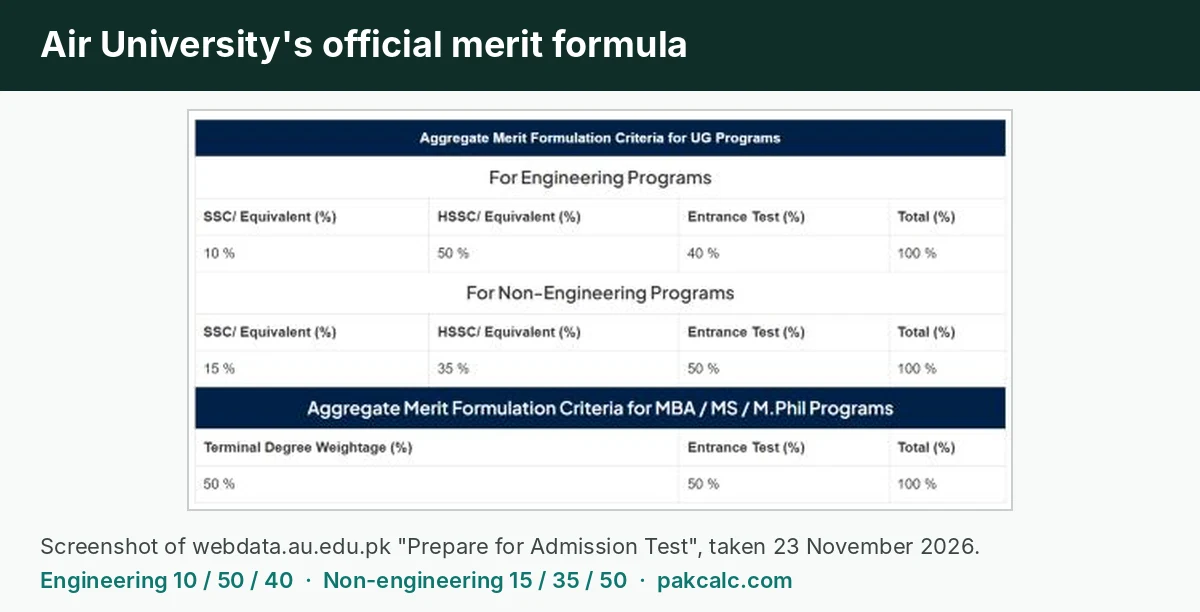
Put your Matric, FSc and test marks into the calculator below. It applies the 10/50/40 or 15/35/50 split from Air University’s admission page and flags the 60%, 50% and 33% lines. It can also work backwards from the aggregate you want to the test score that gets you there.
Spring 2027: apply by 15 December 2026. The AU-CBT is on 19 December, and the first merit list is due on 21 December.
Engineering: Matric 10% + HSSC 50% + test 40%, with 60% HSSC needed. Other BS: 15% + 35% + 50%, with 50% HSSC needed.
Air uni aggregate calculator: your merit, or the test score you need
PakCalc made this Air University merit calculator from AU’s published criteria. AU didn’t build or check it, and the figure on your admission portal is the one that counts.
Nothing showing after a few seconds? Work it out yourself. For engineering, take 10% of your Matric percentage, 50% of your HSSC percentage and 40% of your test percentage, then add them. For other programmes use 15%, 35% and 50%.
“My aggregate” gives your merit score from marks you already have. “Test score I need” starts from a target, say 75%, and tells you the AU-CBT percentage that reaches it with your board marks. On the CBT’s 100 questions, that is roughly the number of correct answers to aim for.
Every result also shows the same marks on the other formula. Engineering, computing and management applicants list their preferences in one application, so one CBT can be judged both ways.
Which formula your programme falls under
AU’s eligibility page sorts programmes into two groups, and the group sets your weights. The surprise is software engineering, which sits in both.
| Programme | Formula | HSSC needed |
|---|---|---|
| Electrical, Mechanical, Mechatronics, Computer Engineering | 10 / 50 / 40 | 60%, with Physics, Chemistry and Maths (ICS with Physics and Maths allowed; Chemistry taught after admission) |
| Bachelor of Software Engineering (PEC) | 10 / 50 / 40 | 60%, same subjects as engineering |
| Biomedical Engineering | 10 / 50 / 40 | 60%, with Physics, Chemistry and Maths or Biology |
| BS Software Engineering (HEC, non-PEC) | 15 / 35 / 50 | 50%, with Maths |
| BS CS, AI, Cyber Security, Data Science, IT, Games, Bioinformatics | 15 / 35 / 50 | 50%, with Maths (pre-medical: 6 credit hours of maths after admission) |
| BBA, Accounting and Finance, Aviation, Tourism, Health Care Management | 15 / 35 / 50 | 50% |
| BS Mathematics | 15 / 35 / 50 | 50%, Pre-Engineering with Maths |
| BS Physics | 15 / 35 / 50 | 50%, Pre-Engineering with Physics and Maths, or Pre-Medical |
| BS Psychology, IR, Media | 15 / 35 / 50 | 50%, any HSSC group (Psychology says any board) |
| BS English | 15 / 35 / 50 | 50%, and at least 55% in English |
Check the exact programme name before you apply. “Bachelor of Software Engineering” is the PEC-accredited engineering degree and needs 60%. “BS Software Engineering” is the HEC computing degree and needs 50%. With the same marks, the two can give different aggregates.
DAE holders can apply to engineering with at least 60%, and AU’s FAQ matches each diploma to the programmes it allows. An Electrical or Electronics diploma, for example, opens Electrical, Mechatronics and Computer Engineering. AU doesn’t say how DAE marks enter the formula. The calculator puts them in the HSSC box, so confirm with admissions before you rely on it.
Six AU campus websites, three different exemption rules
The merit formula is the same on every Air University campus page I checked. The list of tests that let you skip the AU-CBT is not.
| Campus website | Tests listed for exemption | FAQ: do NAT or SAT holders still sit the CBT? |
|---|---|---|
| Islamabad (E-9 and H-11) | NAT and HEC USAT, SAT-I 1100+, plus UET, NED, MUET, NUST and ETEA tests for engineering | “Yes”, though the rest of that answer is about maths courses |
| Multan | NAT and USAT, SAT-I 1100+ (no engineering programmes listed) | Yes |
| Kamra (Aerospace and Aviation) | NAT only, no USAT; SAT-I 1100+ for business; same engineering tests | Yes |
| Karachi | NAT only, no USAT; SAT-I 1100+ for business; same engineering tests | “Yes”, with the same mixed-up answer as Islamabad |
| Kharian, Bahu | NAT only, no USAT; SAT-I 1100+ for business; same engineering tests | Question not in their FAQ |
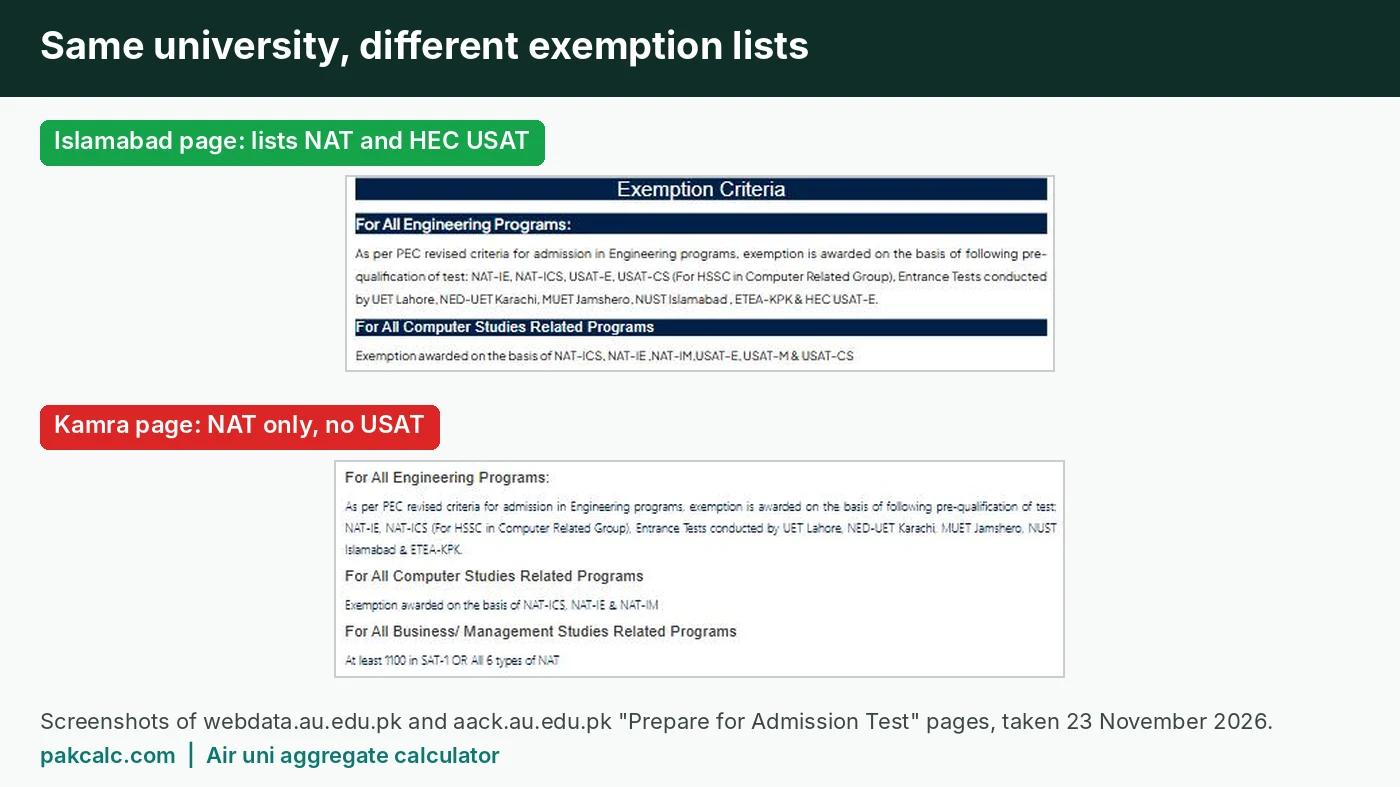
Everywhere, an exemption needs a score of at least 50 and a test that matches your HSSC group. The result must also be from within one year of AU’s closing date.
The NAT type also has to fit the programme. This is the Islamabad list; the other campuses print the same NAT types without the USAT ones.
| Programme | NAT types accepted | USAT types (Islamabad) |
|---|---|---|
| Engineering | NAT-IE, or NAT-ICS with a computer-group HSSC | USAT-E, USAT-CS |
| Computing (CS, AI, Cyber, IT and similar) | NAT-ICS, NAT-IE, NAT-IM | USAT-E, USAT-M, USAT-CS |
| Business and management | Any of the six NAT types, or SAT-I 1100+ | Any USAT type |
| BS Mathematics | NAT-ICS, NAT-IGS, NAT-IE | USAT-E, USAT-CS, USAT-GS |
| BS Physics | NAT-ICS, NAT-IE (Islamabad adds NAT-IM) | USAT-E, USAT-CS, USAT-M |
| English, Psychology, IR | Any of the six NAT types | Any USAT type |
The exemption pages say a qualifying score lets you skip the CBT, while every FAQ that answers the question says you still sit it. AU’s pages don’t settle this.
If you plan to apply on a NAT, USAT or ECAT score alone, email your campus admission office first, and keep the reply. If your only score is USAT and you’re applying outside Islamabad or Multan, that email matters twice. AU’s general line is 051-9262557-9, and the email on its main site is info@au.edu.pk.
If you can, sit the AU-CBT as well. AU says merit is built on your best score, so a second result can only help. It does cost a fresh application and the processing fee: Rs 2,500 on most campus FAQs, Rs 2,000 on Multan’s.
Where extra marks move your aggregate most
The test carries more weight per mark than anything else, by a wide margin. Here is what one extra mark adds to your aggregate.
| One more mark in | Engineering | Non-engineering |
|---|---|---|
| AU-CBT (out of 100) | +0.40 | +0.50 |
| HSSC (out of 1100) | +0.045 | +0.032 |
| Matric (out of 1100) | +0.009 | +0.014 |
In engineering, one CBT mark is worth about 9 FSc marks. In non-engineering it is worth nearly 16. Once your board result is out, the CBT is the only lever left.
AU lets you sit the CBT more than once and keeps your best score. If each question carries one mark, five more correct answers add 2 points to an engineering aggregate and 2.5 to a computing or BBA one.
One applicant, two formulas
Take a made-up applicant with 934 out of 1100 in Matric (84.91%), 876 out of 1100 in FSc (79.64%) and 68 in the AU-CBT. These numbers are for illustration only.
- Engineering: 84.91 × 0.10 = 8.49, plus 79.64 × 0.50 = 39.82, plus 68 × 0.40 = 27.20. Total: 75.51%.
- BS Computer Science: 84.91 × 0.15 = 12.74, plus 79.64 × 0.35 = 27.87, plus 68 × 0.50 = 34.00. Total: 74.61%.
Now say this applicant wants 75% in both. Engineering needs about 66.7% in the CBT, which they already have. Computer Science needs about 68.8%, so 69 correct answers at one mark a question. A strong FSc helps more under the engineering formula; a strong test helps more everywhere else.
The 60%, 50% and 33% lines
An aggregate only matters once you clear AU’s minimums. These come from its eligibility page.
- HSSC: 60% for engineering, 50% for other programmes. AU doesn’t round: 59.9% stays 59.9%, and that is not 60%.
- Entry test: engineering applicants need at least 33%, the pass mark PEC sets for entry tests.
- All subjects passed: a partial pass or a supplementary paper makes you ineligible, even with 60% overall.
- Result awaited: you can get provisional admission. It is cancelled if the final result falls below the line.
- A-Level, result awaited: AU’s FAQ says to enter 660 out of 1100 for engineering or 550 for other programmes. You then submit the IBCC equivalence within 15 days of your result. The A-Level equivalence calculator shows the marks your grades turn into.
- Pre-medical: you can apply to BS Computer Science and similar programmes, then pass 6 credit hours of maths in your first two semesters.
From the CBT to an offer letter
- Apply on your campus portal. The processing fee is Rs 2,500 (Rs 2,000 on Multan’s FAQ) and isn’t refunded. Each CBT attempt needs its own application.
- Order your preferences. Engineering, computing and management programmes go in one application, and AU offers seats in your preference order on merit. Programmes in other faculties need a separate application.
- Sit the AU-CBT, or claim an exemption. The test has 100 MCQs in 120 minutes with no negative marking. The paper follows your HSSC group, as the table below shows.
- Watch the merit lists. Offers show up on your admission portal, and each list has its own fee deadline.
- Query a result if it looks wrong. AU accepts requests to recheck a test result and to recalculate an aggregate, though it says its system calculates without error.
Every AU-CBT paper gives 20% to English and 25% to analytical reasoning. The rest depends on your HSSC group:
| HSSC group | Quantitative | Subject questions |
|---|---|---|
| Pre-Engineering | 25% | Physics, Chemistry, Maths: 10% each |
| ICS (Computer Science) | 25% | Physics, Computer, Maths: 10% each |
| General Science | 25% | Maths, Statistics, Economics: 10% each |
| Pre-Medical | 15% | Physics 10%, Chemistry 10%, Biology 20% |
| Commerce | 15% | Accounts 14%, Commerce 13%, Economics 13% |
| Arts | 15% | Islamiat 10%, Pakistan Studies 10%, general knowledge and current affairs 20% |
That split is from the Islamabad page, and it goes by your HSSC group. Multan’s FAQ sets the paper by programme instead:
- BS CS, IT, Cyber Security, Software Engineering and Mathematics: English 25%, Maths 55%, Physics 20%.
- BBA, Accounting and Finance, Aviation Management: English 60%, Maths 40%.
- BS Psychology: English 40%, Maths 20%, Psychology 40%. BS IR: English 40%, Maths 20%, general knowledge 40%. BS English: English only.
Applying at Multan? Prepare for that version. Questions come from intermediate textbooks on every campus.
Most AU FAQs still say there are no sample papers. That is out of date for Islamabad: its Sample Papers page now has one PDF for each of the six HSSC groups.
Air University’s Spring 2027 schedule for the 2026-27 academic year, as published on its admission schedule page:
| Step | Date |
|---|---|
| Application deadline, all programmes | Tuesday 15 December 2026 |
| UG CBT at all seven campuses | Saturday 19 December 2026 |
| 1st merit list (fee by 28 December) | Monday 21 December 2026 |
| 2nd merit list (fee by 4 January) | Tuesday 29 December 2026 |
| 3rd and later lists | From Tuesday 5 January 2027 |
| First day of classes | Monday 25 January 2027 |
Spring intake is smaller. AU runs its main undergraduate admission once a year for Fall, and in Spring it offers only selected programmes. The Fall 2027 schedule will replace this table when AU publishes it.
Spring 2027 at Islamabad: no engineering, no BS CS
Air University’s Spring 2027 advert for its two Islamabad campuses lists far fewer bachelor’s programmes than a Fall intake. It has no BE engineering programme, and no BS Computer Science, AI or Cyber Security.
- E-9 campus: BS Software Engineering, Data Science, Computational Mathematics with Data Analytics, and Statistics and Data Analytical Science. Also an evening Associate Degree in Computer Science.
- H-11 campus: BBA (Hons), Accounting and Finance, Aviation Management, Financial Technology, Business Analytics, Business and Information Technology, International Relations and English. BBA, Accounting and Finance and Aviation Management also run in the evening.
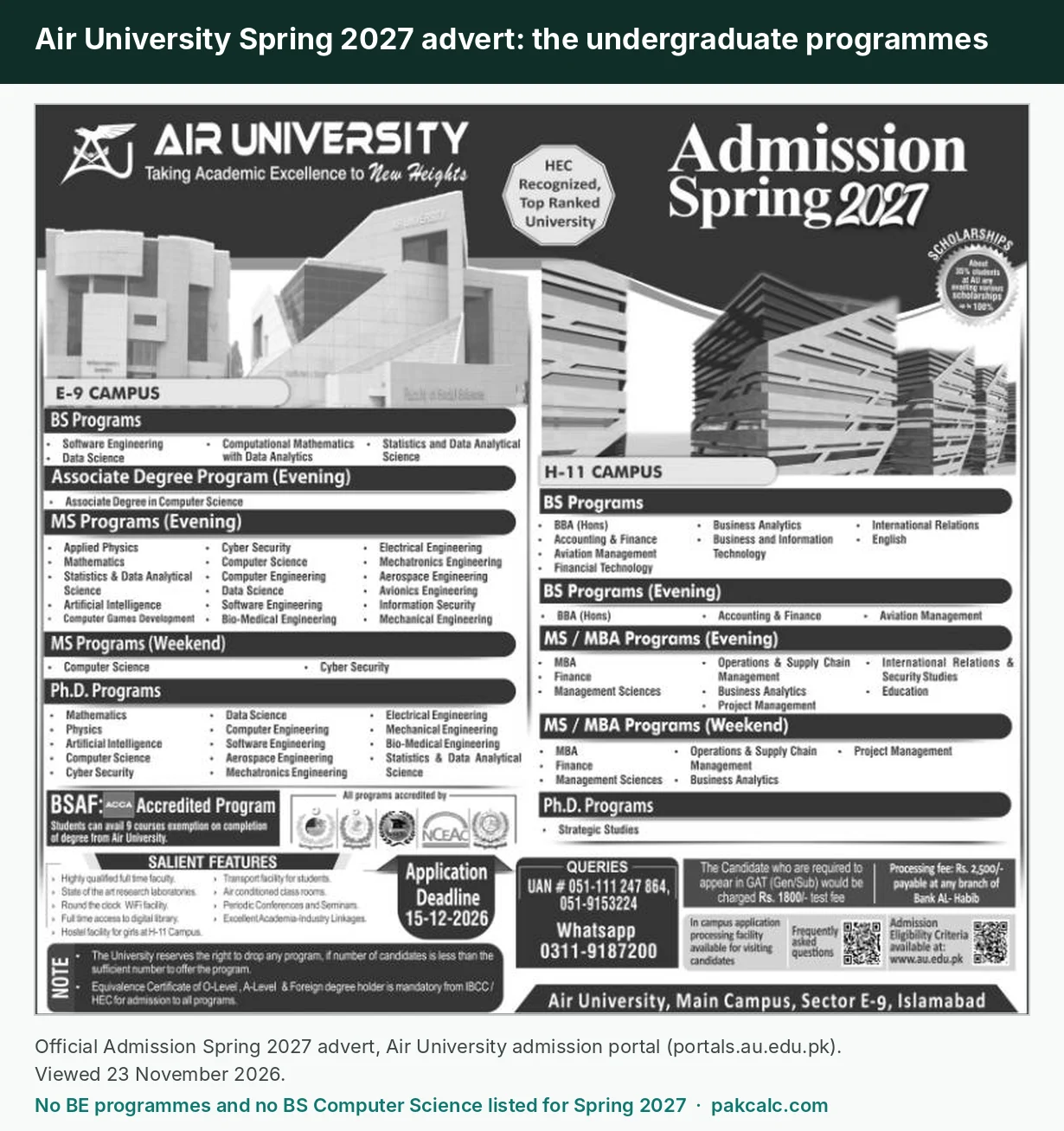
In Spring, almost every Islamabad applicant is on the 15/35/50 formula. The advert doesn’t say whether its Software Engineering is the PEC or the HEC degree. Ask admissions before you rely on either formula, because it also decides whether you need 60% or 50%.
The advert adds that AU can drop any programme if too few candidates apply. It covers Islamabad only, so check your own campus’s portal for its Spring list.
Why this page gives no closing merit
Air University shows selection on each applicant’s portal. I couldn’t find a closing-aggregate table on any AU site. The “closing merit” figures on forums and some calculator pages give no source, and they don’t agree with each other, so I haven’t used them.
One outside account is worth knowing. PASS Education System, an entry-test academy, said in a July 2026 video that the first offers went to lower-merit programmes. Computing and engineering offers came in later lists. That is the academy’s account, not AU’s. Even so, if a high aggregate brings no offer in list one, that isn’t the final word. Check your preference order and keep watching the portal.
Three things online that don’t match AU’s pages
- One formula of 10% Matric, 40% FSc and 50% test. Two calculators ranking for Air University on 23 November 2026 use it. I ran both with the applicant above, and both returned 74.35%. AU’s formulas give 75.51% (engineering) or 74.61% (computing).
- “ECAT and NET scores can’t be used.” AU’s engineering exemption list names the UET Lahore and NUST entry tests. NED, MUET and ETEA are on it too.
- Exact closing merits. One calculator page even labels its unsourced cut-offs “official”. AU doesn’t publish them, so treat any figure without a link to AU with care.
Applying to more than one university? The aggregate calculator for Pakistani universities puts NUST, FAST, COMSATS, ITU and QAU formulas side by side. ECAT and NET takers can also check the UET aggregate calculator and the NUST aggregate calculator with the same score.
Air University admission questions students ask
How is Air University merit calculated?
Turn your Matric, HSSC and test marks into percentages, weight them and add. Engineering uses 10%, 50% and 40%. Every other bachelor’s programme uses 15%, 35% and 50%.
How much percentage is required for Air University?
To apply, 60% in HSSC for engineering and 50% for other programmes. To get a seat you need an aggregate high enough for your preference, and AU doesn’t publish that cut-off.
Can I apply to Air University on an ECAT or NET basis?
For engineering, yes. AU’s exemption list includes the UET Lahore and NUST entry tests, taken within one year of its closing date. They aren’t listed for computing or business. As with NAT, ask your campus whether you still sit the CBT.
Can I use my NTS NAT score instead of the AU-CBT?
AU’s exemption pages accept NAT, and the Islamabad and Multan pages also USAT, at 50 or more in the type that matches your HSSC group. But the FAQs of four campuses say NAT holders still sit the CBT, so get your campus’s answer in writing first.
Do Phase 1 and Phase 2 make one merit list?
AU doesn’t say so directly. It does say each attempt is a separate application and that merit uses your best score. A better result in a later phase should replace the earlier one.
I missed my AU-CBT date. Can I take it on another day?
You can ask. While AU’s tests are still running, the admission office takes rescheduling requests, but only if a slot is free on the date you want. Approval isn’t guaranteed, so ask as early as you can.
Can pre-medical students apply for BS Computer Science at Air University?
Yes. They have to pass 6 credit hours of deficiency maths within their first two semesters. Biomedical Engineering also accepts pre-medical, at 60%.
Does Air University have its own aggregate calculator?
Not a public one that I could find. AU says its admission system works out the aggregate automatically, and you can ask it to recalculate. An Air University aggregate calculator like the one above lets you check the figure before the list comes out.
What is the Air University merit formula for MS and MBA?
50% for your last degree and 50% for the entry test. The test is NTS GAT-General or HEC HAT, with a score of at least 50.
Air University pages behind each number
- Prepare for Admission Test (Islamabad): both UG formulas, the MS formula, AU-CBT composition by HSSC group and the exemption list.
- Eligibility Criteria: minimum HSSC per programme, the 33% PEC line, no rounding, partial pass and provisional admission.
- Admission FAQs: A-Level values, pre-medical and DAE routes, best-score rule, preferences, fee, rechecking.
- Sample Papers (Islamabad): one paper for each HSSC group.
- Admission Schedule, Spring 2027, and the Admission Spring 2027 advert on AU’s admission portal (programme list).
- Campus pages compared: Kamra and its FAQ, Multan and its FAQ, Kharian and its FAQ, Karachi and its FAQ, Bahu and its FAQ.
What the calculator was checked against
92 automated checks, including:
- Both formulas against hand calculations, and weights that add to 100%.
- Both sides of every line: 660 and 659 out of 1100, 59.99%, 550 and 549. Also a 33% and 32.9% test, NAT at 50 and 49, and SAT-I at 1100 and 1099.
- The target mode working back to the same test score, targets that can’t be reached, and targets the board marks already cover.
- Bad input such as marks above the total, a zero or missing test total, a blank test and a target below 1. The A-Level placeholder on both formulas. In a simulated browser: the tabs, the example, Clear and the tab-only storage.
- Not covered: a real Air University merit slip. Portal showing a different aggregate? Send the marks through the contact page, without your name or roll number. I’ll find where the two part ways.
Parts of this page were written with AI help. Every AU rule on it was read and checked on Air University’s own sites.
Update log
- 23 November 2026 (second pass): Independent review. Added SAT-I to four campus rows, NAT types by programme, Multan’s test composition and fee, and Islamabad’s new sample papers. Fixed the A-Level placeholder on the second formula.
- 23 November 2026: Page and calculator built from Air University’s admission pages. Exemption lists and FAQs of all six campus websites compared. Spring 2027 schedule and Islamabad programme list added. Two competing calculators run with the same marks.
Next review: 10 January 2027, after the Spring 2027 merit lists, or sooner when AU publishes its Fall 2027 admission schedule. The calculator accuracy page explains how PakCalc keeps its tools current.
About the author
Disclaimer: results on this page are estimates for information only, not an admission decision or advice. Air University’s merit lists and your admission portal are final. See our Disclaimer. Spotted an error? Contact us.