Home › Education › A Level Equivalence Calculator: IBCC Marks for O and A Levels (2026-27)
A Level Equivalence Calculator: IBCC Marks for O and A Levels (2026-27)
By Shehrooze Butt, independent publisher and researcher | Last updated | Sources checked 14 November 2026 | Unofficial tool
Straight A*s at O Level and A Level come to about 1033 out of 1100 on IBCC’s 2026 tables. That is 93.9%, not 100%.
Here’s why. IBCC (the Inter Boards Coordination Commission) turns each grade into a fixed mark. Even an A* is capped at the average that top Pakistani board students score in that subject: 93, 94 or 95 in 2026.
The A level equivalence calculator below uses each session’s A* values and IBCC’s February 2026 rule. It reproduces all four of IBCC’s worked examples to the mark.
Before you rely on it: this is an estimate from IBCC’s published rules. The marks on your IBCC equivalence certificate are the only figures universities accept.
IBCC equivalence calculator for O Level and A Level
Use the first tab for FSc (HSSC) marks. Switch to the second tab to use it as an O level equivalence calculator for Matric (SSC) only.
The calculator is loading. If it does not respond, refresh the page. You can still work out your marks by hand with the grade table and the examples below.
Abroad means both O and A Levels taken outside Pakistan. Foreign and dual nationals are exempt wherever they sat. If you took O Levels abroad and A Levels in Pakistan, IBCC may still ask for Urdu, Islamiyat and Pakistan Studies, so check with IBCC. On the abroad setting, those three rows are optional: fill them only if you took them.
O Level grades
Pick the exam session each subject was taken in, because the A* value changes by session. “Before 2021” counts an A* as 90. A 9 on the 9-1 scale gets the same marks as an A*.
A Level grades
The grades shown are an illustrative example. Replace them with yours. Your entries stay in this browser tab only and are cleared when you close it.
Plan ahead: target marks and your aggregate
The quick version: IBCC gives A 85, B 75, C 65, D 55 and E 45 marks out of 100. An A* (or a 9) gets the subject’s value for your session, 93 to 95 in 2026. Your 8 O Levels make your Matric (SSC) equivalence. For FSc (HSSC), students in Pakistan who finished O Levels by 2025, and all Humanities students, add 8 O Levels and 3 A Levels out of 1100. Science students who finish O Levels in 2026 or later count only the 5 compulsory O Levels with their 3 A Levels.
What each grade is worth in IBCC marks
IBCC converts every grade into marks out of 100, then adds the subjects up. Grades A to E have fixed values. The 9-1 grades used by IGCSE and GCSE have their own fixed values.
| Letter grade | IBCC marks | 9-1 grade and marks |
|---|---|---|
| A* | Subject’s value for the session (93 to 95 in 2026) | 9: same as A* |
| A | 85 | 8: 87 |
| B | 75 | 7: 82 |
| C | 65 | 6: 77 |
| D | 55 | 5: 70, 4: 60 |
| E | 45 | 3: 50, 2: 40 |
| U, F, G | Not accepted | 1: not accepted |
A 7 is worth 82, which is more than a B’s 75. A 4 is worth 60, which sits between a C and a D. So don’t convert 9-1 grades to letters before you enter them.
A* marks for the 2026 session
IBCC confirmed these values in a notification dated 27 July 2026. They apply to grades A* and 9 from 2026 exams only.
| Subject | O Level (SSC) | A Level (HSSC) |
|---|---|---|
| Physics | 94 | 95 |
| Chemistry | 94 | 94 |
| Biology | 94 | 94 |
| Computer Science | 94 | 93 |
| Mathematics | 94 | 94 |
| English | 93 | – |
| Urdu | 93 | – |
| Pakistan Studies | 94 | – |
| Islamiyat | 94 | – |
| Any other elective | 94 | 94 |
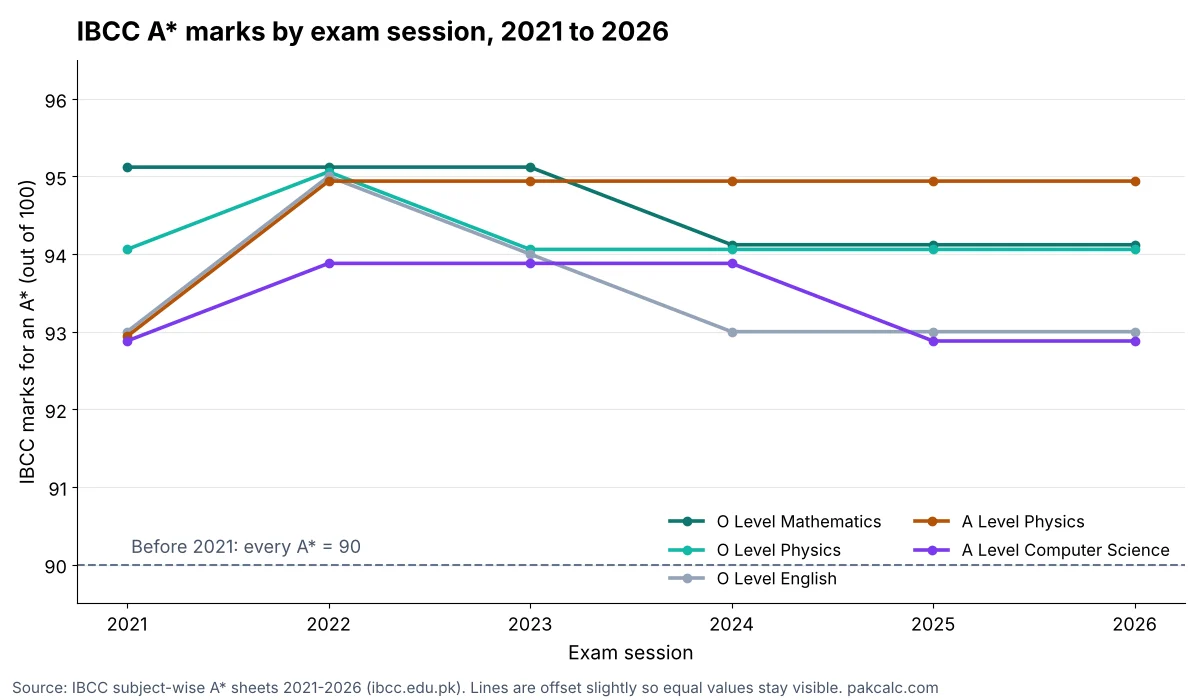
A* marks for 2021 to 2025 sessions
Where IBCC’s sheet for a year names only some subjects, every other subject gets the “other” value.
- 2025: O Level: English, Urdu and Pakistan Studies 93; every other subject 94. A Level: Physics 95, Computer Science 93, every other subject 94.
- 2024: O Level: English, Urdu and Pakistan Studies 93; every other subject 94. A Level: Physics and Mathematics 95, every other subject 94.
- 2023: O Level: Mathematics and Islamiyat 95, Urdu 93, other subjects 94. A Level: Physics 95, other subjects 94.
- 2022: O Level: Computer Science 96, other subjects 95. A Level: Physics and Chemistry 95, Biology, Computer Science and Mathematics 94, other subjects 95.
- 2021: O Level: Mathematics 95, English, Urdu and Pakistan Studies 93, other subjects 94. A Level: Biology 94, other subjects 93.
- Before 2021: an A* counted as 90.
Why an A* is worth 93 to 95, not 100
Until 2020, every A* became 90. That hurt Cambridge students once FSc toppers began scoring in the high 90s.
IBCC’s Equivalence Committee changed the rule on 30 August 2021. Since then, an A* gets the mean mark of local board students who scored between 90 and 100 in that subject.
For subjects that local boards don’t teach, IBCC uses the mean of Physics, Chemistry, Biology and Mathematics. The same approach covers the top grade of IB, AP and similar qualifications.
IBCC’s executive director, Dr Ghulam Ali Mallah, gave the background in a January 2026 interview. He said a survey had found some Lahore medical colleges closing near 92%, so a 90-mark ceiling was unfair. He also said grades A to E are not “cut”: an A, for example, gets roughly the middle of its band.
IB grades follow the same pattern. A 7 gets the session value, a 6 gets 85, 5 gets 75, 4 gets 65 and 3 gets 55. Grades 2 and 1 get zero. This calculator covers Cambridge, Edexcel and other O and A Level boards, not IB.
Which subjects count, and the February 2026 rule
IBCC counts different subjects depending on where you studied and when you finished O Levels:
| Your situation | Subjects counted | How the total is worked out |
|---|---|---|
| O Level (SSC), sat in Pakistan | English, Maths, Urdu, Islamiyat, Pakistan Studies + 3 electives | Total out of 800, shown out of 900 in IBCC’s example |
| O Level (SSC), abroad or foreign/dual national | English, Maths + 3 electives | Total out of 500, scaled the same way |
| A Level (HSSC), O Levels finished by 2025, sat in Pakistan | All 8 O Levels + 3 A Levels | Out of 1100, no scaling |
| A Level, exempt students, O Levels finished by 2025 | 5 O Levels + 3 A Levels | Out of 800, scaled to 1100 |
| A Level science group in Pakistan, O Levels finished in 2026 or later | 5 compulsory O Levels + 3 A Levels | Out of 800, scaled to 1100 |
| A Level Humanities | All 8 O Levels + any 3 A Levels | Out of 1100 (the 2026 notice names science groups only) |
The February 2026 rule comes from IBCC’s notification of 17 February 2026, after its Equivalence Committee met on 26 January. It says O Level electives “shall not be considered” for HSSC marks in the Pre-Medical, Pre-Engineering and Computer Science groups. You still have to pass them.
It applies to students completing O Levels in the 2026 session and taking A Levels after that. If you finished O Levels in 2025 or earlier, all eight O Levels still count, even if you sit A Levels in 2027.
Which rule applies to you
Most comments under KIMS School’s June 2026 video on the new formula ask some version of “does this apply to me?” Find your case here:
| Your situation | How IBCC counts your HSSC marks |
|---|---|
| O Levels finished in 2025 or earlier, A Levels in any year (say O Levels 2024, A Levels 2027) | Old rule: all 8 O Levels plus 3 A Levels, out of 1100 |
| Last O Level paper in the 2026 session, A Levels in Pre-Medical, Pre-Engineering or Computer Science | February 2026 rule: 5 compulsory O Levels plus 3 A Levels, out of 800, scaled to 1100 |
| Most O Levels in 2025, one or two left for June 2026 | Very likely the February 2026 rule, because the notice goes by the session in which you complete O Levels. KIMS School reads it the same way in its June 2026 explainer. Confirm with IBCC. |
| Humanities or social science A Levels (Economics, Sociology, Psychology and so on) | Old rule. The notice names only the three science groups. |
| Both levels taken abroad, or a foreign or dual national | Exempt route: English, Maths and 3 electives plus 3 A Levels, scaled to 1100. The notice covers A Levels taken in Pakistan, so this doesn’t change for students abroad. |
| O Levels finished before June 2006 | 7 O Levels (4 compulsory, 3 electives) were enough then. Pick “Before June 2006” in the calculator. |
The notice covers A Levels taken in Pakistan. It also says foreign and dual nationals stay exempt from Urdu, Islamiyat and Pakistan Studies. IBCC hasn’t published an example for a foreign national who sits A Levels in Pakistan after 2026 O Levels. My reading is English, Maths and three A Levels, out of 500. The calculator shows that figure as a comparison line, not as your main result.
Who gains and who loses from the new rule
The rule moves weight from your O Level electives to your compulsory subjects and your A Levels. I ran two illustrative students through the calculator, both with A, A, A at A Level in 2026:
| O Level grades (2026) | Old rule | February 2026 rule |
|---|---|---|
| Compulsory subjects all B, science electives all A* | 912 / 1100 (82.9%) | 866 / 1100 (78.8%) |
| Compulsory subjects all A*, science electives all B | 948 / 1100 (86.2%) | 994 / 1100 (90.4%) |
That’s a 46-mark swing either way. For the 2026 O Level batch, Urdu, Islamiyat and Pakistan Studies now matter more for medical and engineering merit than O Level Physics or Biology.
Your A Levels matter more too. Under the old rule, one grade step at A Level (say B to A) adds 10 marks out of 1100. Under the new rule it adds 13.75, because three A Levels now make up 3 of 8 subjects instead of 3 of 11.
The same shift shows up in the medical aggregate, where SSC carries 10% and HSSC 40%. Under the old rule your eight O Levels sit inside both, so they carry about 39% of the whole aggregate and your A Levels about 11%. Under the new rule that becomes 35% and 15%. MDCAT stays at 50% either way. KIMS School’s June 2026 video gives the same 39 and 11 for the old rule.
And no, your O Level Physics, Chemistry and Biology aren’t ignored for medical. Under the new rule they drop out of the HSSC marks, but you still have to pass them, and they still count in your SSC marks.
What each university does with your equivalence
Admission offices don’t read your Cambridge grades. They read the marks on your IBCC certificate, and some use only part of it while your A Level result is pending. Here is how the formulas on PakCalc treat O and A Level students.
| Where you apply | What it takes from IBCC |
|---|---|
| MBBS and BDS through MDCAT (MDCAT aggregate calculator) | PM&DC formula: HSSC equivalence 40%, SSC equivalence 10%, MDCAT 50% |
| NUMS colleges (NUMS aggregate calculator) | Same 50/40/10 split, with the NUMS test |
| NUST, final-year A Level (NUST aggregate calculator) | O Level equivalence only, weighted 25%, as NUST states (NET’s 75% is implied, not spelled out) |
| UET Lahore and Taxila, ECAT programmes (UET aggregate calculator) | O Level equivalence 67% + ECAT 33% |
| FAST-NUCES (FAST aggregate calculator) | IBCC percentage for A Level, or for O Level if A Level isn’t out |
| COMSATS (COMSATS merit calculator) | Result awaiting: O Level equivalence 50% plus NTS 50%, per a COMSATS campus FAQ |
| Air University (Air University merit calculator) | Result awaiting: enter 660 out of 1100 for engineering or 550 for other programmes, then send the IBCC equivalence within 15 days of your result, per AU’s admission FAQ |
| Punjab University (PU merit calculator) | Marks on your IBCC certificate in place of Matric and FSc |
QAU runs its own tentative calculator, and it still counts an A* as 90. It also won’t take General Paper, Additional Maths or Further Maths as A Level principal subjects. So QAU’s estimate can come out below your IBCC figure. Apply with the certificate marks.
Notice how much rides on O Levels. At NUST and UET, a final-year A Level student is ranked on O Level equivalence plus the test. Your A2 grades come too late to count.
What a public MBBS seat in Punjab took in 2025-26
UHS’s first selection list for 2025-26 closed public MBBS at 93.6273%, Dawn reported. King Edward Medical College opened at 94.9167%. I worked out the MDCAT score each of these students would have needed to clear that 93.6273%, using the 10/40/50 formula:
| Student | SSC and HSSC | MDCAT needed |
|---|---|---|
| Straight A*s at O and A Level, 2026 sessions | 93.78% (844/900) and 93.91% (1033/1100) | 169 out of 180 |
| FSc student with 98% in Matric and FSc | 98% and 98% | 161 out of 180 |
| Straight A grades, no A* | 85% and 85% (935/1100) | Out of reach: 180/180 gives 92.5% |
So a Cambridge student with a perfect record needs about eight more MDCAT marks than an FSc topper. Under the February 2026 rule, the straight A* case doesn’t move: HSSC still comes to 1033/1100, and the MDCAT needed is still 169. UHS’s 2026-27 lists are due from 17 November 2026, and I’ll add the new closing merit once they’re out. To try your own marks, choose Pre-Medical in the calculator above and type your MDCAT score.
For medical seats there’s an open question. On 7 September 2026, reports said Punjab’s Specialised Healthcare and Medical Education Department had asked IBCC to review the formula. Its concern: top Cambridge students lose ground to FSc toppers. As of 14 November 2026, I found no IBCC notification changing it. I’ll update this page if one appears.
Applying to several places? The aggregate calculator for all universities runs one set of marks through each formula.
Which grade to improve for the biggest gain
IBCC lets SSC, HSSC and equivalent students improve subjects within four years, with more than one attempt, before they move to a higher qualification. The rule was notified on 15 November 2021.
Before you book a resit, check what it’s worth. The IBCC equivalence calculator lists the gain from raising each grade by one step, in HSSC marks. Running the numbers shows three things:
- A to A* is worth no more than B to A. In 2026 an A to A* adds 8 to 10 marks out of 100, depending on the subject. Every lower step adds 10.
- For the 2026 O Level batch in a science group, an O Level elective resit adds nothing to HSSC marks. It still lifts your SSC equivalence.
- Under the new rule, each A Level step is worth 13.75 marks out of 1100, against 10 under the old rule.
An improved result needs a new or revised IBCC certificate. Ask IBCC how it treats your improved grade before an admission deadline.
Testing the A level equivalence calculator against IBCC’s own examples
Every number on this page depends on the calculator being right, so here’s how I checked it. IBCC publishes four worked examples, two for O Level and two for A Level. All use straight A*s, and their A* values match IBCC’s 2021 session sheet. I entered each one and the calculator matched every figure.
| IBCC example | IBCC’s figure | This calculator |
|---|---|---|
| A Level, Pakistani national (8 O + 3 A) | 1030 / 1100 | 1030 / 1100 |
| A Level, foreign national or abroad (5 O + 3 A) | 1031 / 1100 (750 / 800 x 1100) | 1031 / 1100 |
| O Level, Pakistani national (8 subjects) | 844 (from 750 / 800) | 844 / 900 |
| O Level, foreign national or abroad (5 subjects) | 846 (from 470 / 500) | 846 / 900 |
One thing didn’t add up, and it’s IBCC’s, not the calculator’s. Its O Level sheet, uploaded in April 2026, writes the sum as “(750/800) x 1100 = 844/1100”. But 750 ÷ 800 x 1100 is 1031. The 844 only works out if you multiply by 900.
So the number IBCC prints is the 900-mark figure with a 1100 label. The calculator shows your SSC marks out of 900, as IBCC’s result does, and your percentage, which is the same on any total.
I also ran 46 checks in a separate script. They cover the A* value for every subject and session, every 9-1 grade, a U in a compulsory subject and a missing elective. They also cover mixed sessions, Humanities with the 2026 setting, the exempt routes, the before-2006 case and the target planner. Each gave the mark or warning IBCC’s rules call for.
900, 1050 or 1100: sorting out the totals you see online
If three calculators gave you three answers, you’re not imagining it. In November 2026 I checked the calculators that come up for this search, including some of the most used ones. These were the mistakes I kept finding:
- A* taken as 90. That was the rule until 2020. On straight A*s it costs a 2026 student 43 marks out of 1100.
- SSC “out of 1050”. IBCC’s examples use 800 and 900, never 1050.
- “Best eight” O Levels. IBCC doesn’t pick your best subjects. In Pakistan, the five compulsory subjects always count, plus three electives.
- A Levels doubled to 600. No IBCC document does this. A 2018 Sindh High Court case shows a Sindh medical admission formula doing it (225/300 became 450/600), but that was an admission sum, not the certificate.
- The February 2026 rule left out, or applied to students who finished O Levels before 2026.
One difference is genuine: the session. An A* in Pakistan Studies is 93 for 2025 and 94 for 2026, and IBCC’s FAQ confirms identical grades can earn different marks across sessions.
You may also see 850. That’s FAST’s own matric scale: (560 ÷ 800) × 850 = 595. The same Sindh High Court record writes an O Level result as 776/900, the format IBCC certificates use. Universities work from your percentage anyway, so copy the marks and total exactly as your certificate prints them.
Group, subject and grade problems that hold up a certificate
Most delays come from a missing subject, not a low grade. Check these before you apply:
- Seven O Levels. From June 2006, students in Pakistan need eight (five compulsory, three electives). Before that, seven was enough. The calculator has a “Before June 2006” setting.
- O Levels abroad, A Levels in Pakistan (or the reverse). IBCC’s British-system sheet then asks for Urdu, Islamiyat and Pakistan Studies at O Level. In January 2026 IBCC’s executive director said a relaxation for students who lived abroad 5 to 8 years was awaiting approval.
- Gulf grades from June 2026. Cambridge graded UAE students from a portfolio of evidence after cancelling exams, Gulf News reported. I found no IBCC notice treating these grades differently.
- A U, F or G, or AS Level only. IBCC accepts only A* to E (or 9 to 2), and its group rules ask for three full A Levels.
- Pre-Medical without O Level Biology. IBCC’s Pre-Medical rule lists Physics, Chemistry and Biology as the O Level electives.
- Additional Maths, ICT or two sciences. Additional Maths in place of Biology or Computer Science still gives Science at SSC, says IBCC’s FAQ, as does ICT or Computer Science with Physics and Chemistry. Since December 2025, two major science subjects are enough for Science group, Dawn reported.
- Ethics, Urdu A or B, and Urdu relaxations. Non-Muslim students can take Ethics for Islamiyat, and IBCC accepts Urdu A and B. Since November 2024, students who lived abroad five straight years, or have a medical board recommendation, can replace Urdu.
- Two groups. If you qualify for Pre-Medical and Pre-Engineering, IBCC issues a certificate for one and a letter for the other.
Getting the IBCC certificate: fee, papers and timing
You can apply online (photocopies only), by courier or by walk-in appointment at Islamabad, Lahore, Karachi, Peshawar, Quetta or Bahawalpur. The fee is paid through 1Bill, Easypaisa, JazzCash or a UBL challan.
| Item | What IBCC says |
|---|---|
| Fee, foreign qualification | Rs 6,000 each |
| Urgent certificate (O and A Level only) | Rs 12,000 each |
| Duplicate certificate | Rs 8,000, plus a newspaper notice and affidavit |
| Processing time | 15 to 20 working days |
| Statement of Result | Accepted for six months; after that you need the original certificate |
You’ll need your original O and A Level certificates with attested copies. Add your CNIC or birth certificate (or a parent’s CNIC), and your earlier SSC equivalence certificate if you have one. Students from abroad also need a passport copy with the visas for the years of study.
If your Matric is from a Pakistani board and your A Levels from Cambridge, your board must verify the Matric first. IBCC checks Cambridge results from the last five years online.
Apply for O and A Levels in one application and IBCC sends one letter showing both equivalences, with separate certificates. Your name is printed as it appears on your original certificate, and your father’s name as it appears on your CNIC. Fix any mismatch with the board before you apply.
If IBCC still has a document to verify, it may issue a provisional certificate first and the final one after verification.
IBCC’s Express Service is for attestation only. It won’t speed up an equivalence certificate; the urgent fee does that, for O and A Levels.
Short answers for O and A Level families
How do I calculate my A Level equivalence?
Convert each grade to IBCC marks: A 85, B 75, C 65, D 55, E 45, and A* at your session’s value (93 to 95 in 2026). Studied in Pakistan and finished O Levels by 2025, or in Humanities? Add your 8 O Level and 3 A Level marks for a total out of 1100. In a science group with O Levels finished in 2026 or later? Add the 5 compulsory O Levels and 3 A Levels and multiply by 1100 ÷ 800. Exempt students abroad add English, Maths, 3 electives and 3 A Levels, also × 1100 ÷ 800.
What is A Level equivalent to in Pakistan?
A Level is equivalent to FSc, ICS or FA, which IBCC calls HSSC, once you also have the O Level (SSC) requirement. Your A Level subjects decide the group: Pre-Medical, Pre-Engineering, Computer Science or Humanities.
Is O Level equal to Matric?
Yes. IBCC treats O Level, GCSE and IGCSE as equivalent to Matric (SSC) if you pass the required subjects with at least an E. Students in Pakistan need eight subjects, including English, Maths, Urdu, Islamiyat and Pakistan Studies.
How much is 60% in A Levels in IBCC marks?
IBCC doesn’t use your raw paper percentage. It converts the grade you were awarded. So 60% gets whatever grade your board’s threshold gave it that year. You then get that grade’s IBCC marks, such as 65 for a C or 55 for a D.
Does IBCC deduct marks from O and A Level students?
No. IBCC’s executive director said in January 2026 that no marks are cut. Each grade has a fixed value. The gap from 100 comes from the grade bands themselves, and from the A* being capped at the local toppers’ average.
I did O Levels in 2024 and will do A Levels in 2027. Which rule applies?
The old rule. You finished O Levels before the 2026 session, so all eight O Levels count towards your HSSC marks, along with your three A Levels.
Does the February 2026 rule apply to Humanities or social sciences?
No. The notice covers the Pre-Medical, Pre-Engineering and Computer Science groups only. Humanities students keep the old count of eight O Levels plus three A Levels.
Can you explain IBCC equivalence in simple words?
Each grade becomes a number out of 100. Add the numbers for the subjects that count. The O Level total, shown out of 900, is your Matric. The O and A Level total, shown out of 1100, is your FSc. Universities use these two numbers in place of Matric and FSc marks.
Can I apply to universities before my A Level result?
Many universities let final-year A Level students apply on their O Level equivalence. NUST, UET and COMSATS rank you on it, and FAST uses it until your A Level result is out. NUTECH takes your AS Level grades with a hope certificate. Get your O Level (SSC) certificate early.
Sources: the IBCC sheets, notices and FAQs I used
Every link below was opened and read on 14 November 2026.
- IBCC Conversion for Equivalence page: letter and 9-1 grade marks, IB marks, and links to the session sheets.
- IBCC subject-wise A* sheets for O Level 2026 and A Level 2026 (PDF), plus the 2021 to 2025 sheets linked from the same page.
- IBCC notification of 27 July 2026 on 2026 A* and 9 marks.
- IBCC notification of 17 February 2026 on HSSC marks from compulsory O Level subjects.
- IBCC notification of 13 September 2021 on how the A* value is set, and the improvement policy of 15 November 2021.
- IBCC’s worked examples for A Level and O Level (PDF).
- IBCC British System requirements, rules for equivalence and equivalence FAQs (fees, timing, documents, groups).
- Reported, not official: Dawn, 9 December 2025 on Science group for two science subjects; APP, 13 November 2024 on the Urdu relaxation; ProPakistani, 7 September 2026 on Punjab’s review request.
- Universities and merit: Dawn, 10 December 2025 on UHS’s first MBBS list; NUST merit formula as quoted by Eduvision; FAST’s O/A Level equivalence page; QAU’s tentative aggregate calculator; NUTECH admission criteria; Sindh High Court, C.P. D-7714 of 2018.
- Gulf News on Cambridge’s June 2026 cancellations, and KIMS School’s video on the new formula, 18 June 2026.
- The Truth International interview with IBCC’s Dr Ghulam Ali Mallah, 31 January 2026 (Urdu).
Checks I ran
- I pulled the text of all twelve A* sheets for 2021 to 2026 and typed them into the A level equivalence calculator’s table. Then I compared each value back against the PDFs.
- I read the two scanned notifications as images, because their text can’t be copied.
- All four IBCC worked examples match, as the table above shows, and 46 further checks pass.
- For the university table, I reused the rules on PakCalc’s own admission pages, each checked against that university’s documents when published.
- The only real certificate figure with grades I could find online is from 2015. A student reported 759/900 for 1 A*, 6 A and 1 B at O Level. With every session set to “Before 2021”, the calculator gives exactly 759. That confirms the method, including rounding to whole marks, but not the 2026 A* values or the February 2026 rule. If you have a 2026 certificate, remove your name and roll number and send it to me, and I’ll add the comparison here.
How this page was made: I used AI tools to search IBCC’s site, extract the PDF tables and draft the wording. I then checked each number against the documents above and tested the calculator code myself.
Update log
- 14 November 2026: Page written from IBCC’s 2021 to 2026 A* sheets, the February and July 2026 notifications, and IBCC’s equivalence FAQs. Calculator matched all four IBCC worked examples.
I’ll review this page by 15 January 2027, after the November 2026 Cambridge results arrive. If IBCC publishes new A* values or changes the formula after Punjab’s request, I’ll update it sooner. Corrections follow our accuracy process.
Got your certificate? If its marks differ from what the calculator shows, tell me the grades and sessions (no name or roll number needed). I’ll find which rule caused the gap and fix the page if it’s mine.
Your next step: enter your grades in the calculator at the top. Then copy the HSSC and SSC marks into the admission calculator for each university on your list. Still at O Level? Apply for your SSC certificate as soon as the result is out, because several universities rank final-year A Level students on it.
About the author
Disclaimer: this A Level equivalence calculator gives estimates for information only, not official results or advice. See our Disclaimer. Spotted an error? Contact us.
Related calculators
- EducationAir Uni Aggregate Calculator 2027 (Air University Merit)Your Air University aggregate on both AU formulas, the AU-CBT score you need, and each campus’s exemption rules.Open calculator →
- EducationBahria University GPA Calculator and Grading System 2026GPA, CGPA and probation on Bahria’s Spring 2026 handbook, with the MS scale, a final-exam planner and repeat versus honours.Open calculator →
- EducationIIUI GPA Calculator for BS, MS and PhD StudentsGPA, CGPA and probation lines on IIU Islamabad’s rules for BS, MS and PhD, with a terminal-marks planner and repeat outcomes.Open calculator →
- EducationUET GPA Calculator for Lahore, Taxila and PeshawarGPA, CGPA, repeats and probation on UET Lahore, Taxila and Peshawar rules, tested on a real 140-credit-hour UET Lahore transcript.Open calculator →