Home › Education › NUST Aggregate Calculator 2027 – NET Merit
NUST Aggregate Calculator 2027
By Shehrooze Butt, independent publisher and researcher | Last updated | Sources checked 14 October 2026 | Unofficial tool
Calculate your NUST merit aggregate for NET-2027 (Fall 2027 entry), then use the guide below for eligibility, the test, fees, dates and selection. Every fact comes from NUST’s own pages, linked in the sources section. Where NUST has not said something, this page says so.
Time-sensitive: NET Series-1 registration ran from 4 October to 14 November 2026, with tests from 17 November. Series-2 registration follows in December 2026 to January 2027. Dates are tentative, so confirm on ugadmissions.nust.edu.pk.
Your route
Uses NET 75%, SSC or O-Level 10%, HSSC or A-Level 15%.
SSC / Matric / O-Level
HSSC / FSc / FA / A-Level
O-Level equivalence (assumed 25%)
NUST Entry Test (NET)
NET has 200 MCQs and no negative marking, so 200 is assumed as the total. Not taken NET yet? Leave it empty and press Calculate to see the NET score each target needs.
Optional: target aggregate
The official formula
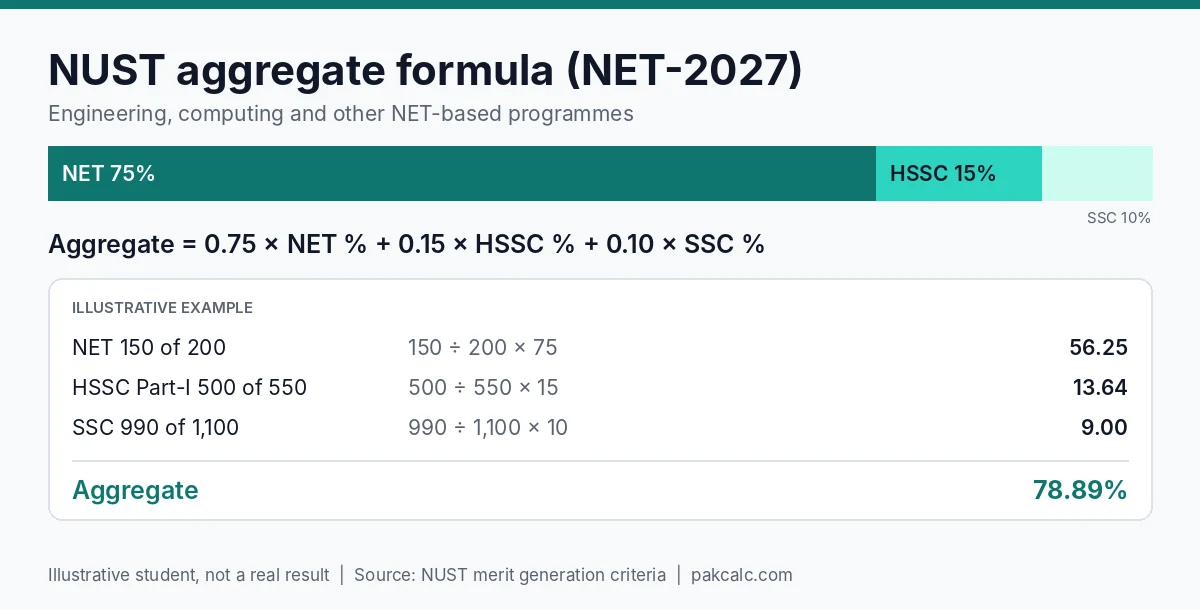
NUST's merit criteria weight your results like this:
| Result | Weight |
|---|---|
| NUST Entry Test (NET) | 75% |
| SSC / O-Level / equivalent | 10% |
| HSSC (Part-1) / HSSC / A-Level / equivalent / DAE | 15% |
Aggregate = 0.75 × (NET ÷ NET total × 100) + 0.10 × SSC % + 0.15 × HSSC %
No other university on PakCalc gives its entry test this much weight. FAST gives its test 33% to 50%, COMSATS gives the NTS 50%, and QAU's BS programmes use no test at all. Run the same marks through our multi-university aggregate calculator to compare them, or see the FAST aggregate calculator if FAST is your second choice.
- Which HSSC marks count. NUST's FAQ says the Part-I marks you enter at application are used for merit generation if you apply on Part-I. Candidates who have already completed HSSC enter their HSSC result. Use the dropdown in the calculator to match your case.
- Final-year A-Level. NUST gives 25% weight to O-Level equivalence marks (IBCC certificate). Its merit table shows NET at 75%, so the calculator assumes 75% NET plus 25% O-Level. NUST's note does not spell out this split, so treat the A-Level result as an estimate and confirm it with NUST.
- Several NET attempts. The best score is picked automatically for merit. Enter a second score in the calculator to see this.
- ACT/SAT route. It has its own merit list (75% test, 10% SSC, 15% HSSC for national seats; 100% test for international seats). This calculator does not cover it, because NUST does not publish how scores convert.
Worked example (illustrative)
NET 150 of 200 gives 56.2500. SSC 990 of 1,100 gives 9.0000. HSSC Part-I 500 of 550 gives 13.6364. Aggregate: 78.8864, shown as 78.89%. A final-year A-Level student with NET 120 of 200 (45.00) and O-Level equivalence of 85% (21.25) gets 66.25%, using the assumed 75/25 split. With SSC at 90% and HSSC at 85%, a 75% target needs 71% in NET, which is 142 of 200.
Aggregate, merit position and admission are different
Aggregate is the percentage above. Merit position is your rank among all candidates, decided by NUST. Admission depends on your position, the programme preferences you gave and the seats available. NUST says closing merit of the previous session is made available on its website for guidance, but we could not find that table on the pages we read, so this page shows no closing-merit figures. Treat percentage tables on other sites with caution, because they are not NUST's official data.
Which programmes can I apply for?
From NUST's UG eligibility page (Pakistani system). Always check the page itself for your exact subjects.
| HSSC background | Engineering | Computing, Robotics & AI | Biotech, Environmental Sci, Agriculture | Architecture | Business, Economics and similar |
|---|---|---|---|---|---|
| Pre-Engineering | Yes | Yes | No | Yes | Yes |
| Pre-Medical | Yes, 8-week NUST Maths course first (unless you took additional Maths) | Yes, 6 credit hours of Maths within a year (unless additional Maths) | Yes | No (needs Maths and Physics) | Yes |
| ICS (Maths, Physics, CS) | Yes, Chemistry as a remedial course in semester 1 | Yes | No | Yes | Yes |
| Arts / other with Maths | No | Yes | No | No | Yes |
| Other, no Maths | No | No | No | No | Yes (Accounting & Finance needs Maths or Accounting) |
Key rules: at least 60% in SSC and HSSC (or IBCC equivalents); LLB also needs a valid HEC LAT score of 50%; DAE holders have a separate DAE eligibility page. For NET-2027, the Pre-Medical Maths course must be finished before 25 July 2027 with 60% marks to be in the merit.
New for Fall 2027: NUST's UG admission updates (read 14 November 2026) add BS Robotics and Artificial Intelligence at SMME, Islamabad and CoEME, Rawalpindi, and BS International Relations at CIPS, Islamabad.
The test (NET)
| NET paper | For | Subject weights |
|---|---|---|
| Engineering | Pre-Eng, Pre-Med, ICS: Engineering, Computing and more | Maths 50, Physics 30, English 20 |
| Applied Sciences | Pre-Medical: Biotech, Agriculture and similar | Biology 50, Chemistry 30, English 20 |
| Business Studies & Social Sciences | Any HSSC: BBA, Economics and similar | Quantitative Maths 50, English 50 |
| Architecture | B Architecture, B Industrial Design | Design Aptitude 50, Maths 30, English 20 |
| Natural Sciences | BS Maths, Physics, Chemistry (non-standard backgrounds) | Maths 50, English 50 |
Source: NUST's NET subjects page. The test has 200 MCQs in three hours with four options each and no negative marking. Questions are based on SSC/HSSC level (Part-1 and Part-II), and the English paper follows the SAT pattern. Computer-based tests run in Islamabad and Quetta (09:00 to 12:00 or 14:00 to 17:00); paper-based tests run in Karachi and Gilgit.
NET-2027 dates (tentative)
| Series | Registration | Tests |
|---|---|---|
| 1 | 4 Oct to 14 Nov 2026 | From 17 Nov 2026 (Islamabad) |
| 2 | Dec 2026 to Jan 2027 | Jan to Mar 2027 |
| 3 | Feb to Mar 2027 | Apr 2027 |
| 4 | Apr to May 2027 | Jun to Jul 2027 |
Each series needs its own registration and fee. Dates re-checked on NUST's admissions site on 14 November 2026. ACT/SAT-basis applications have a separate window (4 May to 25 July 2027).
Many NUST applicants also sit ECAT for UET Lahore, which gives the test 33% of the aggregate instead of 75%. Our UET aggregate calculator shows that formula and UET's Fall 2026 closing merit.
How to apply
- Register on ugadmissions.nust.edu.pk with a valid email. You need your CNIC, Form-B or NICOP.
- Fill the online form and upload a plain-background photo not older than one month. NUST confirms submission by email.
- Print the fee invoice and pay the NET processing fee: Rs 5,000 per exam for Pakistani and dual-national candidates (Rs 10,000 for foreign nationals). Pay by 1Link (instant verification) or credit card. The fee is non-refundable, non-transferable and valid only for that series.
- For the computer-based test, choose a date and session. Paper-based slots are first come, first served.
- Print your admit card and carry it with an original photo ID on test day.
Top three position holders in HSSC board exams are exempt from the fee and should email NUST with proof. Your name is registered as it appears on your Matric or O-Level equivalence certificate. NUST says it neither runs nor sponsors NET preparation activities, so be careful with anyone claiming a NUST connection.
After the test: merit and selection
- Results: computer-based within 24 hours, paper-based within 5 to 7 working days, using your roll number on the portal.
- Merit lists are generated tentatively by the last week of July. You then get 2 to 3 days to edit preferences within a discipline.
- You are offered a programme by your preferences and merit position. Pay dues at HBL by the deadline or you leave the selection process.
- You can change preferences within a discipline once, on a form with a fee. You stay eligible for upgrades as seats free up unless you freeze your programme.
- SSC and HSSC must be complete before classes start. Candidates sitting a second annual exam, or Oct/Nov A-Level exams, are not eligible for that session.
Frequently asked questions
Can Part-I FSc students apply?
Yes. You must have passed Part-I. If your Part-I is under 60% you can still apply and the marks are used for merit, but you must have 60% or more in your complete FSc at joining.
Which NET score counts if I sit more than once?
The best one. Only one attempt per discipline is allowed in a series, and results are valid for the current admission cycle only.
What if I miss my test session?
NUST's policy is no second chance. In extreme emergencies, requests may be considered case by case depending on space.
Can I get my paper rechecked?
Paper-based tests only: apply within 5 days of the result with Rs 500 by bank draft or pay order. Rechecking covers unmarked answers and totalling errors.
Is there an age limit? Are gap-year students penalised?
There is no age limit. Gap-year and repeater candidates are treated as normal candidates, with no merit penalty.
Can I apply to more than one programme?
Yes, if you meet each programme's eligibility criteria.
I am in final-year A-Level. Can I apply?
Yes. You are evaluated on O-Level equivalence marks, and you must provide your A-Level IBCC equivalence certificate within 15 days of your result or at admission, per NUST's FAQ.
I took additional Maths and I am waiting for the result.
You can apply on your Pre-Medical result, but must provide the additional Maths result with passing marks and 60% overall in HSSC at joining.
Where can I practise?
NUST provides a sample test on the portal. The paper draws on textbooks, so understanding concepts from your board books matters.
What if I am selected on both NET and ACT/SAT merit lists?
You choose one seat to retain.
What do I need when I join?
Original documents, IBCC attestation of your educational documents, a medical certificate and an affidavit.
Is NUST financial help available?
Yes. NUST lists need-based aid and other options on its scholarships page. NUST's FAQ also says students with a GPA of at least 3.5 in each semester can get financial assistance under policy.
Is PakCalc an official NUST tool?
No. This is an independent site with no connection to NUST. Estimates only.
Sources and how this page is checked
All facts were read on 14 October 2026 from official NUST pages: merit criteria, UG eligibility page, NET subjects, procedure, salient features, selection process, updates, dates, application fee, FAQs and the admissions portal. Rules change by cycle, so confirm there. We try the calculation logic against fixed cases, but errors can still happen. Our accuracy policy covers updates and corrections. Not covered: fees beyond the application fee, closing merit (not found), ACT/SAT conversion.
AI tools helped research and draft this guide. The 75/10/15 weights, NET dates and fees were checked against NUST's admission pages, linked in the sources.
Change log: 14 October 2026, first version for NET-2027. 22 October 2026, the calculator now shows the NET score you need before you take the test, the A-Level 75/25 split is labelled as an assumption, and links to related calculators were added. 14 November 2026, NET dates re-checked; the time-sensitive note now points to Series-2.
About the author
Disclaimer: estimates only, not official results or advice. See our Disclaimer. Spotted an error? Contact us.
Related calculators
- EducationAir Uni Aggregate Calculator 2027 (Air University Merit)Your Air University aggregate on both AU formulas, the AU-CBT score you need, and each campus’s exemption rules.Open calculator →
- EducationBahria University GPA Calculator and Grading System 2026GPA, CGPA and probation on Bahria’s Spring 2026 handbook, with the MS scale, a final-exam planner and repeat versus honours.Open calculator →
- EducationIIUI GPA Calculator for BS, MS and PhD StudentsGPA, CGPA and probation lines on IIU Islamabad’s rules for BS, MS and PhD, with a terminal-marks planner and repeat outcomes.Open calculator →
- EducationUET GPA Calculator for Lahore, Taxila and PeshawarGPA, CGPA, repeats and probation on UET Lahore, Taxila and Peshawar rules, tested on a real 140-credit-hour UET Lahore transcript.Open calculator →