Home › Education › UET Aggregate Calculator 2027: ECAT Formula + Merit
UET Aggregate Calculator 2027 (ECAT Merit)
By Shehrooze Butt, independent publisher and researcher | Last updated | Sources checked 26 October 2026 | Unofficial tool
UET Lahore’s Computer Science seats at the main campus opened at 87.47% in the first Fall 2026 merit list. By the lowest later list, they closed at 85.37%. That 2.1-point drop equals about 25 ECAT marks, or six correct answers.
UET’s Fall 2026 formula gives Matric 17%, Intermediate Part-I 50% and ECAT 33%, and that is exactly what the aggregate calculator for UET below uses. It then compares your result with the closing merit UET published for its ECAT programmes in five seat categories, including the separate Pre-Medical seats, and shows how many ECAT marks a target needs.
Remember: UET draws up its merit lists category by category, so your aggregate is a guide to your chances, not a seat.
University and route
Matric / SSC
Copy both numbers from your Matric (SSC) result card. The total depends on your board and year.
Intermediate Part-I
UET uses your first-year (Part-I) result even if your full Intermediate result is out. Copy the total from your own result card, because it differs by board. For DAE, enter the combined 1st and 2nd year marks.
BSc Engineering Technology CGPA
ECAT
Not taken the test yet? Leave the marks empty. The calculator then shows the score each target needs. For ETEA, enter the total printed on your ETEA result card.
Optional: Hafiz-e-Quran or sports marks
Only fill this in if UET’s committee has actually awarded you marks (up to 20 for Hafiz-e-Quran, up to 10 for sports). Both are added to your intermediate marks. The Fall 2026 prospectus says this for sports marks, and UET’s 2021 prospectus counted Hafiz-e-Quran marks inside the intermediate percentage too.
Optional: target
Optional: compare with Fall 2026 closing merit
Pre-Medical students compete for the separate -M seats in computing programmes, which closed much higher. You can tick every category you qualify for in one application.
The UET aggregate formula for 2027 admissions
UET Lahore’s Fall 2026 undergraduate prospectus sets the weights in its “Determination of Merit” section. The Fall 2025 prospectus used the same weights, so they have held for two intakes. UET has not published a Fall 2027 prospectus yet.
| Your qualification (ECAT programmes) | Academic part | ECAT |
|---|---|---|
| Intermediate (FSc / ICS) | Matric 17% + Part-I 50% | 33% |
| O and A Level | 11th class (O Level) marks 67% | 33% |
| DAE diploma | 1st + 2nd year 67% | 33% |
| BSc Engineering Technology | CGPA 67% | 33% |
| Non-ECAT programmes | Matric 25% + Part-I 75% | none |
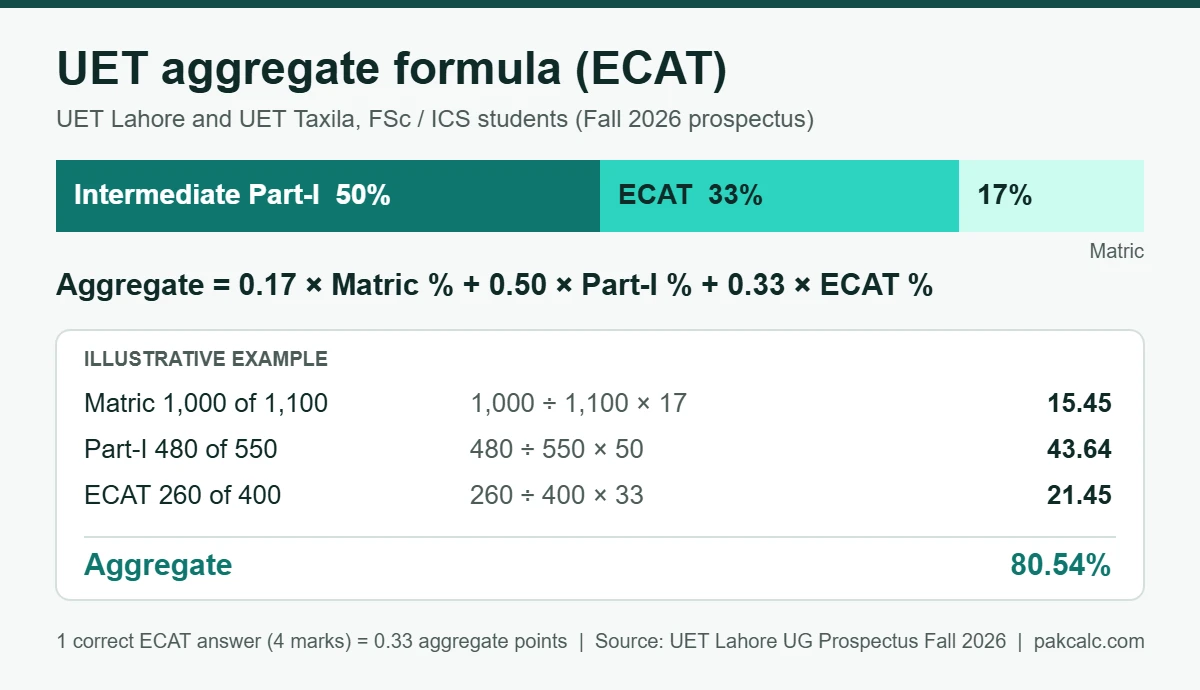
Aggregate = 0.17 × Matric % + 0.50 × Part-I % + 0.33 × ECAT %
Three details in the prospectus change real results, and most calculators skip them:
- Part-I only. Even if your Part-II result is out, UET uses the first-year marks. Typing your full 1,100-mark FSc result gives a different, wrong figure.
- CGPA conversion. For BSc Engineering Technology, a 2.5 CGPA counts as 60% and a 4.0 as 90%, with values in between scaled evenly. So 3.25 becomes 75%.
- No Matric for non-ECAT students without it. If you never sat Matric, the non-ECAT formula uses your intermediate result at 100%.
Why some calculators show 25/45/30
UET’s 2020 admission policy gave ECAT 30%, Matric 25% and Part-I 45%. Pages that still use that split are working from an old intake. For a student with Matric 85%, Part-I 82% and ECAT 300 of 400, the old split gives 80.65% and the current one gives 80.20%. Same marks, 0.45 points apart.
UET Lahore vs UET Taxila and UET Peshawar
UET Taxila is a separate university, but it uses ECAT (it also calls the test TCAT) and the same 17/50/33 split for FSc students. Its official merit calculator shows where the two part ways:
| Qualification | UET Lahore | UET Taxila |
|---|---|---|
| FSc / ICS | 17 / 50 / 33 | 17 / 50 / 33 |
| DAE | DAE 67% + ECAT 33% (no Matric) | Matric 17% + DAE 50% + ECAT 33% |
| A Level | O Level 67% + ECAT 33% | O Level 67% + ECAT 33% |
| BS Maths, BS Physics | Matric 25% + Part-I 75% | Matric 30% + HSSC 70% |
The DAE difference matters. A diploma holder with Matric 900 of 1,100, DAE 1,900 of 2,400 and ECAT 200 of 400 gets 69.54% at UET Lahore and 69.99% at Taxila. A weaker Matric result would reverse that. Pick the right route in the calculator.
UET Peshawar: ETEA, not ECAT
UET Peshawar admits through the ETEA test, with much more weight on the test than UET Lahore gives ECAT. The score calculator run by its admissions directorate gives these weights (admission notices are posted on the UET Peshawar website):
| Programme | Academic part | Test |
|---|---|---|
| BSc Engineering | Matric 10% + FSc Part-I 40% | ETEA 50% |
| BS CS, AI, Cyber Security, Data Science | Matric 40% + FSc Part-I 60% | none |
Neither page names the session year, so treat these as the latest published weights and confirm before you apply. The admission page also gives Hafiz-e-Quran applicants 20 extra marks, but does not say how they enter the aggregate, so the calculator leaves them out for this route. Both routes are in the calculator above.
UET Mardan is a separate university with its own admissions, and this page does not cover it.
Each correct ECAT answer adds 0.33 points
ECAT has 100 questions. Each correct answer earns 4 marks and a wrong answer costs nothing, per UET’s admissions FAQs. So scores move in steps of 4, and every correct answer adds the same slice of aggregate:
| One extra… | Adds to aggregate | Equal to |
|---|---|---|
| ECAT correct answer (4 marks) | 0.3300 points | 1 answer |
| Part-I mark (of 550) | 0.0909 points | about 1/3.6 of an answer |
| Matric mark (of 1,100) | 0.0155 points | about 1/21 of an answer |
These figures come straight from the formula, assuming Part-I out of 550 and Matric out of 1,100. Put simply: one more correct ECAT answer is worth about 3.6 Part-I marks or 21 Matric marks. By the time you sit ECAT, your Matric and Part-I marks are usually fixed. The test is the part you can still move.
Leaving a question blank and guessing wrong score the same, zero. Since there is no negative marking, a blank answer is never the better choice.
UET Lahore closing merit, Fall 2026 (A1 open merit)
UET posts a minimum-aggregate report after each merit list on its downloads page. We read ten of them for Fall 2026 (lists 1 to 4 and 7 to 12) for this page. The table shows the A1 category, morning session, for ECAT programmes: the first-list figure, and the lowest closing figure across those lists.
A1 is the Punjab open-merit category with the lower fee. UET says A1 fees are about 35% lower than A2, on its Bachelors programme page. A2 seats closed lower: at the main campus, by 1.38 points on average across 16 programmes. The calculator also holds the A2, Pre-Medical and AP1 figures.
| Campus: programme | 1st list | Lowest list |
|---|---|---|
| Lahore (Main): Cybersecurity | 86.54% | 85.60% |
| Lahore (Main): Computer Science | 87.47% | 85.37% |
| Lahore (Main): Data Science | 85.16% | 84.02% |
| Lahore (Main): Electrical Engineering | 85.14% | 83.33% |
| Lahore (Main): Mechatronics & Control Engineering | 83.96% | 82.65% |
| Lahore (Main): Mechanical Engineering | 83.29% | 82.28% |
| Lahore (Main): Computer Engineering | 83.76% | 82.11% |
| Lahore (Main): Civil Engineering | 82.64% | 80.96% |
| Lahore (Main): Architectural Engineering | 81.69% | 80.05% |
| Lahore (Main): Chemical Engineering | 81.70% | 80.01% |
| Lahore (Main): Architecture | 81.75% | 79.35% |
| Lahore (Main): Petroleum & Gas Engineering | 80.62% | 79.07% |
| Lahore (Main): Automotive Engineering | 81.14% | 78.94% |
| Lahore (Main): Industrial & Manufacturing Engineering | 79.40% | 77.62% |
| Lahore (Main): Environmental Engineering | 78.49% | 77.02% |
| Lahore (Main): Business Data Analytics | 79.31% | 76.59% |
| Lahore (Main): City & Regional Planning | 78.41% | 76.18% |
| Lahore (Main): Metallurgical & Materials Engineering | 78.46% | 75.85% |
| Lahore (Main): Transportation Engineering | 76.33% | 74.02% |
| Lahore (Main): Mining Engineering | 75.57% | 72.82% |
| Lahore (Main): Product & Industrial Design | 74.14% | 71.53% |
| Lahore (Main): Polymer Engineering | 74.58% | 71.50% |
| Lahore (Main): Geological Engineering | 73.27% | 70.18% |
| KSK (New Campus): Software Engineering | 81.98% | 80.20% |
| KSK (New Campus): Artificial Intelligence | 80.91% | 79.83% |
| KSK (New Campus): Computer Science | 81.17% | 79.75% |
| KSK (New Campus): Cybersecurity | 80.12% | 78.71% |
| KSK (New Campus): Data Science | 79.10% | 77.24% |
| KSK (New Campus): Computer Engineering (NCEAC) | 77.82% | 76.18% |
| KSK (New Campus): Electrical Engineering | 77.45% | 76.02% |
| KSK (New Campus): Mechanical Engineering | 77.51% | 75.94% |
| KSK (New Campus): Biomedical Engineering | 75.96% | 73.79% |
| KSK (New Campus): Chemical Engineering | 74.17% | 71.54% |
| Faisalabad: Computer Science | 78.86% | 75.79% |
| Faisalabad: Cybersecurity | 76.68% | 74.38% |
| Faisalabad: Data Science | 74.97% | 71.77% |
| Faisalabad: Electrical Engineering | 73.71% | 70.40% |
| Faisalabad: Mechatronics & Control Engineering | 72.39% | 69.22% |
| Faisalabad: Computer Engineering (NCEAC) | 73.66% | 68.94% |
| Faisalabad: Textile Engineering | 71.46% | 66.98% |
| Faisalabad: Chemical Engineering | 69.98% | 64.43% |
| RCET Gujranwala: Computer Science | 74.88% | 71.46% |
| RCET Gujranwala: Computer Engineering (NCEAC) | 69.19% | 64.10% |
| RCET Gujranwala: Electrical Engineering | 68.55% | 64.09% |
| RCET Gujranwala: Mechanical Engineering | 67.36% | 63.95% |
| Narowal: Computer Science | 74.45% | 72.70% |
| Narowal: Civil Engineering | 72.91% | 70.55% |
| Narowal: Computer Engineering (NCEAC) | 69.72% | 66.47% |
| Narowal: Mechanical Engineering | 68.47% | 64.45% |
| Narowal: Architecture | 68.11% | 63.81% |
| Narowal: Electrical Engineering | 67.96% | 62.87% |
| Narowal: Biomedical Engineering | 62.66% | 54.05% |
What the table shows. Across all 52 programme-campus pairs, the closing figure fell by 2.66 points on average between the first list and the lowest one. At the main campus the average fall was 1.99 points, and at KSK 1.70. At Faisalabad, RCET Gujranwala and Narowal it was about 4 points. These averages are our own calculation from the UET reports.
In ECAT terms. Since one correct answer adds 0.33 points, a 2-point fall is about six answers, and a 4-point fall about twelve. So the first list overstates what you need, especially at the smaller campuses. The lowest list is a better guide to the real last seat, though the next intake may close differently.
Limits. Lists 5 and 6 and the walk-in and leftover-seat lists were not in the reports we read. Figures for reserved categories such as overseas (S) or minority (NM) seats are in UET’s PDFs. UET Taxila publishes its own lists, which this page does not cover.
A1, A2 and Pre-Medical seats: which list are you on?
UET runs a separate merit list for each seat category, so the closing figure that matters is the one for your category. The main ones, from UET’s category guide:
- A1: Punjab or Islamabad domicile, subsidized fee.
- A2: the same students, partially subsidized (higher) fee.
- A1-M and A2-M: Pre-Medical students, at the same two fee levels.
- AP1 and AP2: students from other provinces, for programmes UET offers on an All Pakistan basis.
- Others: L (Bahawalnagar, Bahawalpur, Rahim Yar Khan, Rajanpur, Muzaffargarh, Jhang, Attock, Chakwal, Mianwali, Dera Ghazi Khan and Jhelum), R (Layyah and Bhakkar), N (children of engineers, architects and town planners), O (children of UET alumni), S (children of overseas Pakistanis), NM (religious minorities), T (disabled), M (children of UET employees) and P (BSc Engineering Technology).
Lowest closing figures at the main campus, Fall 2026:
| Programme (main campus) | A1 | A2 |
|---|---|---|
| Computer Science | 85.37% | 83.10% |
| Cybersecurity | 85.60% | 82.67% |
| Data Science | 84.02% | 82.13% |
| Electrical Engineering | 83.33% | 81.18% |
| Mechanical Engineering | 82.28% | 80.62% |
| Civil Engineering | 80.96% | 79.16% |
| Software Engineering | no A1 seats | 82.58% |
| Artificial Intelligence | no A1 seats | 82.42% |
Three things stand out. First, Software Engineering, Artificial Intelligence and Robotics at the main campus had A2 seats only, so an A1-only application could not reach them. Second, the A2 discount on merit was small, 1.38 points on average, or about four ECAT answers. Third, Pre-Medical seats closed far higher: main-campus Computer Science closed at 89.96% for A1-M against 85.37% for A1, a 4.59-point gap. These comparisons are our own calculation from the UET reports.
UET’s FAQs confirm that Pre-Medical students can apply for computing programmes. In Fall 2026 the -M seats were in computing programmes, Business Data Analytics and Biomedical Engineering. Pre-Medical students sit ECAT with Biology in place of Mathematics. If you are also applying for MBBS, our MDCAT aggregate calculator covers that route.
What the two fee levels cost
UET’s Fall 2026 fee schedule puts the first semester (admission fee plus tuition) at Rs 110,340 for A1 and A1-M seats and Rs 159,290 for A2 and A2-M. Over eight semesters, A1 totals Rs 713,920 and A2 Rs 1,085,430, a difference of Rs 371,510. Hostel, exam and facility charges are extra.
The practical rule: if you can afford A2, apply in both A1 and A2. UET itself advises selecting every category you are eligible for.
UET merit rules that affect your number
- Minimum aggregate 50%. UET will not consider anyone below it, for any undergraduate programme.
- Ties at four decimals. UET compares aggregates up to four decimal places after truncation. Students tied for the last seat are all admitted. That is why the calculator shows four decimals instead of rounding.
- Hafiz-e-Quran marks. A verification committee can award 0 to 20 marks after an oral test. You must tick the box on the application form. UET’s 2021 prospectus counted these marks inside the intermediate percentage; the Fall 2026 one does not say where they go.
- Sports marks. Up to 10 marks, added to your intermediate marks, after a sports test by a committee.
- Pre-Medical with Mathematics. If you took Maths as an extra subject, UET uses your first-year Biology marks in the merit, as long as you passed Maths.
- Merit by category. Each seat category has its own merit list. Unused reserved seats move to Punjab open merit.
All of these come from the merit section of the Fall 2026 prospectus. Read how aggregates work across universities if you are comparing UET with other options.
Who can apply
Engineering, architecture and computer engineering need at least 60% in Intermediate or equivalent. Computing, science, technology and business programmes need 50%. This uses your complete Intermediate result, without Hafiz or sports marks. Open-merit seats are for Punjab domicile (including Islamabad), except programmes UET offers on an All Pakistan basis, such as Mining, Geological and Biomedical Engineering. Fall 2026 admissions ran at the Lahore main campus, KSK, Faisalabad, Narowal and RCET Gujranwala.
How UET admission works after ECAT
- Sit ECAT. Register on the ECAT portal. The second Fall 2026 test cost Rs 3,000. Choose the subject combination that matches your Intermediate subjects.
- Apply on the admission portal. One Rs 3,000 application fee covers every programme and campus you choose. For Fall 2026 the window ran from 8 June to 15 July 2026.
- Order your preferences with care. UET offers you the highest preference your merit reaches, and the ones below it lapse. In 2026 you could edit preferences from 12 to 14 July for Rs 1,500.
- Watch the merit lists. The first list came out on 24 July 2026. Up to the 4th list, UET moves you up automatically if a seat opens in a higher preference.
- Pay and upload on time. If you are selected but miss the fee or documents, UET drops you from all later lists.
- Leftover and walk-in rounds. In 2026 these ran from early September to 9 October.
UET’s own advice is to rank programmes by what you want, not by last year’s merit. Last year’s figures are still useful for one job: picking safety options. Add at least one programme and campus whose lowest closing sits well below your aggregate.
ECAT 2027: what is known so far
UET has not announced ECAT 2027 dates for Fall 2027 as of 14 November 2026. Its 6 November notice opens Spring 2027 applications (BS, MS and PhD) from 16 November 2026, but gives no Fall 2027 ECAT dates. Its Fall 2026 cycle closed with a last walk-in merit list on 9 October 2026, per UET’s news page. For Fall 2026, UET ran ECAT twice: the first test from 30 March to 3 April 2026 and a second, final test from 16 to 21 June 2026, with results on 30 June. Online admission applications then ran from 8 June to 15 July 2026.
The test format from the Fall 2026 FAQs:
- 100 MCQs in 100 minutes, 400 marks, computer-based
- English 10 questions; Physics 30; Mathematics 30; Chemistry, Computer Science or Statistics 30 (Biology replaces Maths for Pre-Medical)
- No passing mark. Merit alone decides admission
- Your ECAT subject combination must match your Intermediate subjects
A 2026 score will not carry over. The prospectus requires the entrance test held for the session you apply to, so Fall 2027 applicants need ECAT 2027. Prep sites such as Maqsad report that UET counts the better score when a student sits both tests in one session; the UET pages we checked do not say this.
What a typical ECAT score looks like
UET publishes average scores by group (first test, second test):
| Group | 1st test 2026 | 2nd test 2026 |
|---|---|---|
| Pre-Engineering | 203 | 238 |
| ICS (Physics) | 201 | 227 |
| Pre-Medical | 222 | 221 |
Compare that with the worked example below, where a student needs 320 for main-campus Computer Science. That is well above either Pre-Engineering average, while KSK Computer Science (252) sits close to the second-test average. The averages include every candidate, not only those admitted.
If the 2027 cycle follows 2026, the first ECAT would fall around late March. Treat that as a pattern, not a date, and check UET’s portal.
Example: 260 in ECAT with 480 in Part-I
| Input | Calculation | Points |
|---|---|---|
| Matric 1,000 of 1,100 | 1,000 ÷ 1,100 × 17 | 15.4545 |
| Part-I 480 of 550 | 480 ÷ 550 × 50 | 43.6364 |
| ECAT 260 of 400 | 260 ÷ 400 × 33 | 21.4500 |
| Aggregate | 80.5409% | |
These marks are made up for illustration. They do not describe a real student. Enter your own marks in the aggregate calculator for UET above to repeat the check.
Target check. The same student’s Matric and Part-I give 59.09 points. Matching the lowest Fall 2026 Computer Science closing at the main campus (85.37%) needs 26.28 more points from ECAT. That is 318.6 marks, so 320 in practice, or 80 correct answers.
A cheaper target. For KSK Computer Science (lowest closing 79.75%), the same student needs 252 marks, or 63 correct answers. The campus choice is worth 17 answers here. On an A2 seat at the main campus (lowest closing 83.10%), the same student needs 292. These are estimates from last year’s figures.
Merit position, UET Mardan and foreign grades
It does not predict your merit position or programme, because that depends on every applicant’s aggregate, preferences and category. It covers UET Peshawar’s formula but not its closing merit, and it does not cover UET Mardan. It does not convert foreign letter grades; UET uses the IBCC equivalence marks for that. Weighing ECAT against other entry tests? NUST’s NET merit formula leans on the test even harder, while FAST’s engineering formula gives its test a third, the same share ECAT gets here. Your ECAT score also counts at Punjab University, where it makes up a third of the PU engineering merit.
Already admitted? Your semester grades then follow a different rule book at each UET, and the UET GPA calculator works out your GPA, CGPA and standing under Lahore, Taxila or Peshawar rules.
Frequently asked questions
What is the UET aggregate formula?
For FSc and ICS students applying to ECAT programmes at UET Lahore, Matric counts 17%, Intermediate Part-I 50% and ECAT 33%. Turn each result into a percentage, multiply by its weight and add the three. UET Taxila uses the same split for FSc students.
Does UET use Part-I or full FSc marks?
Part-I. UET’s FAQs say merit uses first-year marks plus ECAT, even when your complete result is available. You still need the full Intermediate result to meet the 60% or 50% eligibility rule.
What is the passing mark of ECAT?
There is none. UET says ECAT has no minimum passing threshold. What decides admission is your aggregate against others in your category, with a 50% aggregate floor.
How many ECAT marks do I need for UET Computer Science?
It depends on your Matric and Part-I marks. With Matric 1,000 of 1,100 and Part-I 480 of 550, matching the lowest Fall 2026 A1 closing at the main campus needed about 320 of 400. Enter your own marks above and pick the programme to see your figure.
Can I use my ECAT 2026 score for Fall 2027?
No. UET’s prospectus asks for the entrance test held for the session you apply to. For Fall 2027 you will need to sit ECAT 2027.
What is a good ECAT score?
It depends on your academic marks and your target. As a reference, the average Pre-Engineering score was 203 in UET’s first 2026 test and 238 in the second. In our worked example, a student with about 91% in Matric and 87% in Part-I needed 320 for main-campus Computer Science.
Is UET merit lower in later merit lists?
Usually. In Fall 2026, A1 closing figures fell by 2.66 points on average from the first list to the lowest list we read, and by about 4 points at the Faisalabad, Gujranwala and Narowal campuses.
UET prospectus, merit reports and other sources
All sources were checked on 26 October 2026. Rules can change between sessions, so check UET’s prospectus for yours before applying.
Official UET pages and documents
- UET Lahore Undergraduate Prospectus, Fall 2026 (Determination of Merit, pages 20 and 21; eligibility, page 16)
- UET admissions FAQs (Fall 2026)
- UET downloads: Fall 2026 merit list minimum-aggregate reports
- UET Bachelors programme page and admission guidance
- UET admissions news
- UET undergraduate fee schedule, Fall 2026
- UET admission category codes and descriptions
- UET ECAT portal and score statistics for the first and second 2026 tests
- UET Taxila official merit calculator
- UET Peshawar official website and UET Peshawar admissions directorate score calculator
- UET Lahore Undergraduate Prospectus 2021 (Hafiz-e-Quran marks)
Secondary sources
- KICS summary of the UET 2020 admission policy (old 25/45/30 split)
- NFC IET notice of UET’s ECAT 2026 first test dates
- Maqsad guide to UET Lahore admission (report on two ECAT attempts)
Each worked example on this page was run through the calculator and checked by hand. See our accuracy process for how errors get fixed.
AI tools sped up reading UET’s prospectus and merit list reports and drafting the text. The 17/50/33 formula and the closing figures were checked against those UET documents.
Change log: 26 October 2026, first version, built from the UET Fall 2026 prospectus and FAQs, the UET Taxila calculator, UET Peshawar’s admission pages, the fee schedule, category guide and ECAT statistics, and closing figures for five seat categories read from ten UET Fall 2026 merit list reports. 14 November 2026, ECAT 2027 section re-checked on UET’s news page; Spring 2027 notice added.
About the author
Disclaimer: this page is for information only. Results are estimates, not official results or advice. See our Disclaimer. Spotted an error? Contact us.
Related calculators
- EducationAir Uni Aggregate Calculator 2027 (Air University Merit)Your Air University aggregate on both AU formulas, the AU-CBT score you need, and each campus’s exemption rules.Open calculator →
- EducationBahria University GPA Calculator and Grading System 2026GPA, CGPA and probation on Bahria’s Spring 2026 handbook, with the MS scale, a final-exam planner and repeat versus honours.Open calculator →
- EducationIIUI GPA Calculator for BS, MS and PhD StudentsGPA, CGPA and probation lines on IIU Islamabad’s rules for BS, MS and PhD, with a terminal-marks planner and repeat outcomes.Open calculator →
- EducationUET GPA Calculator for Lahore, Taxila and PeshawarGPA, CGPA, repeats and probation on UET Lahore, Taxila and Peshawar rules, tested on a real 140-credit-hour UET Lahore transcript.Open calculator →