Home › Education › COMSATS GPA Calculator (CUI GPA and CGPA)
COMSATS GPA Calculator (CUI GPA and CGPA)
By Shehrooze Butt, independent publisher and researcher | Last updated | Sources checked 1 November 2026 | Unofficial tool
Finish a COMSATS course on 84.5% and you get an A. Finish on 84.4% and it’s an A-. On a 3-credit-hour course, that tenth of a mark is worth 1.02 quality points. The reason is simple: CUI rounds your percentage to a whole number before it decides the grade, and 84.5 rounds up to 85.
The calculator here rounds exactly as CUI does. Type letter grades or raw marks to get your semester GPA and CGPA. It also shows the percentage CUI’s own rule gives your CGPA, and the terminal score you need for the grade you want. Courses with a lab get a separate pass check, because that is where many surprise F grades come from.
Official figure: the one on CU Online and your transcript. Everything here is worked out from CUI’s published rules.
COMSATS GPA and CGPA calculator
Not sure? An A- shown as 3.66 on your result means the current table; 3.7 means the older one.
Use the credit hours printed on your result or scheme of studies, or load a semester from the list below. Leave out dropped, withdrawn and non-credit courses. In marks mode, each percentage is rounded the way CUI does it, and any course with a lab can be split into theory and lab to check both passes.
Your entries stay saved on this device until 30 days after your last change. On a shared or lab computer, press Clear all when you finish.
The share link holds your courses and marks only. No name or registration number.
Add each semester’s GPA and credit hours. Short on time? Put your current CGPA and the total credit hours from CU Online on the first line, then add the new semester below it. CGPA is weighted by credit hours, not a plain average.
What a repeated course would do to your CGPA
CUI’s regulations allow grade improvement but don’t say which attempt counts, so this shows both outcomes.
Spread it over more than one semester
Uses the four boxes above and assumes the same credit hours each semester.
The terminal exam carries 50% of a course at CUI. Enter everything you’ve earned before it as marks out of 50: usually assignments and quizzes (25) plus the mid (25).
Show every CGPA band and its percentage
| CGPA band | Percentage |
|---|---|
| 3.67 to 4.00 | 85% |
| 3.34 to 3.66 | 80% |
| 3.01 to 3.33 | 75% |
| 2.67 to 3.00 | 71% |
| 2.34 to 2.66 | 68% |
| 2.01 to 2.33 | 64% |
| 1.67 to 2.00 | 61% |
| 1.31 to 1.66 | 58% |
| 1.01 to 1.30 | 54% |
| 0.10 to 1.00 | 50% |
The CUI grade table in force since Fall 2021
CUI’s Academic Council approved this table at its 32nd meeting on 6 October 2021, and the Registrar notified it on 18 November 2021 (Notification 4304). It covers undergraduate and graduate students admitted from Fall 2021. The same points appear in CUI’s Graduate Handbook 2023 and in the undergraduate regulations, so the three official documents agree.
| Marks | Grade | Points | QP on 3 CH |
|---|---|---|---|
| 85 and above | A | 4.00 | 12.00 |
| 80 to 84 | A- | 3.66 | 10.98 |
| 75 to 79 | B+ | 3.33 | 9.99 |
| 71 to 74 | B | 3.00 | 9.00 |
| 68 to 70 | B- | 2.66 | 7.98 |
| 64 to 67 | C+ | 2.33 | 6.99 |
| 61 to 63 | C | 2.00 | 6.00 |
| 58 to 60 | C- | 1.66 | 4.98 |
| 54 to 57 | D+ | 1.30 | 3.90 |
| 50 to 53 | D | 1.00 | 3.00 |
| Below 50 | F | 0.00 | 0.00 |
QP means quality points: grade points multiplied by the course’s credit hours (CH).
Admitted to a BS before Fall 2021?
Then your results most likely follow CUI’s older table, which asked for more marks per grade and used different points. CUI’s Sahiwal campus still publishes it on its BS Accounting and Finance grading page, and a real 2011 to 2014 result card follows it exactly (see how this page was checked). Pick “BS admitted before Fall 2021” at the top of the calculator to use it.
| Marks | Grade | Points (older table) |
|---|---|---|
| 90 and above | A | 4.00 |
| 85 to 89 | A- | 3.70 |
| 80 to 84 | B+ | 3.30 |
| 75 to 79 | B | 3.00 |
| 70 to 74 | B- | 2.70 |
| 65 to 69 | C+ | 2.30 |
| 60 to 64 | C | 2.00 |
| 55 to 59 | C- | 1.70 |
| 50 to 54 | D | 1.30 |
| Below 50 | F | 0.00 |
There is no D+ on it, and the lowest pass is worth 1.30, not 1.00. The calculator rounds marks the same way on both tables, because the older documents we found don’t say how half marks were treated. Not sure which table you’re on? Look at the grade points on your result card: an A- printed as 3.7 means the older one.
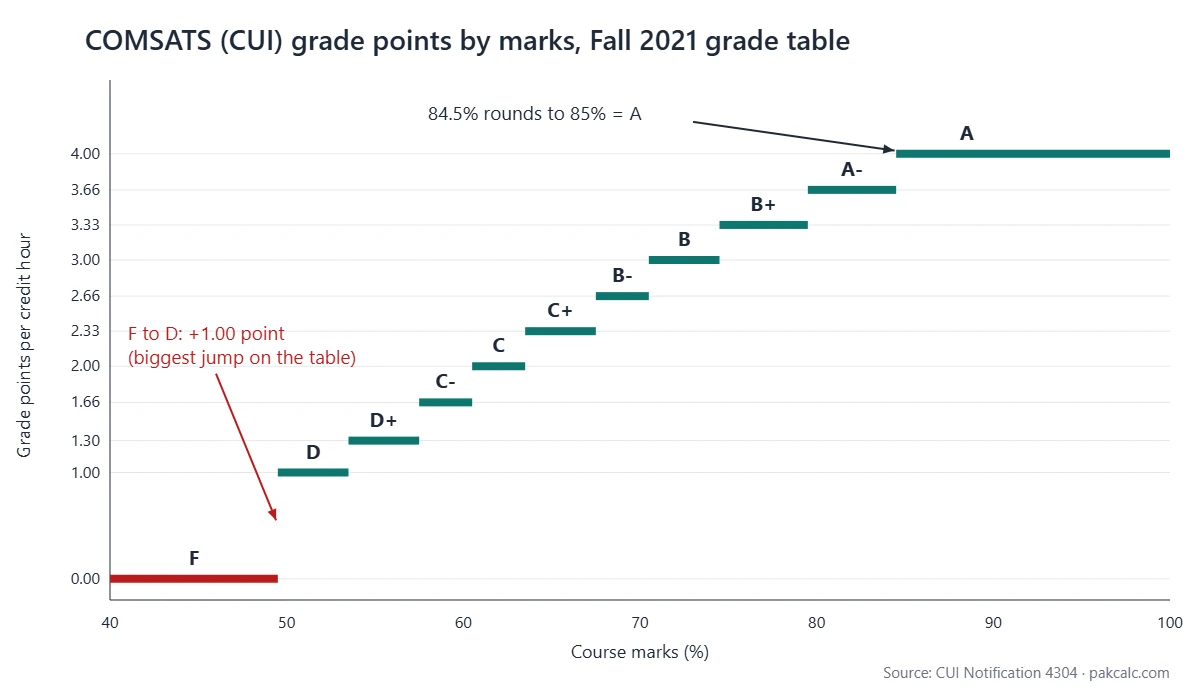
Look at the bottom row first. Moving from F to D is worth a full grade point, three times any other step on the table. A course sitting at 48% is the best place to spend your study hours. A course already at 86% can’t give you anything more.
Some bands are also narrow. B-, C and C- are only three marks wide each, so a small push in the right course can carry you into the next grade.
Half a mark can change your grade
The notification adds a rounding rule. When the first digit after the decimal point is 5 or more, the percentage rounds up. Below 5, it rounds down. CUI’s own example: 70.5 becomes 71, which is a B, while 70.4 becomes 70, a B-.
The rule bites hardest at the pass line. 49.5% rounds to 50 and passes with a D. 49.4% stays at 49 and is an F. On a 3-credit course, that is 3.00 quality points against zero. In marks mode, the COMSATS GPA calculator applies this rule course by course.
How to calculate your COMSATS GPA by hand
- Find each course’s grade points in the table.
- Multiply by the course’s credit hours to get its quality points.
- Add up the semester’s quality points and its credit hours.
- Divide: GPA = total quality points ÷ total credit hours.
Here is a first semester worked through. The course names and marks are illustrative, and the credit hours are typical of a first-year BS.
| Course (CH) | Marks | Grade, QP |
|---|---|---|
| Programming Fundamentals (4: 3 theory + 1 lab) | Theory 78%, lab 88% → 80.5 → 81% | A-, 14.64 |
| Calculus and Analytic Geometry (3) | 73.6 → 74% | B, 9.00 |
| Applied Physics (4: 3 theory + 1 lab) | Theory 66%, lab 84% → 70.5 → 71% | B, 12.00 |
| English Composition (3) | 84.5 → 85% | A, 12.00 |
| Islamic Studies (2) | 62% | C, 4.00 |
| Intro to ICT (3: 2 theory + 1 lab) | Theory 58%, lab 47% | F (lab under 50%), 0.00 |
| Total: 19 CH | 51.64 → GPA 2.72 |
The lab cost this student 0.20 of GPA. ICT’s combined score is 54.3%, normally a D+. But the lab is below 50%, and CUI makes you pass theory and lab separately, so the whole course becomes an F. With 52% in the lab instead, ICT is a D+ and the semester GPA is 2.92.
Two roundings went the student’s way. Programming (80.5) and Physics (70.5) both rounded up into a better grade. English at 84.4% instead of 84.5% would have pulled the GPA down to 2.66.
If your GPA here is 0.01 away from CU Online, check how it is shown. We haven’t confirmed whether CUI rounds a GPA to two decimals or cuts it off, so 2.718 could appear as 2.72 or 2.71.
A final year project counts like any other credit course. Enter each FYP part that appears on your result with its own credit hours.
How one course total is built
The Graduate Handbook 2023 splits a course into 25% for the mid-term, 25% for quizzes and assignments, and 50% for the terminal, with the same split inside a lab. BS students describe the same pattern. In an October 2024 post in a CUI Abbottabad students’ Facebook group, a student lays it out as 10% assignments, 15% quizzes, 25% mid and 50% final for theory, and 25% assignments, 25% mid and 50% final for a lab. Teachers can change how many quizzes they give, but not the weights.
The worked example in that post ends on 70.49%. Under CUI’s rounding, that stays at 70, a B-. One more hundredth of a percent would have rounded it to 71 and a B. On a 3-credit course, that gap is 1.02 quality points.
From GPA to CGPA
CGPA uses the same formula across all your semesters: every quality point so far ÷ every credit hour so far. Don’t average your semester GPAs. Say you have 2.72 over 19 credit hours and then 3.40 over 15. The plain average is 3.06, but the real CGPA is (51.64 + 51.00) ÷ 34 = 3.02.
If CU Online shows only your CGPA and total credit hours, that is enough. Multiply the two to get your quality points so far, or put both on the first line of the CGPA tab. The COMSATS CGPA calculator there then adds each new semester on top.
Courses with a lab: one grade, two passes
CUI’s undergraduate regulations combine theory and lab marks by credit hours:
So in a 4-credit course with 3 theory hours and 1 lab hour, theory carries three quarters of the result. In a 3-credit course split 2 + 1, the lab is a full third, so a weak lab hurts more.
The second rule matters more. You must reach the pass mark in theory and in the lab separately. Fail either part and the whole course is an F, however healthy the combined total looks. A strong lab can’t rescue weak theory, and a strong theory can’t rescue a weak lab.
In the COMSATS GPA calculator, switch to marks mode and tap Theory and lab separately under any course with a lab. It shows the combined percentage, the rounded grade and a warning if either part is below 50%.
One detail the regulations leave open: whether the rounding rule applies to theory and lab separately or only to the combined percentage. The calculator rounds the combined percentage for the grade, and rounds each part before checking it against 50%. If your result differs by one grade at a boundary, this is the likely reason.
Where CUI draws the probation and award lines
The undergraduate lines come from CUI’s undergraduate regulations. They were framed in 2006 and are still printed in the student rules booklet a CUI campus published in January 2026. CUI amends them from time to time, so treat them as the published rule and confirm anything decisive with your campus academic office. The MS and PhD lines come from the Graduate Handbook 2023.
| CGPA | What it means |
|---|---|
| Below 2.00 at the end of a semester | Probation (PRB) |
| Below 2.00 again while already on probation | Dismissal (DIS) |
| 2.00 and above | Good academic standing (GAS) |
| 2.50 | Minimum to apply for an MS at CUI. Also the good-standing line for MS and PhD students admitted from Fall 2023 |
| 3.00 | Minimum MS CGPA to apply for a CUI PhD |
| 3.50 and above | Campus gold, silver and bronze medals |
| 3.75 and above | Institute gold, silver and bronze medals |
| 4.00 | Patron’s Gold Medal |
Dismissal isn’t always the end. A student dismissed in the first four semesters of a bachelor’s degree can apply once for readmission, starting again from the first semester. From the fifth semester on, the single chance is to repeat the semester in which the dismissal happened.
A D grade can block a CUI MS. The Graduate Handbook’s MS eligibility asks for no D grade anywhere in your academic career, on top of the 2.50 CGPA. If you’re aiming for an MS at CUI, a D is worth fixing even when your CGPA is comfortable.
The medal rule has a catch. Medal winners must not have failed or repeated any course, and must finish in the minimum time. So repeating a B to get an A can lift your CGPA and still take you out of the medal race. If you’re close to 3.50, check this with your department before you register a repeat.
The Plan a target tab of the COMSATS GPA calculator works out what next semester has to bring. For example, a student on 1.85 after 37 credit hours needs a 2.31 GPA over 18 credit hours to get back to 2.00.
Turning COMSATS CGPA into a percentage, the CUI way
CUI’s 2020 grading notification (No. 2322, printed in the same PDF as Notification 4304) sets the method. You are given the lowest percentage of the band your CGPA falls in, using HEC’s grade-point ranges. Its own example: a CGPA of 3.00 counts as 71%.
| CGPA | Percentage under CUI’s method |
|---|---|
| 3.80 | 85% |
| 3.50 | 80% |
| 3.20 | 75% |
| 3.00 | 71% |
| 2.50 | 68% |
| 2.20 | 64% |
| 2.00 | 61% |
The bands also create a jump. A CGPA of 3.00 converts to 71%, but 3.01 converts to 75%.
If a form asks for a different method, the marks percentage calculator works out the other conversions in use.
One caution. The 2021 notification changed the grade points and says it only partly modifies the 2020 one. It doesn’t repeat the percentage note. If an employer or admission form needs an official percentage, ask your campus examination section for it rather than relying on any calculator, this one included.
Why some sites show different COMSATS grade points
If you’ve seen A- listed as 3.67 or 3.7, an A+ at 90%, or A shown as “3.67 to 4.00”, here is where those numbers come from.
| What you may see | What CUI’s table says |
|---|---|
| A+ at 90% and above | No A+ grade. A covers 85% and above at 4.00 |
| A- = 3.67 | A- = 3.66 |
| A- = 3.7, or A only from 90% | CUI’s older table, for BS students admitted before Fall 2021. Since Fall 2021, A- = 3.66 and A starts at 85% |
| D+ = 1.33 | D+ = 1.30 |
| Ranges such as A = 3.67 to 4.00 | HEC’s suggested ranges, printed beside the fixed points CUI adopted |
The range column causes most of the confusion. Notification 4304 prints two tables side by side: HEC’s criteria on the left and, on the right, the criteria approved by CUI’s Academic Council. Copy the left column and your GPA drifts. A CUI GPA calculator built on those ranges will be off by a few hundredths. This one uses the right column.
Repeats, withdrawals and attendance
Improving a grade. The undergraduate regulations let you improve a course grade on payment of the fee, and repeat a failed prerequisite. What they don’t spell out is which attempt then counts in your CGPA. Many students assume the better grade replaces the old one, and some sites state that as fact. Students ask about this all the time in CUI Facebook groups, and the answers they get from each other don’t agree. We couldn’t find the rule in CUI’s published documents either, so the CGPA tab of this COMSATS GPA calculator shows your CGPA both ways. Confirm with your campus examination section before you plan around it.
Dropping and withdrawing. Under the undergraduate regulations, you can drop a course within four weeks of classes starting, with no academic penalty, although the fee isn’t adjusted. You can withdraw from a course or a whole semester before the mid-term starts, with your campus’s permission, also without academic penalty. Graduate transcripts show a withdrawal as W. Leave dropped and withdrawn courses out of the calculator.
Attendance. The regulations require 80% attendance in lectures and in labs to sit the terminal. Fall short and you’re treated as having failed that course, so enter it as an F.
Credit load. Undergraduates register at least 12 credit hours to stay full-time, and at most 21 a semester in a four-year programme (24 in a five-year one).
MS or PhD before Fall 2021. If you were admitted to a graduate programme before Fall 2021, your pass mark is 60% (C) and the older grading policy applies. This calculator doesn’t cover that scale.
Frequently asked questions
Is this the official COMSATS GPA calculator?
No. PakCalc is independent and isn’t connected to COMSATS University Islamabad. The calculator follows CUI’s published grading notification, but CU Online and your transcript are the official record.
How do I find the GPA of one subject at COMSATS?
Round the subject’s total percentage to a whole number (84.5 becomes 85), then read its grade points from the table. 76% is a B+ worth 3.33 points per credit hour, so a 3-credit subject earns 9.99 quality points. In this COMSATS GPA calculator, switch to marks mode and enter just that one course.
Is there an A+ grade at COMSATS?
No. The highest grade is A, given at 85% and above (84.5% after rounding), worth 4.00 points per credit hour. 80% is an A- at 3.66, and 50% is a D at 1.00.
How do I convert my COMSATS CGPA to a percentage?
Under CUI’s 2020 notification, you take the lowest percentage of your CGPA’s band. A 3.24 CGPA is in the 3.01 to 3.33 band, so it counts as 75%. A 3.60 is in the 3.34 to 3.66 band, so 80%. For an official figure, ask your campus examination section.
Does COMSATS use relative grading?
No. The grading notification links each grade to a fixed percentage band, so your grade depends on your own marks, not on how the rest of the class performed.
What CGPA puts me on probation at COMSATS?
A CGPA below 2.00 at the end of a semester. If you’re already on probation and stay below 2.00 at the end of the next semester, the undergraduate regulations call for dismissal.
What CGPA do I need for an MS at COMSATS?
At least 2.50 from a semester-system degree (or a first division in the annual system), with no D grade in your academic career, plus an NTS GAT General score of at least 50%, according to the Graduate Handbook 2023.
How this page was checked
- Grade points and rounding were checked against Notification 4304 and section 2.10 of the Graduate Handbook 2023. Both match the table in the undergraduate regulations.
- Every worked figure on this page (the 2.72 semester, the 2.92 and 2.66 variations, the 3.02 CGPA and the 2.31 target) was re-run through the calculator’s own code.
- Other tools. In November 2026 we went through the COMSATS GPA calculators ranking on Google in Pakistan. The common problems were grade-point ranges copied from the HEC column, the “× 25” percentage shortcut, and repeat-course rules with no source.
- Semester presets use the course lists and credit hours from CUI’s official schemes of studies for BS Electrical Engineering (Fall 2023 onward, notified March 2025) and BS Computer Engineering (Fall 2025 onward). Deficiency and non-credit courses, such as Pakistan Studies, are left out.
- Student reports. The course weight split and the repeat question were cross-checked against public posts in CUI student Facebook groups (2024 and 2025). These are student accounts, not official rules, and are labelled as such.
- Older rules. Probation, dismissal, medals, the lab formula, attendance and credit load come from the 2006 undergraduate regulations as printed in a 2026 CUI student rules booklet. We found no newer published version, but CUI may have amended parts of them.
- A 2026 result card. We ran a Spring 2026 CUI Lahore MBA semester result card, posted on Facebook, through the calculator. All six courses got the same letter grade and grade points from their marks (71 = B at 3.00, 77 = B+ at 3.33, 85 and above = A), and the semester GPA came out at 3.72, the same as the card.
- An older result card. A BS Computer Engineering student at CUI Islamabad posted his own result cards for Spring 2011 to Fall 2014 publicly online. We left out his name and registration number. On CUI’s older table, the calculator gives all eight printed CGPAs, from 3.46 after the first semester to 3.62 at the end. On the current table, the same marks would give 3.81 and the same letters 3.61. That is why older intakes now have their own setting.
- Still open: whether CUI rounds a GPA to two decimals or cuts it off. On that card both methods give 3.72, so it can’t settle the question. If your CU Online result shows a GPA, please send the credit hours, grades and GPA (no name or registration number) through our contact page and we’ll check it.
AI tools helped gather CUI’s notifications and draft the text. Every grade point and rule was then checked against those CUI documents, listed below.
CUI notifications and other sources used
- CUI Notification 4304 (18 November 2021), with Notification 2322 (7 December 2020): grade points, rounding rule, CGPA-to-percentage method.
- CUI Sahiwal, BS Accounting and Finance: examinations and grading: the older grade table (A from 90%, A- 3.7, D 1.3).
- CUI Graduate Handbook 2023: grade table, MS and PhD eligibility, graduate standing, withdrawal and W grade.
- CUI Rules and Regulations for students (undergraduate regulations), Abbottabad campus: pass mark, lab formula, probation and dismissal, medals, attendance, drop and withdrawal, credit load.
- CUI scheme of studies, BS Electrical Engineering (Fall 2023 onward) and BS Computer Engineering (Fall 2025 onward): semester presets.
Update log
- 15 November 2026: Added CUI’s older grade table as a calculator setting for BS students admitted before Fall 2021, after a real 2011 to 2014 result card showed the current table doesn’t fit older intakes, and corrected the line that said it did. Saved entries now clear 30 days after your last change.
- 1 November 2026: Page published. Grade table and rounding checked against Notification 4304 and the Graduate Handbook 2023; standing, lab and medal rules checked against the undergraduate regulations.
CUI’s grading notifications drive updates here: a new one means a fresh check, and the page gets a full review every academic year (how the checks work). Applying to CUI rather than studying there? Our COMSATS merit calculator for admissions works out your aggregate. More tools are on our education calculators page, including the UAF CGPA calculator and a GPA calculator for other Pakistani universities.
If you’re mid-semester, the most useful next step is the Final exam needed tab of this COMSATS GPA calculator: it tells you exactly what the terminal has to bring for each grade.
About the author
Disclaimer: this COMSATS GPA calculator gives estimates for information only, not official results or advice. See our Disclaimer. Spotted an error? Contact us.
Related calculators
- EducationAir Uni Aggregate Calculator 2027 (Air University Merit)Your Air University aggregate on both AU formulas, the AU-CBT score you need, and each campus’s exemption rules.Open calculator →
- EducationBahria University GPA Calculator and Grading System 2026GPA, CGPA and probation on Bahria’s Spring 2026 handbook, with the MS scale, a final-exam planner and repeat versus honours.Open calculator →
- EducationIIUI GPA Calculator for BS, MS and PhD StudentsGPA, CGPA and probation lines on IIU Islamabad’s rules for BS, MS and PhD, with a terminal-marks planner and repeat outcomes.Open calculator →
- EducationUET GPA Calculator for Lahore, Taxila and PeshawarGPA, CGPA, repeats and probation on UET Lahore, Taxila and Peshawar rules, tested on a real 140-credit-hour UET Lahore transcript.Open calculator →