Home › Education › FAST GPA Calculator: SGPA and CGPA on FAST-NUCES Rules
FAST GPA Calculator: SGPA and CGPA on FAST-NUCES Rules
By Shehrooze Butt, independent publisher and researcher | Last updated | Sources checked 16 November 2026 | Unofficial tool
A first-semester CS student at FAST Lahore says he finished Calculus on about 67 out of 100 and still got an A. He puts the class’s modified average near 38, and under FAST’s relative grading policy an A starts at 65 at that average.
That is why a FAST GPA calculator needs more than a grade table. This one works out your SGPA and CGPA on FAST’s 4.00 scale. It also shows what a repeat does to your CGPA and the SGPA you need for a target. It estimates a grade from your marks and the class MCA, and tracks your warning count.
The formula, in one line: SGPA = (grade points × credit hours, added up) ÷ credit hours. CGPA is the same sum over every course so far, counting only the latest attempt of a repeated course. W doesn’t count, and I stays out until it becomes a letter grade or an F. F and FA count as zero.
FAST SGPA and CGPA calculator
Unofficial calculator, not made by or affiliated with FAST-NUCES. Your Flex result is final.
The calculator is loading. If it doesn’t appear, use the grade table below: multiply each grade point by the course’s credit hours, add them, and divide by the total credit hours.
The rows below hold a real Fall 2025 first semester from FAST Lahore (see the transcript section). Replace them with your own courses. A theory course and its lab are separate rows.
Your course rows and tracker entries stay on this device and are cleared the first time you open the page after 30 days without changes. On a shared computer, press Clear all when you finish.
Use the CGPA from your latest Flex transcript and the credit hours attempted behind it, F courses included and W or I left out. Leave both empty if this is your first semester.
Target CGPA: the SGPA you need next semester. It starts from the new CGPA above if you filled in this semester, otherwise from your current CGPA.
Your course outline says which scheme the course uses. For relative grading, Flex shows the course’s class average and MCA.
Enter the CGPA you finished each semester with, oldest first. A summer semester counts as its own row, because the warning count moves in summer too.
Getting a different SGPA from Flex? Send me the grades and credit hours, without your name or roll number, and I’ll check the calculator against them.
Letters and points on FAST’s 2026 scale
FAST’s June 2026 rule book gives every letter one fixed value, the same at every FAST campus. A+ and A both carry 4.00. There is no 4.3 at FAST, whatever some search answers suggest.
| Grade | Points | What FAST calls it |
|---|---|---|
| A+ | 4.00 | Outstanding |
| A, A- | 4.00, 3.67 | Excellent |
| B+, B, B- | 3.33, 3.00, 2.67 | Good |
| C+, C | 2.33, 2.00 | Adequate |
| C-, D+, D | 1.67, 1.33, 1.00 | Pass; the course may be repeated |
| F, FA | 0.00 (FA is treated as a fail) | Fail; fail through attendance shortage |
| I, W, S, U | none | Incomplete, withdrawn, PhD thesis grades |
For BS and BBA students, D is the lowest pass. FAST’s grading page sets higher floors elsewhere: C (2.00) is the lowest pass in MS and MBA courses, and the PhD table stops at B- (2.67).
The points come from rules 2.2 and 2.3 of the Undergraduate Academic Rules and Regulations 2026. They match FAST’s own academic grading page, which uses slightly different labels, for example A- “Very Good” and B- “Average”.
The Fall 2025 transcript we ran through the calculator
To test the FAST GPA calculator, I needed a real FAST result, not a made-up one. A FAST Lahore BS Computer Science student shared his full Fall 2025 transcript in a public video uploaded on 16 June 2026. I copied only the credit hours and grades.
If you are the student in the video and want this example changed, tell me and I’ll replace it.
| Course | Credit hours | Grade | Quality points |
|---|---|---|---|
| ICT | 1 | A | 4.00 |
| Programming Fundamentals lab | 1 | B | 3.00 |
| Programming Fundamentals | 3 | A | 12.00 |
| Calculus and Analytical Geometry | 3 | A | 12.00 |
| Applied Physics | 3 | A+ | 12.00 |
| Functional English lab | 1 | B+ | 3.33 |
| Functional English | 2 | A- | 7.34 |
| ICP (Ideology and Constitution of Pakistan) | 2 | A- | 7.34 |
| Pakistan Studies | 2 | B+ | 6.66 |
| Total | 18 | 67.67 |
67.67 ÷ 18 = 3.759, which rounds to 3.76. That is the SGPA printed on his transcript, and it is what the calculator shows when you load the example.
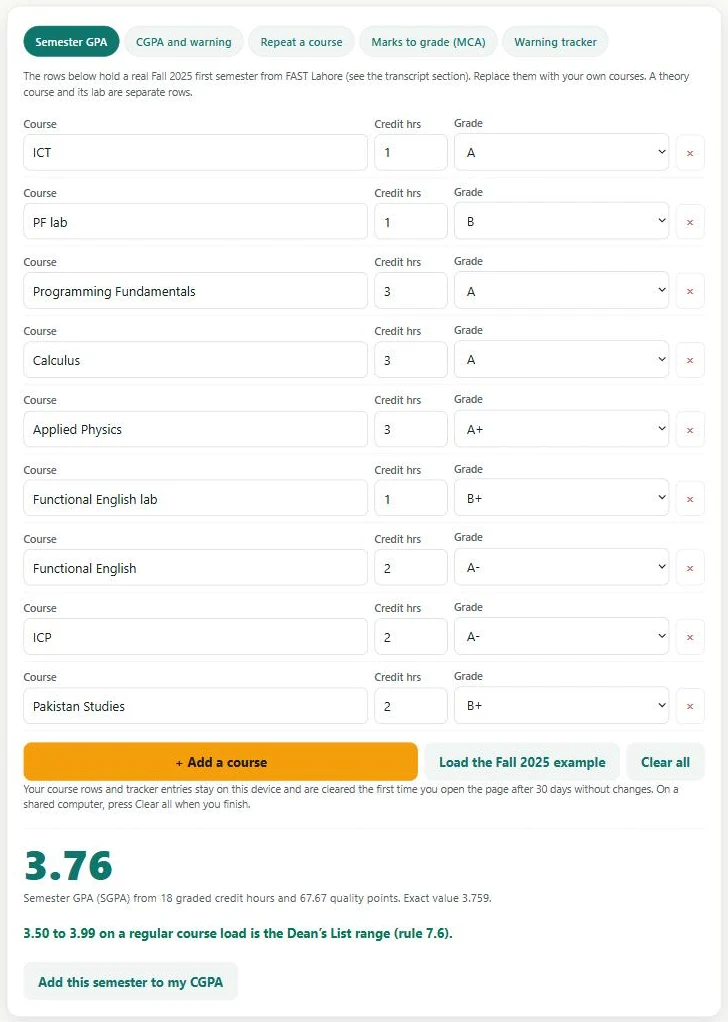
The A+ in Applied Physics earned no more than the A’s did. And the 1-credit lab B pulled the GPA down far less than a 3-credit B would have, because each course weighs by its credit hours.
When I loaded these grades myself, the two 1-credit labs (B and B+) cost 1.67 quality points against straight A’s. That is more than the 1.34 lost to the 2-credit B+ in Pakistan Studies.
Absolute or relative: read your course outline first
FAST lets each instructor grade a course in one of two ways and state it in the course outline. You can have both kinds in the same semester. Before a grade is given, your course total is rounded to the nearest whole number.
Semester work normally makes up 50% of that total and the final exam the other 50% (rule 5.2). A different split needs the Dean of the Faculty’s approval (rule 5.3).
Under the absolute scheme, fixed marks decide the letter:
| Total (%) | Grade | Total (%) | Grade |
|---|---|---|---|
| 90 and above | A+ | 66 to 69 | C+ |
| 86 to 89 | A | 62 to 65 | C |
| 82 to 85 | A- | 58 to 61 | C- |
| 78 to 81 | B+ | 54 to 57 | D+ |
| 74 to 77 | B | 50 to 53 | D |
| 70 to 73 | B- | 49 and below | F |
So an absolute course total of 85.6 rounds to 86 and becomes an A, while 85.4 stays an A-.
Where these numbers come from: the absolute table and the MCA scheme below are from FAST’s grading policy in force since Spring 2020. The June 2026 rule book lists the letters and points but not these cut-offs.
The policy isn’t posted on nu.edu.pk today, so I read a copy that students share. The Fall 2025 Calculus case above is consistent with it, but your outline and Flex are what count.
How the MCA turns your marks into a grade
In a relatively graded course, Flex shows two averages for the course total: the class average and the modified class average (MCA). The MCA is the average after unusually high and low scores are removed with the interquartile-range method, so a few outliers can’t drag it around.
The rounded MCA sits in the middle of one grade, and every other grade spreads out from it in 5-mark steps:
- MCA below 50: the middle grade is C+.
- MCA from 50 to 64: the middle grade is B-.
- MCA of 65 or more: the middle grade is B.
Five limits sit on top of the steps. A total of 50 is always a pass, and 90 is always at least an A.
An A below 65 needs the Head of Department’s approval, and so does a pass below 30. If the MCA is below 40 or above 75, the HoD reviews the course for possible changes. The policy also says it does not use standard deviation, so a “Z-score” FAST calculator is applying the wrong method.
| MCA | C+ from | B from | A- from | A from | A+ from | F at |
|---|---|---|---|---|---|---|
| 40 (hard paper) | 38 | 48 | 58 | 65 | 70 | 29 or less |
| 53 | 46 | 56 | 66 | 71 | 76 | 29 or less |
| 68 (easy paper) | 56 | 66 | 76 | 81 | 86 | 35 or less |
These three rows are from the policy’s own examples. I tested the “Marks to grade” tab against all seven of its example rows (MCA 40, 46, 53, 59, 68, 75 and 84), and every starting mark matched.
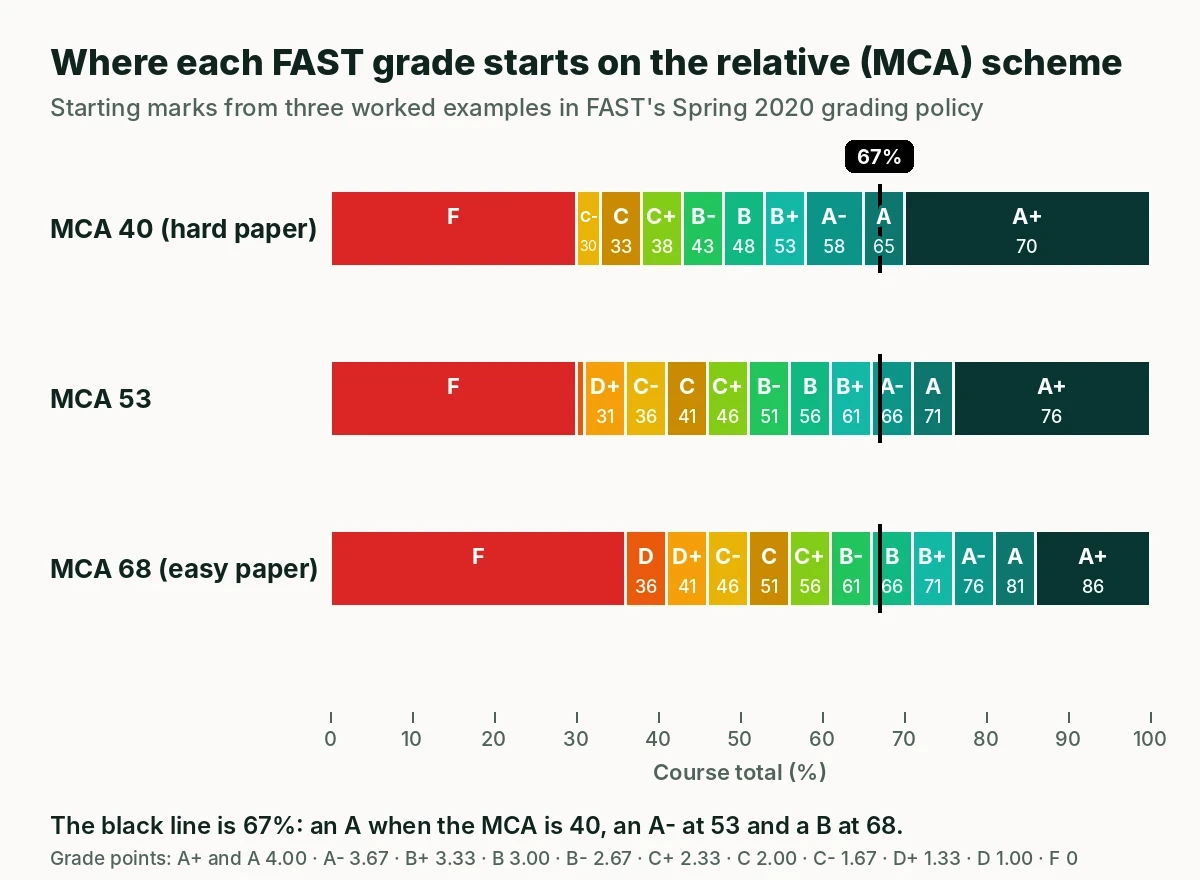
The same 67% is an A when the MCA is 40, an A- at 53 and only a B at 68. If your instructor announces relative grading, your distance from the MCA matters more than any fixed number.
Repeating a FAST course can lower your CGPA
You might expect a repeat to keep your better grade. FAST doesn’t. Rule 2.7 says that for a repeated course, only the most recent grade points are used, even if they are lower than the earlier attempt.
Take a student on a 2.10 CGPA over 52 credit hours who repeats a 3-credit B- hoping for better and ends up with a C. The CGPA falls to about 2.06. Had the new grade been an F, it would drop to 1.95, and that is a warning. The “Repeat a course” tab shows the effect before you register.
A failed or missed course has to be registered again in the next semester it is offered (rule 5.8).
Four more repeat rules from the 2026 book:
- Taking a different course does not erase an F. If you pass a new course in place of the one you failed, both grades count in your CGPA (rule 5.11). Repeating the same course is what replaces the F.
- Formal course replacement is narrow. It needs the Dean’s approval and applies only when you are finishing your degree and the F course is no longer offered. The replacement must also have been passed at least a semester after the F. A core course can never be replaced (rules 4.27 and 4.28).
- Repeating a course whose follow-up you already passed is risky. You sign an undertaking that if you fail the repeat, the later courses’ grades turn into F too (rule 5.10).
- Theory and lab go together. Fail the theory and you repeat both parts, even if you passed the lab. Fail only the lab and only the lab is repeated. To improve a course you passed, you register for both parts (rules 4.5 to 4.9).
Summer isn’t open to everyone. Rule 6.1 limits it to students on a first or second warning, graduating students, and those who need summer credits for FYP-I or a prerequisite for a Fall course.
Summer is for repeats only, in courses you already have a letter grade in (rules 6.2 and 6.3). You can take at most two, plus their labs (rule 6.6). Attendance must be 80%, and there is no scholarship or fee concession (rules 6.7 and 6.10).
A summer course runs only if at least 10 students register (rule 6.11). Taking it at another campus needs the Director’s written permission, and only when your own campus isn’t offering it (rule 6.13).
Warning count: from one to a closed admission
FAST checks your CGPA at the end of every semester, summer included (rule 5.5); its grading page adds that this starts from the first semester. If it ends below 2.00, you get an academic warning and your warning count goes up by one.
If the CGPA stays below 2.00 for three semesters in a row, the count reaches three and the university closes your admission automatically (rules 5.4 to 5.6).
After a closure, you can come back only by passing the admission test again and starting as a new student (rule 3.15). Rule 3.17 allows that readmission only once.
One semester ending at 2.00 or above after a first or second warning resets the count to zero (rule 5.7). That is why the tracker tab asks for every semester in order, summer included.
The rule book files this under “Academic Warning/Probation”. While you are under warning, rule 4.4 changes how you register:
- You must register again for every course with an F, if it is offered.
- You should register again for courses with D, D+ or C-.
- You shouldn’t take more than five courses, and your parents or guardian are called in to meet the Head of Department.
- On a second warning, you can’t register for a new course unless the HoD recommends it and the Controller of Examinations approves.
A warning also blocks the final-year project. To register for FYP-I, your warning count must be zero and you must have passed every course in your study plan up to the second-last semester (rule 4.11).
FAST’s grading web page words the repeat duty more strictly than the 2026 book. It says students under warning must repeat passed courses graded below the minimum CGPA. The academic rules in FAST’s 2024 prospectus say they should.
If you are under warning, ask your academic office which wording your department applies. MS and MBA students face warnings below 2.50, and PhD students below 3.00.
FA, I and W: how each one affects your CGPA
FA is treated as a fail: it is worth 0.00 and counts in your GPA like an F.
FAST expects 100% attendance. The Head of Department may excuse up to 20% of absences for genuine reasons such as illness. Miss more, and you are barred from the final and given FA (rules 1.21 and 1.22). “Below 80% means FA” is the short version, but the 20% is a ceiling on excused absences, not an allowance.
Rule 2.10 gives FA a second meaning: a student who doesn’t appear in the final exam. Either way it is 0.00.
I (incomplete) is a temporary grade for unfinished work. If it isn’t changed to a letter grade in time, it turns into an F (rule 2.9); FAST’s grading page puts the limit at the end of the next semester.
A missed exam can be retaken only for listed reasons, such as hospitalisation, a death in the immediate family or an ISSB date clash. The documents go in on Flex (section 9). Coughs and colds, minor injuries, a cousin’s wedding and more than five earlier retake requests don’t qualify.
W (withdrawn) shows on the transcript but doesn’t touch your CGPA (rule 2.8).
The fee isn’t refunded, a parent or guardian must countersign the request, and first-semester students can’t withdraw except in unavoidable cases approved by the Director. The deadline is the last day of the makeup week (rules 4.22 to 4.25). Students on any financial support can’t withdraw at all (rule 4.26).
Dropping a course is a separate step. It is allowed only in the first two weeks with the HoD’s approval, and not in your first semester or in summer (rules 4.19 to 4.21).
Dean’s List, medals and Latin honours
| Recognition | What it takes | Rule |
|---|---|---|
| Rector’s List | SGPA 4.00 with at least 30 credit hours, on a regular course load | 7.3 to 7.5 |
| Dean’s List | SGPA from 3.50 to 3.99 on a regular course load | 7.6 to 7.8 |
| Semester position medal (top 3 in the department) | Semester GPA of 3.00 or more; no F, repeat or withdrawal that semester; exactly the prescribed credit hours | 7.9 to 7.12 |
| Graduation medals (gold, silver, bronze) | Top three positions in the degree programme at your campus, with a CGPA of at least 3.00 | 7.1 |
| Summa / magna / cum laude | CGPA 3.90 or more / 3.75 to 3.89 / 3.60 to 3.74 | 7.2 |
You may see a Dean’s List cut-off of 3.67 elsewhere online. FAST’s own rule says 3.50. Rule 7.3 doesn’t say how 30 credit hours fit into one semester, so check with your campus before counting on the Rector’s List.
None of the FAST documents I read gives a CGPA-to-percentage formula. If a form asks for a percentage, ask the office that wants it which conversion it accepts, or use the methods compared on the marks and CGPA percentage calculator.
Disputing a FAST grade: 14 days on Flex, 7 for rechecking
Your answer book is shown to you in a scheduled paper-viewing session. Objections to the marking go in writing (rules 5.17 and 5.18).
If you think a grade is wrong, you start a grade change request from your own Flex account within 14 days of the final grade being generated. The instructor can update marks and send a proposed grade to the Head of Department, who approves or rejects it (Faculty Handbook 2026, section IX).
A formal recheck of a final exam is a separate step. You apply on the prescribed form with the fee, and the application must reach the Examination Office within seven days of the result (rules 5.19 to 5.21).
You can ask for a recheck even if you skipped paper viewing, and the fee is refunded if your marks go up (rules 5.24 and 5.25).
FAST students also ask
Is an A+ worth more than an A at FAST?
No. Both carry 4.00 grade points (rule 2.3). An A+ shows on your transcript and marks the top of the class, but your SGPA is the same either way.
What is the passing percentage at FAST?
On the absolute scheme, 50% gives a D, the lowest pass for BS students. On the relative scheme, 50% is always a pass, and the policy allows a pass below 50 when the MCA is low.
Does FAST use standard deviation for relative grading?
No. The Spring 2020 grading policy says standard deviation isn’t used, because marks are rarely bell-shaped. Grades are spaced in 5-mark steps around the MCA instead.
Can I graduate with D grades on my transcript?
Yes, if each course is passed and your CGPA is at least 2.00 (rule 1.25). D is a passing grade, so a minimum of C in every course is not a FAST rule for BS students.
Can I calculate my CGPA by averaging my semester GPAs?
Only if every semester had the same credit hours. Otherwise weight each semester by its credit hours, which is what the CGPA tab does. If you repeated a course, use the Repeat tab, because only the latest attempt counts.
What SGPA do I need to clear a FAST warning?
Put your CGPA, its credit hours and 2.00 as the target in the CGPA tab. From 1.80 over 40 credit hours, 17 new credit hours need an SGPA of about 2.47. If 3 of those 17 are a repeated F, you need about 2.12, because the F leaves your CGPA (rule 2.7).
How long do I have to finish a FAST bachelor’s degree?
At least four years (eight regular semesters) and at most six. One more year is possible only with the approval of the university’s statutory bodies (rule 1.23).
FAST rule books and PDFs I read for this page
- Undergraduate Academic Rules and Regulations 2026 (PDF), dated June 2026:
- attendance (1.21 to 1.25) and grading (2.1 to 2.11)
- readmission (3.15 to 3.17), registration under warning and theory/lab (4.4 to 4.11), add/drop, withdrawal and replacement (4.19 to 4.28)
- assessment, warnings and repeats (5.1 to 5.11), rechecking (5.19 to 5.25)
- summer (section 6), honours (section 7) and retakes (section 9)
- Faculty Handbook 2026 (PDF), dated June 2026: section IX, final result and change of grade.
- FAST academic grading page: MS, MBA and PhD grade floors and minimum CGPAs.
- NUCES Grading Policy with effect from Spring 2020 (copies shared by students on Scribd and Studocu): the absolute table, the MCA scheme and its seven worked examples.
Testing the calculator and settling conflicts
- I read the grading, registration, assessment, summer, honours and retake sections of the 2026 rule book page by page, plus section IX of the faculty handbook.
- The FAST GPA calculator passed 102 automated checks: 55 on the formulas and 47 on the page itself. They cover the Fall 2025 transcript (3.76), all seven MCA rows of the 2020 policy, repeats that lower a CGPA and the rule 5.11 case.
- They also cover warning counts with resets and closure, target CGPAs, credit hours outside 1 to 4, and rounding edges such as 89.5 and 49.5.
- Where FAST’s documents differ, the page shows both. That covers the warning repeat rule (web page against rule 4.4) and the meaning of FA (rule 1.22 against rule 2.10). The faculty handbook’s points table also leaves out C-, which the student rule book lists at 1.67.
AI tools helped draft this page and the calculator. Every rule and example was checked against the documents listed above, and I checked rules 2.3 and 2.7 in the PDF myself.
Update log
- 16 November 2026: Page written from FAST’s June 2026 rule book, Faculty Handbook 2026, grading web page and the Spring 2020 grading policy. Calculator tested on a real Fall 2025 transcript.
- 16 November 2026 (later): Fixed credit-hour handling and repeat guidance in the calculator; added summer eligibility, the MCA review band, FA under rule 2.10, rule 5.8 and the retake exclusions. Added the target CGPA tool, readmission (3.15, 3.17) and recheck refunds (5.24, 5.25).
I’ll recheck this page by 15 February 2027, or as soon as FAST posts a new rule book. The wider process is on how PakCalc keeps calculators accurate.
If your CGPA sits comfortably above 2.00, the semester tab of the FAST GPA calculator is all you need. If it is close, run the repeat tab before you register a retake, because at FAST a weaker second attempt replaces the first.
If you are still applying to FAST rather than studying there, the FAST aggregate calculator is the one you need. The GPA calculator for other Pakistani universities compares FAST’s scale with theirs.
About the author
Disclaimer: results on this page are estimates for information only, not official results or advice. Your Flex record and transcript are final. See our Disclaimer. Spotted an error? Contact us.
Related calculators
- EducationAir Uni Aggregate Calculator 2027 (Air University Merit)Your Air University aggregate on both AU formulas, the AU-CBT score you need, and each campus’s exemption rules.Open calculator →
- EducationBahria University GPA Calculator and Grading System 2026GPA, CGPA and probation on Bahria’s Spring 2026 handbook, with the MS scale, a final-exam planner and repeat versus honours.Open calculator →
- EducationIIUI GPA Calculator for BS, MS and PhD StudentsGPA, CGPA and probation lines on IIU Islamabad’s rules for BS, MS and PhD, with a terminal-marks planner and repeat outcomes.Open calculator →
- EducationUET GPA Calculator for Lahore, Taxila and PeshawarGPA, CGPA, repeats and probation on UET Lahore, Taxila and Peshawar rules, tested on a real 140-credit-hour UET Lahore transcript.Open calculator →