Home › Education › FAST Aggregate Calculator 2027: All Programmes
FAST Aggregate & Merit Calculator 2027
By Shehrooze Butt, independent publisher and researcher | Last updated | Sources checked 22 October 2026 | Unofficial tool
It is easy to assume the entry test decides a FAST-NUCES admission. For engineering it carries only a third of your merit, while your FSc carries half.
Pick Computing, Business or Engineering below and put in your marks. You’ll get the aggregate FAST itself would work out, using the weights from its own eligibility page, and if you have a target merit in mind, the test score it would take to get there.
Important: FAST sets its cut-off marks itself and does not publish a fixed closing merit. Your aggregate is an estimate, not an offer.
Programme group
Matric / SSC or O-Level (IBCC)
HSSC: Part I + II, Part-I only, or A-Level (IBCC)
If your Part-II result is not out, enter Part-I marks and the Part-I total (often 550). FAST uses your full result once it is available.
Admission test
Enter your FAST test score as a percentage (out of 100), or your NAT or SAT score and its total. FAST does not publish how it converts SAT or NAT scores, so treat those results as a rough guide. Not taken the test yet? Leave it empty, add a target below, and the calculator shows the test score you need.
Optional: target aggregate
Computing, Business or Engineering: which FAST formula is yours
FAST-NUCES (the National University of Computer and Emerging Sciences) splits its bachelor programmes into three groups on its eligibility criteria page. Two groups share a formula.
| Group and degrees | Merit formula | Minimum marks |
|---|---|---|
| Computing: AI, Computer Science, Cyber Security, Data Science, Software Engineering | Test 50% + HSSC 40% + SSC 10% | SSC 60%, HSSC 50% |
| Business: BBA, Accounting and Finance, Business Analytics, Financial Technology | Test 50% + HSSC 40% + SSC 10% | SSC 60%, HSSC 50% |
| Engineering: Civil, Electrical, Computer Engineering | Test 33% + HSSC 50% + SSC 17% | SSC 60%, HSSC 60% |
Engineering = 0.33 × test % + 0.50 × HSSC % + 0.17 × SSC %
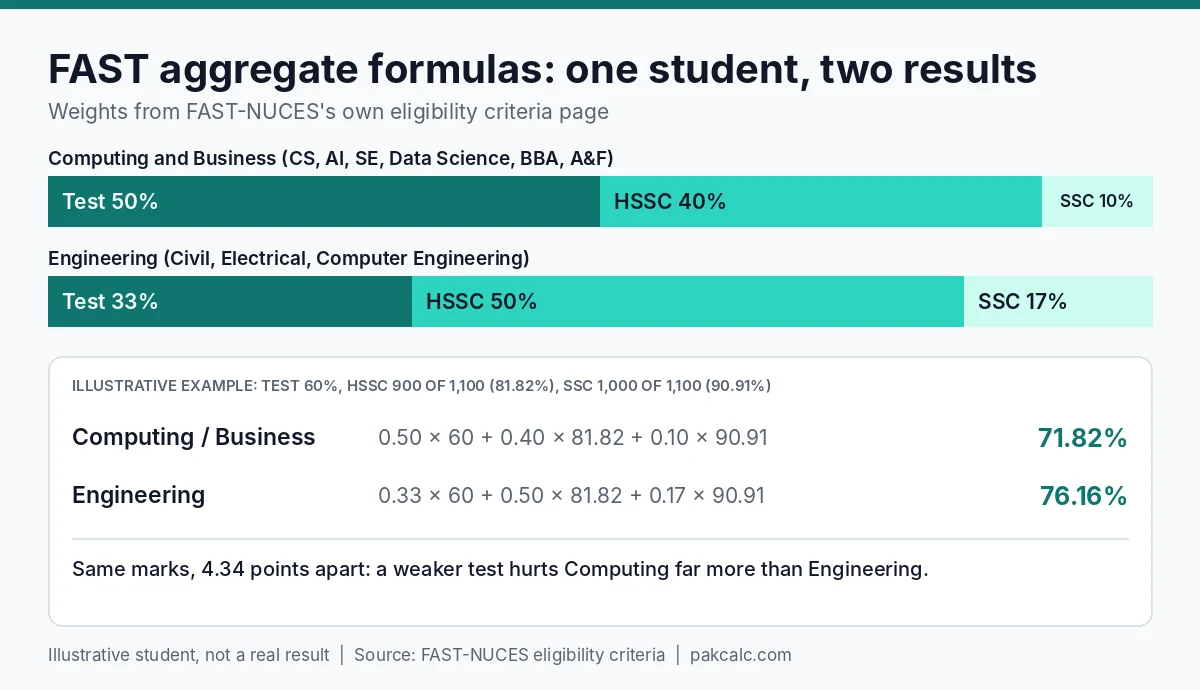
For Engineering, your HSSC must be Pre-Engineering (Physics, Chemistry, Maths) or ICS (Computer Science, Maths, Physics). Computing needs Maths at HSSC level, and pre-medical students who passed additional Maths can apply. FAST's page was last updated on 10 August 2026.
Why your FSc matters more in Engineering
The weights decide how much each extra percent is worth. A result with a 50% weight adds half a point for every percent you gain in it.
| 1 extra percent in | Computing / Business | Engineering |
|---|---|---|
| Admission test | +0.50 points | +0.33 points |
| HSSC | +0.40 points | +0.50 points |
| SSC | +0.10 points | +0.17 points |
So in Computing, a good test day pulls your aggregate up the most. In Engineering, your FSc does. That can flip who gets in first.
Two imaginary students, both with 85% in SSC:
- Student A: HSSC 90%, test 55%. Engineering gives 77.60. Computing gives 72.00.
- Student B: HSSC 75%, test 70%. Engineering gives 75.05. Computing gives 73.50.
Student A ranks above B in Engineering but below B in Computing, and neither student's marks change. If your FSc is strong and your test went badly, Engineering's formula is kinder to you. If your test was your best result, Computing and Business reward it more.
These students are made up for illustration. Try both formulas with your own marks in the FAST aggregate calculator above: it shows the other formula's result under your own.
What the FAST admission test covers
FAST lists two bachelor test patterns on its test pattern page. The share of each section is below.
| Section | CS and Engineering | BBA and business BS |
|---|---|---|
| Advanced Maths | 50% | None |
| Basic Maths | 20% | 50% |
| Analytical skills and IQ | 20% | 25% |
| English | 10% | 10% |
| Essay writing | None | 15% |
- Format: taken on a computer, and lasts two to three hours, according to FAST's how to apply page.
- Your result: a summary appears on screen at the end of the test. Results also go on the admission portal.
- Negative marking: yes. FAST does not state the penalty for each wrong answer.
- Calculators: not allowed. Bring only your admit card.
- Not published: the number of questions, and official sample papers. FAST's site gives only the section breakdown above.
Half of the CS and Engineering paper is advanced Maths. For Computing, where the test is worth 50% of merit, that one section works out to about a quarter of your whole aggregate. If you have time for only one thing before the test, make it Maths.
FAST test, NAT or SAT: which one to submit
For each programme group you choose one test option. FAST does not accept NTS tests held for a specific university.
| Group | Tests accepted |
|---|---|
| Computing | FAST test, SAT, NTS NAT-IE or NAT-ICS |
| Business | FAST test, SAT, NTS NAT-IE, NAT-ICS, NAT-ICOM or NAT-IGS |
| Engineering | FAST test, SAT or NTS NAT-IE |
- NAT age: FAST's 2026 prospectus accepts NTS NAT only if you took it in the previous six months.
- SAT conflict: the eligibility page lists SAT for every group, but the 2026 prospectus says SAT is for students who live abroad. Ask FAST before you rely on SAT from inside Pakistan (contacts below).
- Score conversion: FAST does not publish how SAT or NAT scores become a test percentage. The calculator above treats your score as obtained ÷ total, which may differ from FAST's method.
Part-I, complete HSSC or IBCC: which marks count
FAST goes down this list and uses the first one that fits you when it makes the merit list.
- HSSC Part-I and Part-II marks together.
- HSSC Part-I marks, if the Part-II result is not out.
- The percentage on your IBCC equivalence certificate, for A-Level.
- The percentage on your IBCC equivalence certificate, for O-Level.
You can apply while waiting for your result. FAST then gives provisional admission, which it cancels if your final marks miss the minimum.
Fees, campuses and last year's schedule
From FAST's 2026 prospectus:
| Fee item | Amount |
|---|---|
| Application processing fee | Rs 3,000 |
| Each additional campus | Rs 500 |
| Each additional type of admission test | Rs 500 (each type can be taken once) |
The fee is non-refundable. Applications are online only, at admissions.nu.edu.pk. FAST has campuses in Islamabad, Lahore, Karachi, Peshawar, Chiniot-Faisalabad and Multan.
FAST has not yet published dates for 2027. Its 2026 schedule gives a guide to the usual pattern:
| Step | 2026 dates (undergraduate) |
|---|---|
| Applications | 20 May to 30 June |
| Admission tests | 29 June to 10 July |
| Merit list | 22 July |
What a FAST degree costs over four years
FAST has no fixed semester fee. You pay per credit hour, so the total depends on your programme. From FAST's fee structure (effective Fall 2026):
- Tuition: Rs 12,000 per credit hour, for BBA and all BS programmes.
- Admission fee: Rs 30,000, paid once.
- Security deposit: Rs 20,000, refunded when you finish or leave.
- Student Activities Fund: Rs 2,500 per semester.
Adding these to each programme's required credit hours gives an estimate of the four-year cost:
| Programme | Credit hours | Estimated 4-year total |
|---|---|---|
| BS Computer Science | 134 | Rs 16,58,000 |
| BBA | 136 | Rs 16,82,000 |
| BS Electrical Engineering | 140 | Rs 17,30,000 |
Total = Rs 30,000 + (credit hours × Rs 12,000) + (8 × Rs 2,500)
For BS Computer Science, that works out to about Rs 2,03,500 a semester on average. This is our own calculated estimate, not a FAST figure. It leaves out the refundable deposit, hostel, transport and retakes, and it assumes today's rate stays the same, which it may not.
Retakes cost more than fees at FAST. Once you are enrolled, a repeated course keeps its newest grade even if it is lower, which the FAST GPA and CGPA calculator lets you check before you register.
FAST also offers need-based aid, interest-free loans and merit scholarships; see its scholarships page.
The same marks at NUST, ITU and QAU
If FAST is not the only university on your list, this part is for you. Take one imaginary student with SSC 85%, HSSC 90% and 55% in the test, and run those marks through each formula.
| University and formula | Aggregate |
|---|---|
| NUST (NET 75%) | 63.25 |
| ITU, BS CS (test 50%) | 71.75 |
| FAST Computing (test 50%) | 72.00 |
| FAST Engineering (test 33%) | 77.60 |
| QAU, BS (no test) | 88.50 |
A student whose test was the weak spot looks far stronger under FAST Engineering than under NUST. Each university has its own tests and cut-offs, so compare formulas this way, not your chances. Run your own marks through every formula at once in our aggregate calculator, or see the NUST aggregate calculator for NET details. Sitting ECAT as well? Our UET aggregate calculator covers UET Lahore, Taxila and Peshawar.
Does FAST publish its closing merit?
Not on the admission pages checked for this article. FAST says it sets the merit cut-off marks itself, and none of its eligibility, schedule, FAQ or prospectus pages gives a closing-merit table. Figures you see on prep sites, such as a single "CS Islamabad" cut-off, come without an official source. Treat them as rumours, not targets.
FAST's admission pages also do not say how many merit lists it runs, or how many days you get to pay the fee after selection. Watch the admission portal and your email closely once the first list is out.
A better plan is to push your aggregate as high as your marks allow and apply to more than one campus. An extra campus costs only Rs 500. When FAST puts out its merit list, check where you actually stand.
FAST admission office contacts
For questions this page cannot answer, such as SAT from inside Pakistan or how NAT scores are converted, ask FAST directly. These contacts are listed on FAST's admissions FAQ.
| Campus | Phone | |
|---|---|---|
| General | admissions@nu.edu.pk | 111-128-128 |
| Islamabad | admissions.isb@nu.edu.pk | (051) 111-128-128 |
| Lahore | admissions.lhr@nu.edu.pk | (042) 111-128-128 |
| Karachi | admissions.khi@nu.edu.pk | (021) 111-128-128 |
| Peshawar | admissions.pwr@nu.edu.pk | (091) 111-128-128 |
| Chiniot-Faisalabad | admissions.cfd@nu.edu.pk | (041) 111-128-128 |
| Multan | admissions.mtn@nu.edu.pk | (061) 111-128-128 |
Frequently asked questions
How is the FAST aggregate calculated?
Turn your test, HSSC and SSC results into percentages. For Computing and Business, add 50% of the test, 40% of HSSC and 10% of SSC. For Engineering, add 33% of the test, 50% of HSSC and 17% of SSC.
Is the FAST merit calculator the same for BBA and CS?
The weights are the same (50/40/10), but the tests differ. The BBA test has more basic Maths and an essay, while the CS and Engineering test is half advanced Maths. The minimum HSSC mark is 50% for both.
Can I apply to FAST with Part-I marks?
Yes. If your Part-II result is not out, FAST uses your Part-I marks. It switches to your full result once it is available, and admission stays provisional until then.
Can I apply to more than one FAST campus?
Yes. Each additional campus adds Rs 500 to the Rs 3,000 application fee. Campuses are Islamabad, Lahore, Karachi, Peshawar, Chiniot-Faisalabad and Multan.
How much does a FAST degree cost?
Tuition is Rs 12,000 per credit hour from Fall 2026, plus a Rs 30,000 admission fee and Rs 2,500 per semester for student activities. For a 134-credit-hour BS Computer Science, that is roughly Rs 16.6 lakh over four years, by our estimate.
Is PakCalc an official FAST tool?
No. PakCalc is independent and not affiliated with FAST-NUCES. Results are estimates, and FAST decides official merit.
FAST pages this calculator is based on
All sources were checked on 22 October 2026. FAST updates its pages each cycle, so confirm with FAST before you apply.
- FAST eligibility criteria (updated 10 August 2026)
- FAST admission test pattern
- FAST admission schedule (updated 21 October 2026)
- FAST admissions FAQ (campuses, tuition, contacts)
- FAST how to apply (test format and length)
- FAST 2026 prospectus, admission information (application fees, NAT and SAT rules)
- FAST fee structure (tuition and fees from Fall 2026)
- FAST programme pages for credit hours: BS(CS), BBA, BS(EE)
Applying to COMSATS as well? Its merit formula gives the NTS test half of your aggregate, far more than FAST gives its own test for engineering. See how these calculators are checked.
Written with AI assistance for research and drafting. FAST's formulas, test-score rules and fees were each checked against FAST's own admission pages before they went into the calculator.
Change log: 22 October 2026, first version.
About the author
Disclaimer: this page is for information only. Results are estimates, not official results or advice. See our Disclaimer. Spotted an error? Contact us.
Related calculators
- EducationAir Uni Aggregate Calculator 2027 (Air University Merit)Your Air University aggregate on both AU formulas, the AU-CBT score you need, and each campus’s exemption rules.Open calculator →
- EducationBahria University GPA Calculator and Grading System 2026GPA, CGPA and probation on Bahria’s Spring 2026 handbook, with the MS scale, a final-exam planner and repeat versus honours.Open calculator →
- EducationIIUI GPA Calculator for BS, MS and PhD StudentsGPA, CGPA and probation lines on IIU Islamabad’s rules for BS, MS and PhD, with a terminal-marks planner and repeat outcomes.Open calculator →
- EducationUET GPA Calculator for Lahore, Taxila and PeshawarGPA, CGPA, repeats and probation on UET Lahore, Taxila and Peshawar rules, tested on a real 140-credit-hour UET Lahore transcript.Open calculator →