Home › Education › PU Merit Calculator 2027 (Punjab University Aggregate)
PU Merit Calculator 2027 (Punjab University Aggregate)
By Shehrooze Butt, independent publisher and researcher | Last updated | Sources checked 27 October 2026 | Unofficial tool
Some PU merit calculators say Matric counts 25%. Others say 15%. Both are partly right, and that is the problem: Punjab University does not give Matric a fixed weight at all. It adds a quarter of your Matric marks to your Intermediate marks, so Matric’s share changes with the totals you enter.
Everything in the PU merit calculator below is taken from the University of the Punjab’s 2026-27 admission regulations, programme type by programme type, engineering, LLB, BS 5th semester and M.Phil included. Once you have your merit, it sets it against the 2026 lists PU published for 249 programmes and shows the test marks you’d need.
Important: your merit is an estimate, not a seat. PU’s departments calculate the final figure themselves before each merit list.
Punjab University merit calculator
Programme type
Matric / SSC
O-Level students: enter the marks on your IBCC equivalence certificate.
Intermediate (FA / FSc / ICS / I.Com)
If your Part-II result is not out when you apply, PU uses your Part-I marks. Then enter your Part-I marks and Part-I total (often 550, but check your result card).
BA / BSc / Associate Degree
Semester-system graduates: PU multiplies graduate marks by 0.85 (AIOU by 0.75) before merit. Enter the converted figure if that applies to you.
PU admission test
Copy both numbers from your result. Not taken the test yet? Leave the marks empty and the calculator shows the score each target needs.
Department test / interview
College of Art & Design programmes add their own drawing test, portfolio or interview. Leave empty if you do not have it yet.
Extra marks and late years
Elective, diploma and I.Com marks depend on the department (see the table below the calculator). Late sessions do not apply to self-supporting, replica, afternoon or evening programmes, which have no session limit.
Optional: target and 2026 comparison
Picking a programme also switches the formula above when the programme uses a different one.
Your degrees
Research, experience, test and interview
Departments decide how experience counts. Some value only experience in the relevant field.
How PU calculates merit (and why calculators disagree)
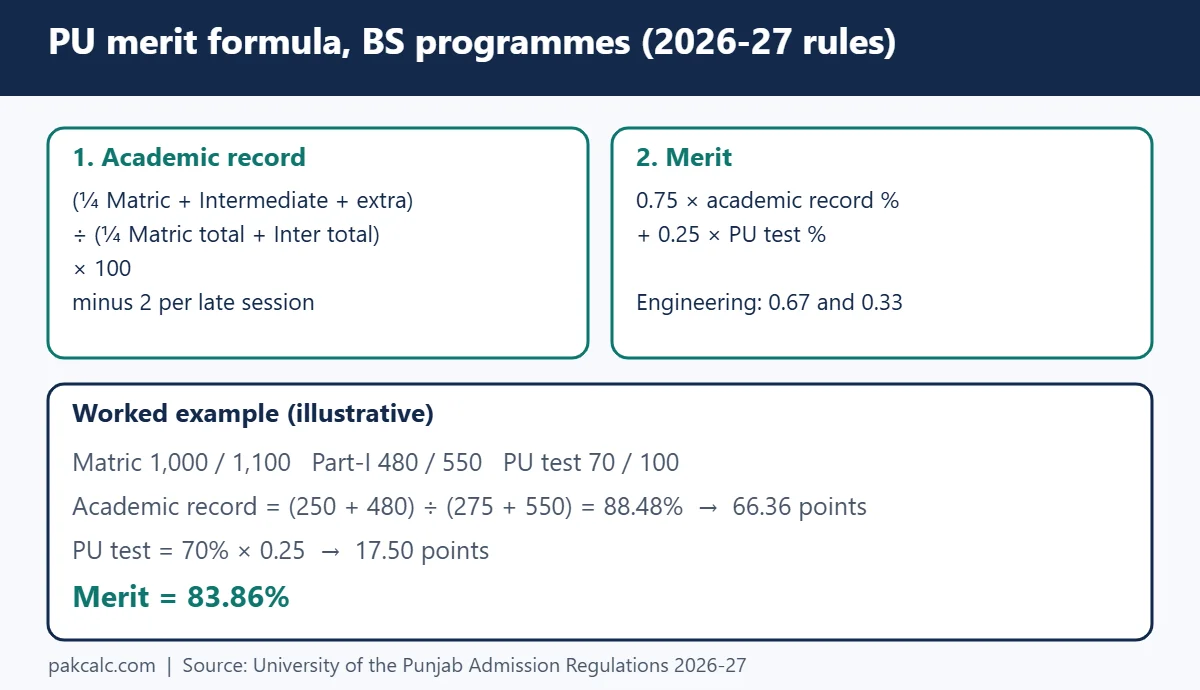
PU’s Admission Regulations 2026-27 build your merit in two steps. First comes the academic record, which PU calls “Formula A” for BS programmes:
Academic record % = (¼ of Matric marks + Intermediate marks + extra marks) ÷ (¼ of Matric total + Intermediate total) × 100
Then the academic record and the admission test are weighted. For most BS programmes, the PU merit formula is 75% academic and 25% test:
Merit = 0.75 × academic record % + 0.25 × test %
Because Matric enters as a quarter of its marks, its real share depends on your Intermediate total. That is why some pages quote 25/50/25 and others 15/60/25:
| Your totals | Matric’s real share | Intermediate’s real share |
|---|---|---|
| Matric 1,100 + Part-I 550 (provisional) | 25% | 50% |
| Matric 1,100 + full Intermediate 1,100 | 15% | 60% |
The test keeps its 25% in both cases. So a “25/50/25” calculator is right only for Part-I students, and a “15/60/25” one only for students with the full result. Entering your actual marks and totals, as this calculator does, gives the right figure in both cases.
PU calls the result “merit”, while most universities call it an aggregate. So a PU aggregate calculator and a PU merit calculator do the same job, as long as they use PU’s formula.
We checked our formula against PU’s own basic merit calculator. The same marks gave the same result: 84.14 for a BS 1st-semester example and 68.34 for a BS 5th-semester one.
Which formula your programme uses
Most programmes follow the 75/25 rule, but the regulations list several exceptions. These weights come from the programme pages of the 2026-27 regulations:
| Programme | Academic record | Tests and interviews |
|---|---|---|
| Most BS 1st semester, FCIT (CS, SE, IT, AI, Data Science), Pharm-D, IBA BBA, BBIT, Hailey College | 75% | PU test 25% |
| B.Sc. Engineering (Electrical, Chemical, Energy, Metallurgy, Industrial) | 67% | Entry test 33% (ECAT, NUST test or PU-E / PU-M / PU-CSP) |
| LL.B. 4 years | 75% | PU test 25% (LAT is only an eligibility condition) |
| Most BS 5th semester, BBA 5th semester | 100% | None |
| BFA Fine Arts, Textile, Graphic Design, Sculpture | 25% | PU test 25% + drawing test or interview 50% |
| B.Arch | 50% | PU test 10% + department test 20% + interview 20% |
Three details change real results:
- Engineering. The regulations list “Basic” admission criteria with a 67% academic weight, which we read as the same Formula A. Electrical Engineering also asks for at least 33% in the entry test, and every engineering programme needs 60% in FSc, ICS, DAE or A-Level.
- Pharm-D. PU’s Jhelum Campus notice for 2026-27 accepts either MDCAT or the PU test. Eligibility is FSc Pre-Medical with 60%.
- LL.B. You need a valid HEC Law Admission Test (LAT) pass with 50%, but LAT marks do not enter the merit. The PU test does.
The PU admission test has seven categories: PU-E, PU-M, PU-AHS, PU-CSP, PU-CSS, PU-GS and PU-COM. Last year’s PU test result does not count for a new admission.
Extra marks: Hafiz-e-Quran, electives and diplomas
Extra marks go into the top of Formula A, before the percentage is worked out. The total stays the same. With full Intermediate totals (1,100 + 1,100), 20 marks lift your academic record by about 1.5 points. With Part-I totals (1,100 + 550), they add about 2.4 points.
| Extra marks (as listed by PU) | Marks |
|---|---|
| Hafiz-e-Quran | 20 |
| Elective subject / Diploma | 20 each |
| Optional subject, Additional elective, Combination of subjects | 10 each |
| Additional optional subject | 5 |
| Any other (set by the department) | 5 to 10 |
Each department decides which of these apply. A few examples from the programme pages:
- LL.B. (University Law College): 25 marks for each FA or A-Level elective, up to two. The list includes Civics or Political Science, Philosophy, English Literature, Sociology, Law and Economics.
- IBA BBA: 40 marks for I.Com students, and 20 for each of Statistics, Mathematics or Economics as electives, up to 40.
- FCIT and most science departments: only the 20 Hafiz-e-Quran marks.
Hafiz-e-Quran marks need an authenticated certificate attached to your original application, and the department interviews you to confirm it. Without that, PU gives no credit, so tick the Hafiz box only once you are sure you can pass the check.
Part-I marks, gap years and the age limit
Part-I or full Intermediate? If your Part-II result is still awaited when you apply, PU admits you provisionally on your Part-I marks. The admission is cancelled if you then fail to meet the eligibility rules in Part-II. Students whose full result is out use the full marks.
Gap years. PU deducts 2 marks from your academic record percentage for each late session, up to 5 sessions, and considers only the last five sessions. For the 2026-27 intake, PU’s admission instructions counted these as late:
| Late sessions | Intermediate exams (2026-27 intake) |
|---|---|
| 1 | 1st Annual 2025 and 2nd Annual 2024 |
| 2 | 1st Annual 2024 and 2nd Annual 2023 |
| 3 | 1st Annual 2023 and 2nd Annual 2022 |
| 4 | 1st Annual 2022 and 2nd Annual 2021 |
| 5 | 1st Annual 2021 and 2nd Annual 2020 |
For a 2027 intake, each row should move one year later, but PU has not published that table yet. Late candidates also sign an affidavit that they took no admission elsewhere in between.
The cut comes off the academic record, not the final merit. So one late session costs 1.5 points of final merit on a 75/25 programme, 1.34 in engineering and 2 in a 100% academic programme. We followed the regulations’ wording here. A department could also show the cut against the final figure.
Age. For regular programmes you must be 24 or younger on the closing date for BS, and 26 or younger for BS 5th semester. The Vice-Chancellor can relax this by up to 2 years for men and 5 years for women.
Self-supporting, replica, afternoon and evening programmes have no age limit and no session limit. Disabled students have no age limit either.
One test mark counts almost as much as three Part-I marks
By the time you sit the test, your board marks are fixed. The test is the part you can still move, so it helps to know its exchange rate. These figures come straight from the formula, for a test out of 100 and Matric out of 1,100:
| One extra mark in… | Adds to merit | Equal to |
|---|---|---|
| PU test (of 100) | 0.25 points | 1 test mark |
| Part-I (of 550) | 0.091 points | about 1/2.75 of a test mark |
| Full Intermediate (of 1,100) | 0.055 points | about 1/4.6 of a test mark |
| Matric (of 1,100), full-result student | 0.014 points | about 1/18 of a test mark |
Put simply, 4 test marks add a full point of merit. A full-result student would need about 18 more Intermediate marks to gain the same point.
PU closing merit 2026: what the lists show
PU publishes every merit list on its admissions portal. On 27 October 2026 we read the open-merit lists for every BS 1st-semester, engineering, LL.B. and Pharm-D programme listed there, 249 in total, and recorded the last merit on each list. The PU merit calculator above holds all 249. Here are popular morning programmes:
| Programme (campus) | 1st list closed | Lowest numbered list |
|---|---|---|
| BS Computer Science (New Campus) | 92.16% | 90.58% |
| BS Software Engineering (New Campus) | 91.36% | 89.29% |
| BS Data Science (New Campus) | 91.31% | 88.97% |
| BS Computer Science (Old Campus) | 90.94% | 89.20% |
| Pharm-D, morning (College of Pharmacy) | 89.05% | 88.34% |
| BS Clinical Psychology | 88.36% | 84.36% |
| BBA, IBA | 87.39% | 83.06% |
| BS Human Nutrition & Dietetics | 86.88% | 82.64% |
| BBIT | 86.45% | 83.71% |
| BS Biotechnology | 86.29% | 83.21% |
| LL.B., University Law College | 86.11% | 85.33% |
| BS Computer Science (Gujranwala) | 86.00% | 84.97% |
| B.Sc. Electrical Engineering | 85.96% | 80.71% |
| BS English, Institute of English Studies | 85.78% | 78.00% |
| BS Accounting & Finance, Hailey College | 84.65% | 82.89% |
| B.Sc. Chemical Engineering | 82.94% | 78.60% |
| LL.B. (Gujranwala) | 79.36% | 75.81% |
| BS Commerce, Hailey College | 73.35% | 69.04% |
Two patterns stand out. First, later lists usually close lower: Electrical Engineering ran to eight numbered lists and fell 5.25 points from the first. Second, PU’s own “Merit of Last Year 2025” document shows much lower figures for several of these programmes:
| Programme | PU’s 2025 figure | 2026 lowest numbered list |
|---|---|---|
| BS Computer Science (New Campus) | 87.18% | 90.58% |
| BBA, IBA | 81.79% | 83.06% |
| LL.B., University Law College | 81.56% | 85.33% |
| B.Sc. Electrical Engineering | 76.69% | 80.71% |
| BS Commerce, Hailey College | 60.25% | 69.04% |
| Pharm-D (morning) | 91.34% | 88.34% |
The 2025 document does not say which list its figures come from, so the two years are not a perfect match. Still, if you plan with 2025 numbers, you may think you are safer than you are. We suggest planning against the 2026 lists, then checking 2027 lists as they appear.
How to read these numbers. Each figure is the lowest merit printed on that open-merit list. Quota seats (sports, PU employees, overseas Pakistanis and others) have separate lists. Some programmes also ran “physical appearance” or waiting lists that went lower, which we left out because they depend on who turns up.
BS 5th semester merit
After a BA, BSc or two-year Associate Degree, PU uses “Formula B”:
Academic record % = (¼ Matric + ⅕ Intermediate + BA/BSc/ADP + extra) ÷ (the same three totals) × 100
Most BS 5th-semester programmes use the academic record at 100%, with no test. The regulations also allow a 70% academic weight where a department adds a test, so the calculator offers both. Your graduation marks carry most of the weight here, since Matric and Intermediate are scaled down.
- Half the seats go to Punjab University graduates and half to open merit.
- Semester-system graduates’ marks are multiplied by 0.85, AIOU graduates’ by 0.75, and three-year BA/BSc (Hons) marks by 0.90.
- You can apply on your ADP Part-I result if Part-II is awaited, but only if you passed the first year.
- Ties are broken by BA/BSc marks, then FA/FSc, then Matric, then age (older first).
MS and M.Phil merit at PU
For MS, M.Phil, LLM and Ph.D, PU uses a 100-mark scheme instead of a percentage formula:
| Part | Marks |
|---|---|
| Academic qualifications | 40 |
| Publications in HEC-approved journals (1 each) | 5 |
| Relevant professional experience (1 per year) | 5 |
| Subject written test | 40 |
| Interview | 10 |
The 40 academic marks come from fixed bands. For a 16-year applicant, Matric, FA/FSc and BA/BSc each earn marks by percentage:
| Percentage | Marks per degree |
|---|---|
| 45% | 2 |
| 50% | 4 |
| 55% | 5 |
| 60% | 7.5 |
| 70% | 8.5 |
| 80% or more | 10 |
A four-year BS counts double. It earns 10, 12, 15, 17 or 20 marks at a CGPA of 2.5, 2.7, 3.0, 3.4 or 3.8. Below 45% or a 2.5 CGPA, a degree earns zero. If your BS is from UAF, get your exact CGPA from the UAF quality point table before you work out these marks. Ph.D applicants are scored on a separate 18-year table, which the calculator also follows.
You also need at least 50% in the written test and 50% in the interview, separately. Ph.D applicants need 60% in the test. There is no late-year deduction at this level. Choose “MS / M.Phil” in the PU merit calculator to work out your score.
Four made-up applicants, real PU numbers
These students are made up, but every number is calculated with PU’s formula.
1. Part-I applicant, BS Computer Science. Matric 1,000 of 1,100, Part-I 480 of 550, PU test 70 of 100. Academic record: (250 + 480) ÷ (275 + 550) = 88.48%, worth 66.36 points. The test adds 17.50, so merit is 83.86%.
To match the lowest 2026 list for Computer Science at the New Campus (90.58%), this student needed 97 of 100. The IBA BBA list (83.06%) needed only 67.
2. One gap year plus Hafiz-e-Quran. Matric 1,000 of 1,100, full Intermediate 940 of 1,100, test 70. A fresh applicant gets 82.41%. One session late, the merit falls to 80.91%. Adding the verified 20 Hafiz marks lifts it to 82.00%, so the Hafiz marks almost cancel the gap-year cut.
3. LL.B. with two electives. Matric 900 of 1,100, FA 820 of 1,100, PU test 60. Without electives, merit is 72.00%. With two eligible electives (+50 marks), the academic record rises to 79.64% and merit to 74.73%.
4. Engineering with ECAT. Matric 1,000 of 1,100, FSc 950 of 1,100, ECAT 260 of 400. Academic record 87.27% × 0.67 = 58.47, plus ECAT 65% × 0.33 = 21.45, gives 79.92%. Matching the lowest 2026 Electrical Engineering list (80.71%) needed about 270 of 400 in ECAT.
Rank, department add-ons and quota seats
- Your rank. Merit lists rank applicants. Your seat depends on how many people above you accept their offers.
- Department add-ons. Departments can add or subtract marks before the list, as PU notes on its own calculator.
- Quota seats. Sports, co-curricular, disabled, minority and other reserved seats have separate lists and trials.
- 2027 rules. PU sets weights each year. Everything here comes from the 2026-27 cycle; we will update this page when the 2027-28 regulations are published.
Applying to several universities? Compare formulas on our aggregate calculator for Pakistani universities. Using an ECAT or NUST score for PU engineering? The UET aggregate calculator and NUST aggregate calculator show what the same score is worth there. Pre-Medical students can check the MDCAT aggregate calculator.
Frequently asked questions
How is merit calculated at Punjab University?
For most BS programmes, PU adds a quarter of your Matric marks to your Intermediate marks and any extra marks. It divides that by the same totals and takes 75% of the percentage. Your PU admission test percentage adds the other 25%. Engineering uses 67% and 33%. The PU aggregate calculator at the top of this page does this sum for you.
Does PU use Part-I or full Intermediate marks?
Full marks if your result is out. If you apply while your Part-II result is awaited, PU admits you provisionally on Part-I marks. In that case, enter your Part-I marks and Part-I total.
How many marks are cut for a gap year?
Two marks per late session come off your academic record percentage, for up to five sessions. On a 75/25 programme that lowers your final merit by 1.5 points per session. Self-supporting, replica, afternoon and evening programmes have no session limit.
Is the PU admission test compulsory?
Yes, for BS admission after Intermediate, including reserved sports seats. Engineering also accepts ECAT or the NUST test, LL.B. needs both LAT and the PU test, and Pharm-D accepts MDCAT or the PU test.
What merit do I need for BS Computer Science at PU?
In 2026, the open-merit lists for Computer Science closed between 89.20% (Old Campus) and 90.58% (New Campus) at their lowest numbered list. Gujranwala Campus closed at 84.97%. 2027 cut-offs will be different.
Can I apply for more than one programme?
Yes. You apply and pay separately for each programme and each shift, such as morning or self-supporting. You can only hold admission in one degree programme at a time.
PU regulations and merit lists used
All sources were checked on 27 October 2026. Rules change each session, so confirm with PU before you apply.
Official University of the Punjab documents and pages
- Admission Regulations 2026-27 (Annexure II admission criteria; programme pages for weights and extra marks; Part 2 conversions)
- Admission guidelines and eligibility criteria 2026-27 (late-session table, quotas, age)
- PU admissions portal: 2026 merit lists
- Merit of Last Year 2025 (Directorate of Students Affairs)
- PU basic criteria merit calculator
- PU FAQs: general admission information
- PU Jhelum Campus admission notice 2026-27 (test categories, Pharm-D and engineering tests)
- PU news on the first 2026 entry test and the second 2026 entry test
The calculation was checked against PU’s own calculator and the worked examples above. Corrections follow our accuracy policy.
Drafting help came from AI tools. The PU formula, the extra-marks rules and the closing merit figures were checked against Punjab University’s own notices before publishing.
Change log: 27 October 2026, first version. Built from PU’s 2026-27 admission regulations and guidelines, PU’s 2025 merit document, and the 2026 open-merit lists of 249 programmes on the PU admissions portal.
About the author
Disclaimer: this page is for information only. Results are estimates, not official results or advice. See our Disclaimer. Spotted an error? Contact us.
Related calculators
- EducationAir Uni Aggregate Calculator 2027 (Air University Merit)Your Air University aggregate on both AU formulas, the AU-CBT score you need, and each campus’s exemption rules.Open calculator →
- EducationBahria University GPA Calculator and Grading System 2026GPA, CGPA and probation on Bahria’s Spring 2026 handbook, with the MS scale, a final-exam planner and repeat versus honours.Open calculator →
- EducationIIUI GPA Calculator for BS, MS and PhD StudentsGPA, CGPA and probation lines on IIU Islamabad’s rules for BS, MS and PhD, with a terminal-marks planner and repeat outcomes.Open calculator →
- EducationUET GPA Calculator for Lahore, Taxila and PeshawarGPA, CGPA, repeats and probation on UET Lahore, Taxila and Peshawar rules, tested on a real 140-credit-hour UET Lahore transcript.Open calculator →