Home › Education › UMT GPA and CGPA Calculator (Current UMT Rules)
UMT GPA and CGPA Calculator (Current UMT Rules)
By Shehrooze Butt, independent publisher and researcher | Last updated | Sources checked 6 November 2026 | Unofficial tool
Say you dropped a course this semester and got a W. You open UMT’s own CGPA calculator and enter your other three grades, an A, a B+ and a B. It shows 3.43. Then you add the W row, because it is on your result card, and the GPA falls to 2.33.
We ran that exact test on 6 November 2026. The form counts a W as minus one point. UMT’s handbook says a W has no effect on your GPA at all.
Our calculator follows UMT’s latest Undergraduate Participants’ Handbook instead. That is the 2025-26 edition, which is still the current one. Enter your letter grades to get your semester GPA and CGPA. It also handles repeats under the current rule, tells you where you stand on probation and shows the CGPA your scholarship needs.
Short answer: your UMT CGPA is total quality points ÷ total graded credit hours. A course’s quality points are its grade points (A 4.00 down to C- 1.70, F 0.00) × its credit hours. W, SA, I, P and NC grades stay out of both totals.
For anything official, go by myUMT and your transcript. This page estimates from UMT’s handbook.
UMT GPA calculator: CGPA, repeats, probation
Pick each course’s credit hours and the letter on your result. W, SA, I, P and NC courses can stay in the list. The calculator leaves them out of the GPA the way UMT does.
Your entries stay saved on this device for 30 days after your last change, then clear themselves. On a shared computer, press Clear all when you finish.
Count the credit hours of every graded course so far, including an F you haven’t repeated yet. Leave out W, SA, P and NC courses.
Planning to graduation, a scholarship line or a medal? Set the number of semesters you have left. UMT lets undergraduates register up to 18 credit hours in a regular semester, whatever their CGPA.
Under UMT’s current handbook you can repeat a course graded C- or below, and only the higher of the two grades counts.
The scholarship list covers undergraduate programmes except Pharm-D and LLB. In your first semester, UMT treats your semester GPA as your CGPA.
Need a percentage for a job or PPSC form? Ask UMT’s examination office for a percentage letter instead of converting it yourself. To compare other conversion methods, try the marks percentage calculator.
Result look wrong? Tell us what you entered and we will look into it.
UMT grading system: the points behind each letter
UMT uses a single table for undergraduate and graduate programmes. It appears in section 3.3 of the 2025-26 handbook and on the examination office’s Assessment and Evaluation page. Both list the same values.
| Grade | Grade points | Note |
|---|---|---|
| A+ / A | 4.00 | Same points for both |
| A- | 3.70 | |
| B+ | 3.30 | |
| B | 3.00 | |
| B- | 2.70 | |
| C+ | 2.30 | |
| C | 2.00 | |
| C- | 1.70 | Lowest passing grade |
| F | 0.00 | Counts until you repeat |
There is no D or D+ on the current table. Anything below a C- is an F. That matters for repeats, because a C- is the highest grade you’re allowed to repeat.
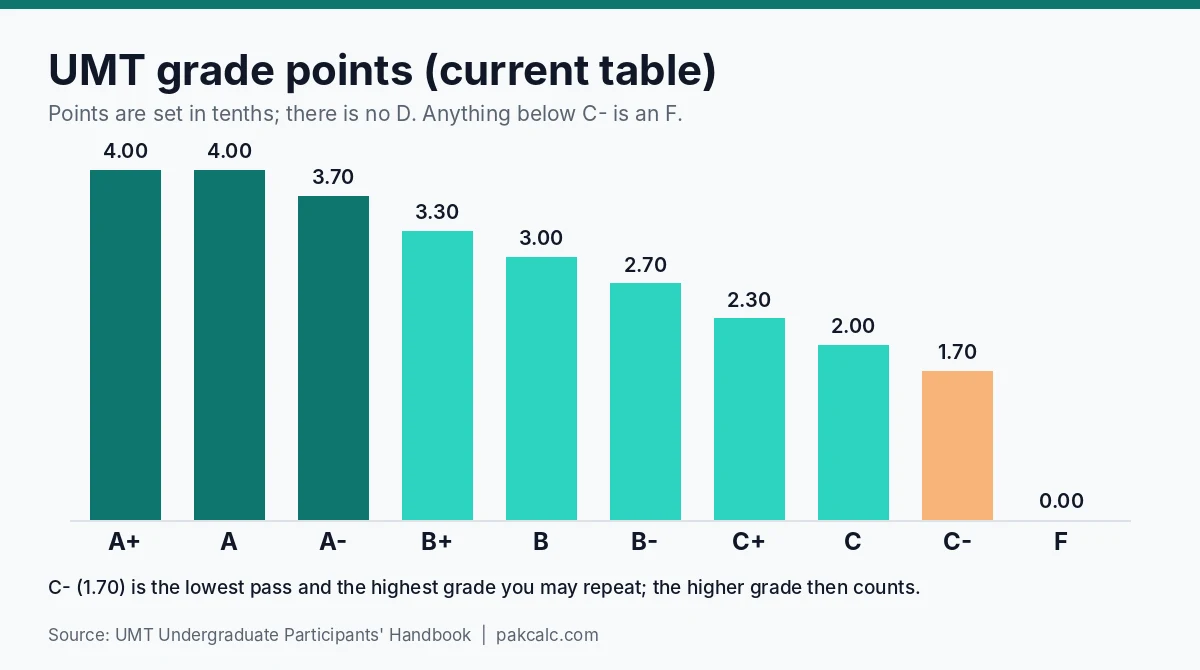
UMT sets its points in tenths, so a B+ is worth 3.30 here. The same letter is worth 3.50 at NUST, and 3.33 at COMSATS and at the University of Central Punjab, whose rules our UCP CGPA calculator follows. Across town, the University of Lahore also values a B+ at 3.50, and an A- at 3.75, on the fixed marks bands our UOL GPA calculator uses. If you’re comparing with a friend at another university, our GPA calculator for Pakistani universities runs the same grades through each scale.
Codes that never enter your GPA
| Code | Meaning |
|---|---|
| W | Withdrawn from the course |
| SA | Short attendance, below 75% |
| I | Incomplete, end-term still pending |
| IP | In process, for theses and projects |
| P or S | Pass or satisfactory, credits count toward the degree only |
| NC or AU | Non-credit or audit |
Why your marks can’t tell you your letter
UMT grades on a curve. Its examination office says teachers place grades by rank in the class, using a bell curve, the distribution-gap method or standard deviations. So 82% could be an A in one section and a B+ in another.
The handbook does set one fixed number. You need 50% of the marks to pass a course in a 16-year programme.
Engineering programmes have their own version (handbook section 3.4). The teacher and the department chairperson set a minimum marks threshold, and anyone below it gets an F. Everyone above it is ranked, and grades from A+ down to C- are placed on a normal curve or a similar method.
Labs count as separate subjects: 40% for continuous assessment and 60% for an end-term viva taken by at least two teachers.
Several calculators ranking for this search print a marks table for UMT, such as 85 to 100 for an A. We couldn’t find any such table in UMT’s documents, so this calculator works from letters only. COMSATS, by contrast, publishes fixed marks bands, so a marks-based tool makes sense there.
Your marks still come from the same places. For a theory course, assignments and projects carry 20% to 35%, quizzes 15%, the midterm 25% to 30% and the end-term 40% to 50%. Practical courses split 40% coursework and 60% end-term.
A UMT semester worked through on paper
- Find each course’s grade points in the table above.
- Multiply them by the course’s credit hours. That gives the course’s quality points.
- Add the quality points, then add the credit hours of the graded courses.
- Divide the first total by the second. That is your semester GPA (UMT also calls it SGPA).
- For your CGPA, do the same division across every semester so far.
Here is an illustrative first-year semester. The course names and grades are made up, and the credit hours are typical of a BS programme.
| Course (credit hours) | Grade (points) | Quality points |
|---|---|---|
| Financial Accounting (3) | A- (3.70) | 11.10 |
| Business Mathematics (3) | B+ (3.30) | 9.90 |
| Microeconomics (3) | B (3.00) | 9.00 |
| Functional English (3) | C+ (2.30) | 6.90 |
| Islamic Studies (2) | A (4.00) | 8.00 |
| Computing Lab (1) | B- (2.70) | 2.70 |
| 15 credit hours | 47.60 → GPA 3.17 |
Now add it to the earlier semesters. Say your CGPA was 2.85 over 33 credit hours. That is 2.85 × 33 = 94.05 quality points. Your new CGPA is (94.05 + 47.60) ÷ 48 = 2.95.
Averaging the two numbers instead gives (2.85 + 3.17) ÷ 2 = 3.01. That’s 0.06 too high, because your earlier semesters cover more than twice as many credit hours. The calculator’s CGPA tab always weights by credit hours.
A quick note on credit hours. At UMT, a three-credit course means 45 contact hours over the semester. A one-credit lab means about three hours of lab work each week.
Summer courses go into the same sum. The handbook’s CGPA formula takes every course in every semester, and a summer session is simply a shorter, eight-week semester.
Transferred credits work differently. Credits brought in from another university count toward your degree. Their grade points stay out of your UMT CGPA, and the transcript marks them “Transferred”. Leave those courses out of the calculator.
A switch between programmes inside UMT is the exception: the old grades that apply to the new programme carry over into its CGPA.
Two things to watch in UMT’s own CGPA calculator
UMT’s examination office has a CGPA calculator on its website. Its basic sum is right. We ran test entries through it on 6 November 2026 and found two spots where it can give you the wrong answer.
It counts W, P and NC as minus one point
| What we entered (3 credit hours each) | GPA shown |
|---|---|
| A, B+, B | 3.43 |
| A, B+, B, plus a W | 2.33 |
| A, B+, B, plus an NC or a P | 2.33 |
In the form’s code, W, NC and P each carry a value of −1, and their credit hours are added to the total. The handbook (section 2.12) says a W has no effect on GPA or CGPA. So leave those rows out of UMT’s form. Our calculator drops them for you.
The same form also lists D+ (1.30) and D (1.00). Neither grade appears in UMT’s current grading table.
Its second box wants grade points, not your CGPA
To update a CGPA, the form asks for your earlier credit hours and your earlier “total grade points”. It’s easy to type your CGPA there instead. With 30 earlier credit hours at a 3.20 CGPA plus the 3.43 semester above, typing 3.20 gives 0.87. Typing the real total of 96 gives 3.25.
The fix is simple: multiply your CGPA by its credit hours first (3.20 × 30 = 96). Our CGPA tab shows that number for you.
Repeating a course under UMT’s current rules
Section 2.7 of the 2025-26 handbook sets three rules for undergraduates:
- You can repeat a course if you got a C- or below. A C or better can’t be repeated to improve it.
- Both grades stay on your transcript, but only the higher one counts in your CGPA.
- Courses with an F, SA or W can be repeated in a regular semester or in summer, if the course is offered.
You pay the course fee again, and scholarships and financial aid don’t cover repeats.
What happens to your CGPA depends on the old grade. Take an illustrative student with a 2.40 CGPA over 60 credit hours:
| Repeat of a 3-credit course | New CGPA | Why |
|---|---|---|
| F repeated, B earned | 2.55 | Credit hours stay at 60; 9 points added |
| C- repeated, B earned | 2.47 | 1.70 swapped for 3.00 |
| W repeated, B earned | 2.43 | 3 new credit hours enter the CGPA |
| W repeated, F earned | 2.29 | The F now counts at 0.00 |
An F hurts your CGPA from the day it appears, because its credit hours count at zero points. A W doesn’t count until you take the course again, and then the new grade counts in full.
Where UMT’s own pages disagree. The examination office’s Academic policy page says the new grade earned on a repeat is the one that counts. The 2025-26 handbook says the higher grade counts. The handbook is the newer document, so the calculator follows it. When your expected repeat grade is lower, the calculator also shows the result under the older wording.
One more cost: a repeat for grade improvement rules you out of convocation medals, and out of a merit award for that semester.
Will repeats delay your degree? Only if you run out of time. A four-year BS can take up to six calendar years, and a two-year degree up to three, including freezes and repeats. Summer sessions let you repeat a course without adding a regular semester, when the course is offered.
W, SA and I: the deadlines that change your grade
| Grade | How you get it | What follows |
|---|---|---|
| W | You withdraw within six weeks of classes starting | No effect on GPA; repeat fee when you retake it |
| SA | Attendance below 75% in the course (the student services FAQ still says 80%) | Barred from the end-term; course must be repeated |
| I | Approved request after an emergency | Take only the end-term next semester, or it becomes F |
| IP | A thesis or project running past one semester | Finish next semester, or it becomes F |
The six-week limit comes from the 2025-26 handbook, and the 2026-27 academic calendar matches it. The examination office’s older policy page still says the end of the 12th week, so go by the calendar date, not that page.
Dates for 2026-27 that touch your grades
| Event | Fall 2026 | Spring 2027 |
|---|---|---|
| Classes start | 5 Oct 2026 | 22 Feb 2027 |
| Last date to withdraw | 14 Nov 2026 | 3 Apr 2027 |
| Midterms | 30 Nov to 5 Dec 2026 | 19 to 24 Apr 2027 |
| Final exams | 25 Jan to 6 Feb 2027 | 21 Jun to 3 Jul 2027 |
| Results declared | 19 Feb 2027 | 16 Jul 2027 |
These dates come from the 2026-27 calendar on UMT’s main website, which excludes the School of Health Sciences. UMT Sialkot posts its own calendar, so check yours if you study there. The summer 2027 session has its withdrawal date on 9 August and results on 28 September.
Two more rules from the handbook can turn into an F without warning. Leaving the university without approval, or skipping an end-term without approval, both lead to an F grade.
Warning, probation and the 1.75 line
UMT’s undergraduate probation policy (handbook section 2.19) works in steps. Each one is triggered by your CGPA at the end of a semester.
| Status | When it starts | What changes |
|---|---|---|
| Warning | CGPA below 2.00 | Automatic ERP letter; meet your batch advisor |
| 1st probation | Below 1.75 in the semester after a warning | Letter and advisor meeting |
| 2nd probation | Below 1.75 two semesters in a row | Letter and advisor meeting |
| 3rd probation | Below 1.75 three semesters in a row | Only old courses can be registered, to improve; new courses wait until the CGPA is above 2.0 |
| After 3rd probation | No improvement in two more semesters | Department committee recommends continuing, an Associate Degree exit or dismissal |
There is one faster route out. A student with five or more F grades in the first semester can have their enrolment cancelled.
The handbook leaves one gap. It doesn’t say what happens if your CGPA is between 1.75 and 1.99 after a warning. Expect the warning to stay until you reach 2.00, and ask your batch advisor. If you clear probation and later fall below 1.75 again, you restart at 1st probation.
Here is how the maths of getting back to 2.00 works. Take an illustrative 1.70 CGPA over 45 credit hours. You’d need a 2.75 semester on 18 credit hours to reach 2.00.
Repeats can be faster. Say two of your courses so far were three-credit F grades. Earning a B in each on a repeat lifts you from 1.70 to 2.10 on its own.
The CGPA your UMT scholarship needs
Merit fee waivers have a CGPA floor. For batches that joined in Fall 2024 or later, it is set in handbook section 7.3. The rule covers all undergraduate programmes except Pharm-D and LLB. It applies from your first semester, when your semester GPA counts as your CGPA.
| Merit scholarship | CGPA to keep it |
|---|---|
| 100% | 3.90 |
| 90% | 3.80 |
| 80% | 3.70 |
| 70% | 3.60 |
| 60% | 3.55 |
| 50% | 3.50 |
| 45% | 3.45 |
| 40% | 3.40 |
| 35% | 3.35 |
| 30% | 3.30 |
| 25% | 3.25 |
| 10% | 3.00 |
| Non-merit scholarship or aid | 3.00 |
The bar is high for the top awards. Take a student on a 50% merit scholarship with a 3.42 CGPA after 33 credit hours. To get back to 3.50, they need a 3.65 next semester on 18 credit hours. The calculator’s Probation and scholarship tab works this out for your own numbers.
The same handbook section also lists a general rule: 2.75 for merit scholarships in bachelor’s programmes and 2.50 for non-merit aid. The table above is the one tied to Fall 2024 onward batches. If you joined earlier, check the CGPA condition in your award letter.
Falling below the line doesn’t end the scholarship at once. UMT’s student services FAQ says a scholarship suspended for a low CGPA can be restored for one semester, once in the whole degree. Reach the required CGPA that semester and it continues. Miss it again and it is cancelled, unless you meet the CGPA in a later semester.
Two other conditions apply. Waivers end for good after a fee default of two quarters in a row. Scholarship holders also have to finish in the normal duration of the programme.
Dean’s list, Rector’s award and convocation medals
UMT’s semester awards are based on the semester GPA (SGPA), not the CGPA. Its medals are based on the final CGPA.
- Dean’s Merit Award: SGPA 3.70 or above (3.80 for MBA Professional), a full course load and no F, SA, W or repeat. The top ten in each programme get a fee discount worth three credit hours for one quarter. MS and M.Phil students get the award but no fee waiver.
- Rector’s Merit Award: SGPA 4.00 under the same conditions, with a fee discount worth six credit hours.
- Patron’s Medal (gold): the highest CGPA in each bachelor’s programme, with a minimum of 3.80.
- Rector’s Medal (silver): the second-highest CGPA, with a minimum of 3.70.
Final-semester students get the merit award but no fee discount. Medals have stricter conditions. You must finish in the normal time with no F, SA or W anywhere on the transcript. Improvement repeats, transfers and disciplinary penalties also rule you out.
Some calculator sites say UMT’s Dean’s list starts at a 3.50 CGPA. We found no such figure in UMT’s documents. The handbook’s figure is a 3.70 semester GPA.
What UMT students say about CGPA
We went through three recent YouTube videos by Usama Husnain, who makes videos about UMT. He says these are the habits he followed during his own BSCS. One of them is an interview with a UMT computer science student. These are personal accounts, not UMT rules, so we checked each point against the handbook.
- How the curve feels in a real course. Each teacher sets the weight of quizzes, assignments, the midterm, any project or viva, and the final. These weights are in the course outline shared in the first class.
- Who sets the bands. In his experience, the grade bands are set from the top scores in the class. That fits UMT’s relative grading, but the exact cut-offs change from teacher to teacher.
- Where students lose marks. Late or copied assignments, and quizzes treated as too small to matter. Also skipping the midterm to bet on the final, last-week submissions with late penalties, and never using teachers’ counselling hours.
- What worked for him. About 20 minutes reviewing notes after each lecture and a weekly plan for assignments and quizzes. He also solved programming problems on his own every day instead of reading solutions.
- The interviewed student’s view. A good CGPA at UMT takes steady work on quizzes and assignments, but it is manageable. For job shortlisting, he suggests staying above 3.00.
- Scholarship CGPA. The scholarship video reads out the same table as the handbook, from 3.90 for a 100% award down to 3.00 for 10%. It describes the first miss as a warning; UMT’s own wording is a suspension that can be restored once.
UMT CGPA to percentage
UMT’s examination office posts a CGPA-to-percentage sheet dated 30 November 2018 on its HEC Guidelines page. The sheet uses a sliding formula rather than a fixed multiplier:
| CGPA | Percentage on the UMT-hosted sheet |
|---|---|
| 4.00 | 100.00% |
| 3.50 | 86.76% |
| 3.00 | 73.33% |
| 2.80 | 68.11% |
| 2.50 | 60.00% |
| 2.00 | 52.90% |
We couldn’t confirm whether UMT uses this sheet on its official percentage letters. When a job form or PPSC asks for a percentage, get the letter from the examination office. Its fee list shows Rs 200 per semester, or Rs 500 for the DMC version.
Want to compare the HEC band method as well? Our marks percentage calculator shows three CGPA conversion methods side by side.
MS, M.Phil and PhD: different lines
Graduate students use the same letters and points, but UMT’s graduate handbook draws its lines higher and allows fewer repeats.
| Rule | MS and M.Phil | PhD |
|---|---|---|
| Probation | CGPA below 2.25 | Semester GPA below 3.00 |
| Dropped | Below 2.25 again after last probation | Below 3.00 again the next semester, or any F |
| Degree CGPA | 2.50 without thesis, 3.00 with thesis | 3.00 |
| Repeats | F, SA, W, C- or C; at most two courses | Not covered here |
For an MS or M.Phil, a 3.00 CGPA also matters early. The handbook ties the thesis option to a 3.00 CGPA in your first two semesters. If you reach 3.00 after the third semester, a thesis can still be offered.
The repeat limit rises to four courses for the 66-credit MBA. Only the better grade counts, and an F has to be cleared within the maximum duration of the degree. Withdrawal closes at the end of the sixth week, the same as for undergraduates. The calculator’s Probation and scholarship tab has options for MS, M.Phil and PhD.
UMT CGPA kaise nikalein (Roman Urdu)
Har course ke grade points ko uske credit hours se multiply karein. Is se us course ke quality points bante hain. Semester ke saare quality points jama karein aur graded credit hours ke total se divide kar dein. Ye aap ka semester GPA hai.
CGPA ke liye pichla CGPA × pichle credit hours karein, is semester ke quality points jama karein, aur naye total credit hours se divide karein. W, SA, I, P aur NC wale courses dono totals se bahar rakhein. UMT mein 2.00 se kam CGPA par warning aati hai.
Frequently asked questions
How do I calculate my CGPA at UMT?
Multiply each course’s grade points by its credit hours, add the results for every semester, and divide by your total graded credit hours. If you only have your old CGPA, multiply it by its credit hours to get your total grade points. Then add this semester’s points and divide by the new total of credit hours.
Is this the official UMT calculator?
No. PakCalc is independent and isn’t connected to the University of Management and Technology. The calculator follows UMT’s 2025-26 handbook and examination office pages. Your myUMT result and final transcript are the official record.
Does UMT use relative or absolute grading?
Relative. UMT’s examination office says grades are placed by your rank in the class, using a bell curve, the distribution-gap method or standard deviations. The only fixed marks rule is the 50% needed to pass a course.
Can I repeat a course with a C at UMT?
Not to improve it. The 2025-26 handbook allows undergraduates to repeat courses graded C- or below. Courses with an F, SA or W can also be repeated, and only the higher grade counts in the CGPA.
Does a W affect my CGPA at UMT?
No. A W carries no grade points and its credit hours stay out of your GPA and CGPA. It does cost the repeat fee when you retake the course. Leave W rows out of UMT’s own online form, which counts them as minus one point.
What is a 2.8 CGPA in percentage at UMT?
68.11% on the 2018 conversion sheet UMT’s examination office posts, compared with 70% on the CGPA × 25 shortcut. For a job or admission form, use UMT’s percentage letter rather than either number.
How we checked the numbers
- Rules come from UMT’s undergraduate and graduate handbooks for 2025-2026, its 2026-27 academic calendar and the examination office pages listed below. All were read on 6 November 2026. From the undergraduate handbook we used sections 2.5 to 2.19, 3.1 to 3.7, 5 and 7.3.
- UMT’s online calculator was tested on 6 November 2026 with the entries shown in the tables above. We also read the form’s code to see how it values each grade.
- Every figure on this page was run through the calculator’s own code. That covers the 3.17 semester, the 2.95 CGPA, the repeat table, the 2.75 and 2.10 probation figures, the 3.65 scholarship figure and the percentage table.
- Conflicts we found: the handbook and the examination office pages disagree on which repeat grade counts and on the withdrawal deadline. The 2026-27 academic calendar settles the deadline in the handbook’s favour. For repeats we follow the 2025-26 handbook and show both results.
- The graduate handbook’s grade table prints the grade points one row out of line (A+/A next to 3.70, for example). We used the examination office’s table, which lists the same points for undergraduate and graduate programmes.
- Other tools: in November 2026 we read the UMT calculators ranking on Google in Pakistan. Common problems were invented marks ranges, D grades UMT doesn’t use, a 3.50 “Dean’s list” and the CGPA × 25 formula.
- Student accounts: forums had little that was specific to UMT. So we went through the transcripts of three YouTube videos by a UMT-focused creator, including a student interview. Their points are labelled as personal accounts and checked against UMT’s rules.
- Not covered: the grade table UMT used before Fall 2005, and School of Health Sciences dates.
AI assistance went into the research and first draft. The rules and numbers were then checked line by line against the UMT documents listed below.
UMT documents behind these numbers
- UMT Undergraduate Participants’ Handbook 2025-2026 (PDF): grading table, GPA formula, repeats, withdrawal, attendance, probation, pass marks, merit awards, medals and scholarship CGPA rules.
- UMT Graduate Participants’ Handbook 2025-2026 (PDF): MS, M.Phil and PhD probation, repeats, withdrawal and degree CGPA.
- UMT Academic Calendar 2026-27: withdrawal deadlines, exam weeks and result dates.
- UMT examination office, Assessment and Evaluation: relative grading methods, marks weights and the grade table.
- UMT examination office, Academic policies: I, IP and W grades and the older repeat wording.
- UMT examination office, CGPA Calculator: the form we tested.
- UMT examination office, Degree Completion Requirement: 2.00 and 2.50 CGPA minimums and maximum durations.
- UMT examination office, Convocation Medals and Awards: Patron’s and Rector’s medal conditions.
- CGPA to Percentage Conversion Formula, 30 November 2018 (PDF hosted by UMT): the percentage sheet.
- UMT examination office, Services: percentage letter fees.
- UMT Participant Relations, FAQs: scholarship reinstatement, merit award waivers and the 80% attendance wording.
- Usama Husnain on YouTube: How to Get 3.7 CGPA in UMT BSCS (August 2025), UMT scholarship CGPA (August 2025) and UMT CS Experience, Honest Student Review (February 2026). Used for the student accounts above.
Update log
- 6 November 2026: Page written. Rules checked against the 2025-26 handbooks, the 2026-27 academic calendar and the examination office pages; UMT’s online calculator tested.
UMT usually posts a new handbook before each academic year, and that is when this page gets its next full check. A rule change from the examination office brings it forward. Our accuracy policy explains the process.
When your result comes out on myUMT, start with the Semester GPA tab and send it to the CGPA tab. Near a line that matters, such as 2.00 or your scholarship’s CGPA? The Probation and scholarship tab shows the gap. Used that way, this UMT CGPA calculator turns one result into a plan for next semester.
About the author
Disclaimer: this UMT GPA calculator gives estimates for information only, not official results or advice. See our Disclaimer. Spotted an error? Contact us.
Related calculators
- EducationAir Uni Aggregate Calculator 2027 (Air University Merit)Your Air University aggregate on both AU formulas, the AU-CBT score you need, and each campus’s exemption rules.Open calculator →
- EducationBahria University GPA Calculator and Grading System 2026GPA, CGPA and probation on Bahria’s Spring 2026 handbook, with the MS scale, a final-exam planner and repeat versus honours.Open calculator →
- EducationIIUI GPA Calculator for BS, MS and PhD StudentsGPA, CGPA and probation lines on IIU Islamabad’s rules for BS, MS and PhD, with a terminal-marks planner and repeat outcomes.Open calculator →
- EducationUET GPA Calculator for Lahore, Taxila and PeshawarGPA, CGPA, repeats and probation on UET Lahore, Taxila and Peshawar rules, tested on a real 140-credit-hour UET Lahore transcript.Open calculator →