Home › Education › MDCAT Aggregate Calculator 2026-27
MDCAT Aggregate Calculator 2026-27
By Shehrooze Butt, independent publisher and researcher | Last updated | Sources checked 21 October 2026 | Unofficial tool
Public-sector MBBS and BDS merit in Pakistan rests on one split: MDCAT 50%, FSc 40% and Matric 10%. Put your marks in below to see your aggregate, or leave the MDCAT box empty to see the score a target aggregate needs.
Pick your programme and province as well. They set the MDCAT pass mark and the FSc minimum. Every weight and rule comes from an official admission page, linked below.
Keep in mind: an aggregate is not a merit position and does not guarantee a seat. UHS, KMU and every other admitting university run their own merit lists.
Programme and province
The programme sets the MDCAT pass mark (MBBS 55%, BDS 50%). The province sets the FSc check (Punjab 60%, KP 65%, Sindh 65% in 2025-26).
Matric / SSC
FSc / HSSC (complete result) or IBCC equivalent
MDCAT
PM&DC’s MDCAT 2026 notice lists 180 MCQs, so 180 is assumed. Matric and FSc totals vary by board, so copy all totals from your result cards. Preparing for MDCAT 2027? Leave your MDCAT marks empty to see the score each target needs.
Optional: target aggregate
The merit formula
Public-sector MBBS and BDS merit uses the same three weights in every policy checked for this page. Engineering and computing universities weigh their tests very differently; our aggregate calculator for all universities compares them.
| Result | Weight |
|---|---|
| MDCAT | 50% |
| FSc (Pre-Medical) / HSSC or equivalent | 40% |
| Matric / SSC or equivalent | 10% |
Aggregate = 0.50 × MDCAT % + 0.40 × FSc % + 0.10 × Matric %
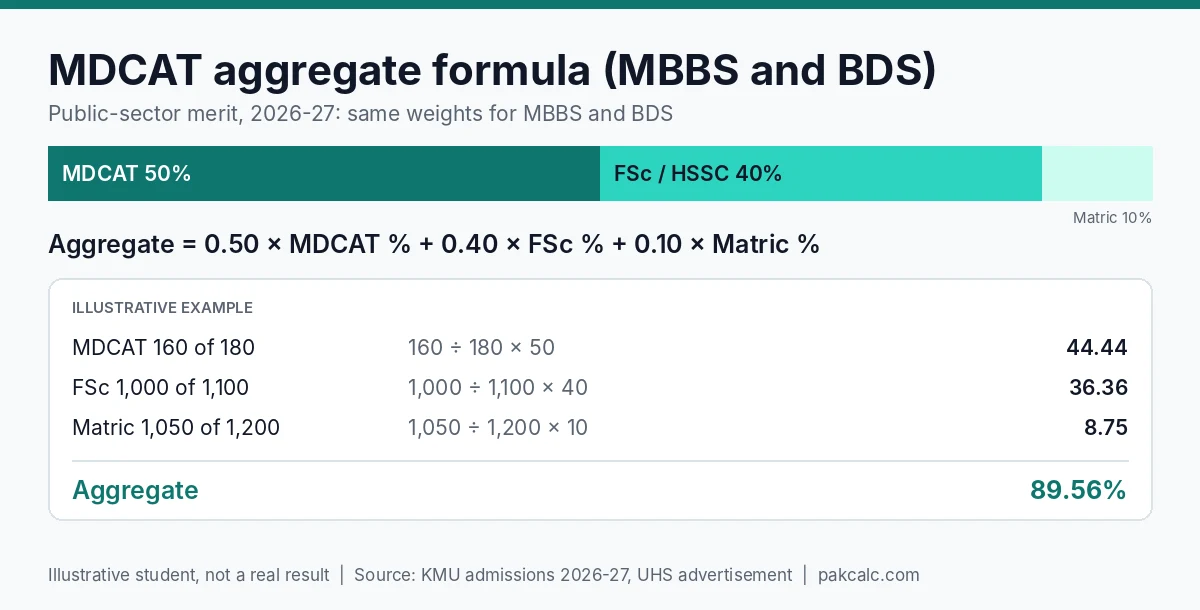
- Khyber Pakhtunkhwa (official, 2026-27): KMU's admissions page lists these weights. The KP 2025-26 policy adds that final merit is rounded to five decimal places.
- Punjab (reported, 2026-27): the Daily Times, Minute Mirror and UHS's advertisement (republished by Ilm Ki Dunya) give the same split. This page has not read the Punjab policy PDF itself.
- MBBS and BDS: the weights are the same, but you must apply separately for each programme.
Key MDCAT and MBBS admission dates, 2026-27
Last verified 30 October 2026. Dates change, so confirm on the official portal before you plan around them.
| Item | Detail |
|---|---|
| MDCAT 2026 | Held on Sunday, 20 September 2026, after PM&DC moved it from 16 August (rescheduling notice). 180 MCQs, no negative marking. |
| Punjab (UHS), public MBBS | Applications ran from 16 October to 30 October 2026, 5:00 PM, on the UHS MBBS portal. Check that page for any extension and for merit lists. |
| Punjab (UHS), public BDS | On 30 October 2026 the UHS BDS portal said online applications were closed, while still showing 15 November 2026 as the last date. UHS's advertisement, as republished, gives 15 to 30 December. Check the portal again before mid-December. |
| KP (KMU), public MBBS and BDS | Applications closed on 21 October 2026 at 5:00 PM, per the KMU admissions page. Check that page for any extension and for merit lists. |
| MDCAT results accepted | Punjab and KP accept MDCAT 2024, 2025 or 2026 for 2026-27, with 55% for MBBS or 50% for BDS |
Punjab MBBS dates come from the UHS advertisement as republished by Ilm Ki Dunya. Both Punjab rows were re-checked on the UHS portals on 30 October 2026.
How to use this MDCAT merit calculator
- Obtained and total. Copy both numbers from your result cards. Any total works, because each result is turned into a percentage. UHS's own example uses a Matric total of 1,050.
- FSc. Enter your complete FSc / HSSC result. KP's 2025-26 policy example uses "adjusted" FSc marks without explaining the adjustment, so check your admitting university if your case is unusual.
- A-Level or foreign results. You need an IBCC equivalence certificate. Enter the marks and total printed on it. No certificate yet? The A level equivalence calculator estimates those marks from your grades.
- MDCAT. Enter your marks and the total for your paper. The calculator assumes 180, as in PM&DC's 2026 notice.
- Programme and province. The programme sets the pass mark in the target table. The province sets the FSc warning.
MDCAT at a glance
The 180-MCQ, paper-based format with no negative marking is confirmed in the PM&DC MDCAT 2026 exam notice. The subject split and 3-hour length come from the PMDC MDCAT 2025 curriculum.
| Item | Detail |
|---|---|
| Questions | 180 MCQs, paper-based, 3 hours |
| Negative marking | None |
| Pass marks | MBBS 55% (99 of 180), BDS 50% (90 of 180) |
| Biology | 45% (81 MCQs) |
| Chemistry | 25% (45 MCQs) |
| Physics | 20% (36 MCQs) |
| English | 5% (9 MCQs) |
| Logical Reasoning | 5% (9 MCQs) |
From marks to aggregate: two examples
| Input | Calculation | Points |
|---|---|---|
| MDCAT 150 of 180 | 150 ÷ 180 × 50 | 41.6667 |
| FSc 1,005 of 1,100 | 1,005 ÷ 1,100 × 40 | 36.5455 |
| Matric 1,020 of 1,100 | 1,020 ÷ 1,100 × 10 | 9.2727 |
| Aggregate | 87.48485 (87.48% shown) | |
These marks are made up for illustration. They are made-up marks, not a real applicant's.
KP's own example: the KP policy uses Matric 880/1,100, FSc 880/1,100 and MDCAT 120/200. That gives 8.00000 + 32.00000 + 30.00000 = 70.00000. The calculator returns the same figure with an MDCAT total of 200.
UHS's own example: the UHS aggregate sheet uses Matric 992/1,050, FSc 980/1,100 and a test score of 970/1,100, and gets 89.1745%. This calculator gives 89.1749 for the same marks. It applies the weights directly to each percentage, while UHS rounds the Matric part to two decimals first. Follow your admitting university's published method if its rounding differs.
Target check: with Matric at 90% and FSc at 88%, those two add 9.00 + 35.20 = 44.20. To reach 85%, MDCAT must supply 40.80 points. That is 81.6% of the paper, so 147 of 180 in practice.
When the pass mark decides: with Matric and FSc both at 95%, those add 9.50 + 38.00 = 47.50. A 70% target needs only 81 MDCAT marks. That is below both pass marks, so you still need 99 for MBBS or 90 for BDS.
Why one MDCAT mark is worth more than seven FSc marks
MDCAT carries 50% and is out of only 180 marks, so one MDCAT mark moves your aggregate far more than one FSc or Matric mark. These figures assume totals of 180, 1,100 and 1,100.
| One extra mark in | Adds to aggregate | Compared with MDCAT |
|---|---|---|
| MDCAT (of 180) | 0.2778 points | 1 mark |
| FSc (of 1,100) | 0.0364 points | about 1/7.6 of a mark |
| Matric (of 1,100) | 0.0091 points | about 1/30.6 of a mark |
So 10 more MDCAT marks add 2.78 points, the same as about 76 more FSc marks. The figures come straight from the formula (50 ÷ 180, 40 ÷ 1,100 and 10 ÷ 1,100). Check your admitting university's rules on retakes before you plan around them.
How your MDCAT 2026 score compares
UHS announced the Punjab MDCAT 2026 result on 24 September 2026. Of 47,475 candidates who appeared, 37,708 cleared the MBBS mark and 40,457 cleared the BDS mark, as reported by ProPakistani, Pak Observer and TechJuice.
UHS published marks bands. The running totals below were added up for this page.
| MDCAT marks (of 180) | Candidates at or above | Share who appeared |
|---|---|---|
| 170 or more | 1,772 | 3.7% |
| 160 or more | 8,454 | 17.8% |
| 150 or more | 14,714 | 31.0% |
| 140 or more | 20,071 | 42.3% |
| 130 or more | 25,010 | 52.7% |
| 120 or more | 29,392 | 61.9% |
| 110 or more | 33,580 | 70.7% |
| 100 or more | 37,346 | 78.7% |
| 90 or more | 40,457 | 85.2% |
This covers Punjab (UHS) candidates only, not all of Pakistan. It also does not show your merit position, because FSc and Matric count too.
Aggregate, merit position and admission
- Aggregate is the percentage this calculator produces.
- Merit position is your rank among all candidates, which the admitting university decides.
- Admission depends on your position, your college preferences and the seats available.
KMU's 2025-26 policy says admissions run through at least three merit lists, and candidates can be upgraded. Selected candidates must pay the fee within three working days or the seat goes to the next candidate. When aggregates tie, KP's policy prefers the older candidate, then higher Matric marks, then higher MDCAT marks.
The first merit list is not the closing merit. UHS ran 13 selection lists for open-merit and quota seats in 2025-26 (UHS 2025-26 page). Its 2024-25 page shows lists up to the seventeenth. Punjab selects on merit and preference, so a college's cut-off can change between lists.
Punjab closing merit, 2025-26 (last year)
The table shows the lowest aggregate placed at each public MBBS college in the UHS thirteenth and final open-merit list for 2025-26 (UHS list page). Open-merit seats only.
| College | Closing aggregate |
|---|---|
| King Edward Medical University, Lahore | 94.8677% |
| Allama Iqbal Medical College, Lahore | 94.4530% |
| Services Institute of Medical Sciences, Lahore | 94.2273% |
| Nishtar Medical College, Multan | 94.1455% |
| Ameer-ud-Din Medical College, Lahore | 94.0061% |
| Rawalpindi Medical College | 93.9263% |
| Fatima Jinnah Medical College, Lahore | 93.8136% |
| Punjab Medical College, Faisalabad | 93.7924% |
| Quaid-e-Azam Medical College, Bahawalpur | 93.7182% |
| Gujranwala Medical College | 93.6742% |
| Sahiwal Medical College | 93.6606% |
| Khawaja Muhammad Safdar Medical College, Sialkot | 93.6273% |
| Nawaz Sharif Medical College, Gujrat | 93.6015% |
| Sargodha Medical College | 93.5909% |
| Sheikh Zayed Medical College, Rahim Yar Khan | 93.5439% |
| D.G. Khan Medical College | 93.5303% |
| Narowal Medical College | 93.5091% |
What the spread means. The highest and lowest closing figures differ by 1.36 points (94.87 minus 93.51). One MDCAT mark is worth 0.2778 points, so that gap is about 5 MDCAT marks. This is a calculated estimate from the table above.
A target example. With Matric and FSc both at 95%, those add 47.50 points. Reaching 93.51 then needs 46.01 from MDCAT, which is 92% of the paper, or about 166 of 180. This is an estimate for an imaginary student, and your own marks will differ.
Limits. These are last year's figures, and 2026-27 lists may close higher or lower. The figures were worked out from the UHS list for this page, as the lowest aggregate at each college, so check them against the list itself. Dental colleges and other provinces are not covered.
Eligibility basics
- FSc / HSSC minimum. KP asks for 65% (KMU, 2026-27). Punjab's 2026-27 policy is reported to ask for 60%. Sindh's 2025-26 advertisement asked for 65%.
- Subjects. Biology and Chemistry, plus Physics or Mathematics, passed at HSSC level.
- MDCAT. At least 55% for MBBS or 50% for BDS. Punjab and KP accept results from 2024, 2025 and 2026 this year.
- Domicile. KMU asks for KP or merged-district domicile. Check your own university's domicile rule.
- Foreign qualifications. You need an IBCC equivalence certificate.
- Extra marks. The Punjab 2026-27 reports say no marks are added for Hafiz-e-Quran.
What to do with your aggregate
- Compare your MDCAT marks with your programme's pass mark: 99 for MBBS, 90 for BDS.
- Check your FSc percentage against your province's minimum before you apply.
- Apply separately for MBBS and BDS if you want both, and watch each deadline.
- Punjab's public colleges are reported to need every college listed in your order of preference.
- Compare your aggregate with last year's closing merit in the table above, not with the first list.
- Also sat ECAT with Biology? UET Lahore keeps separate Pre-Medical seats in computing programmes, and our UET aggregate calculator shows their closing merit.
Other provinces and admitting bodies
It covers the 50/40/10 route. Other admitting bodies may use different tests or formulas.
Applying to a NUMS college such as CMH, Bahria or Fazaia? NUMS runs its own test, so use the NUMS aggregate calculator instead.
Only Sindh's 2025-26 advertisement was read for this page, not the Sindh, Balochistan or AJK policies. Check your own province's notice.
Frequently asked questions
What is the MDCAT aggregate formula?
MDCAT counts for 50%, FSc for 40% and Matric for 10%. Convert each result to a percentage, multiply by its weight and add the three. MBBS and BDS use the same weights.
What FSc percentage do I need?
KP asks for 65% in 2026-27, and Punjab is reported to ask for 60%. Sindh asked for 65% in 2025-26. Check your admitting university's current notice.
How many MDCAT marks do I need for a target?
Enter your Matric and FSc marks, choose your programme and press Calculate. You can leave the MDCAT marks empty if you have not taken the test yet. The table also covers 70% to 95%, and it never shows fewer marks than the pass mark.
When was MDCAT 2026 held, and what marks pass?
On Sunday, 20 September 2026, after PM&DC moved it from 16 August. You need 55% for MBBS (99 of 180) or 50% for BDS (90 of 180).
Is my aggregate my merit position?
No. The aggregate is a percentage, and your merit position is your rank among all candidates. A high aggregate does not promise a seat, because preferences and seats matter too.
Is PakCalc an official tool?
No. PakCalc is independent and not affiliated with PM&DC or any university. Results are estimates.
PM&DC, UHS and KMU sources
All sources were checked on 21 October 2026. Rules change each session, so confirm with PM&DC and your admitting university.
Official pages and documents
- KMU admissions page for 2026-27
- KP Admission Policy 2025-26
- PM&DC MDCAT rescheduling notice
- PM&DC MDCAT 2026 exam notice
- PMDC MDCAT 2025 curriculum
- UHS aggregate calculation sheet
- UHS pages: 2025-26 final open-merit list, 2025-26 lists, 2024-25 lists, MBBS portal and BDS portal
Notices and news reports
- Sindh 2025-26 admission advertisement
- Daily Times report on Punjab 2026-27 and Minute Mirror report
- UHS advertisement republished by Ilm Ki Dunya
- Punjab MDCAT 2026 result: ProPakistani, Pak Observer and TechJuice
KP's and UHS's own worked examples both come out right in the calculator. Our checking process is explained separately.
AI tools were used for research and a first draft. The 50/40/10 formula and the Punjab closing merit figures were checked against the official documents linked on this page.
Change log: 21 October 2026, first version, with the 2025-26 closing-merit table added the same day. 22 October 2026, the calculator now shows the MDCAT marks needed before you take the test, and the KMU deadline was marked as passed.
About the author
Disclaimer: this page is for information only. Results are estimates, not official results or advice. See our Disclaimer. Spotted an error? Contact us.
Related calculators
- EducationAir Uni Aggregate Calculator 2027 (Air University Merit)Your Air University aggregate on both AU formulas, the AU-CBT score you need, and each campus’s exemption rules.Open calculator →
- EducationBahria University GPA Calculator and Grading System 2026GPA, CGPA and probation on Bahria’s Spring 2026 handbook, with the MS scale, a final-exam planner and repeat versus honours.Open calculator →
- EducationIIUI GPA Calculator for BS, MS and PhD StudentsGPA, CGPA and probation lines on IIU Islamabad’s rules for BS, MS and PhD, with a terminal-marks planner and repeat outcomes.Open calculator →
- EducationUET GPA Calculator for Lahore, Taxila and PeshawarGPA, CGPA, repeats and probation on UET Lahore, Taxila and Peshawar rules, tested on a real 140-credit-hour UET Lahore transcript.Open calculator →