Home › Education › Aggregate Calculator 2026-27: NUST, FAST, COMSATS, ITU, QAU
Aggregate Calculator for Pakistani Universities (2026-27)
By Shehrooze Butt, independent publisher and researcher | Last updated | Sources checked 22 October 2026 | Unofficial tool
Every university in Pakistan mixes your Matric, Intermediate and entry-test marks in its own way. NUST lets its test decide 75% of your aggregate, while QAU’s BS programmes use no test at all. The calculator below uses each university’s published weights, so you get the number for the place you’re applying to.
Pick a university, enter your marks, and the calculator shows your aggregate. It also shows what the same marks would give you at the other universities on this page.
Worth knowing: an 80 at one university is not an 80 at another, and no aggregate is a seat offer. Compare yours only with that university’s own merit list.
University and programme
Weights from your university’s notice (%)
The three weights must add up to 100.
Matric / SSC or IBCC equivalent
Use the marks and total from your result card. Only have subject marks? Add them up in our marks percentage calculator first.
Intermediate / HSSC
Entry test
Optional: target aggregate
Not taken the test yet? Leave the test score empty, enter a target, and the calculator shows the score you need.
How an aggregate (merit) score works
An aggregate is a weighted average of your results. Each result is first turned into a percentage, then multiplied by the weight the university gives it. The three parts are added together.
Aggregate = (test % × test weight) + (Inter % × Inter weight) + (Matric % × Matric weight)
Some universities call this number a merit score, so a merit calculator and an aggregate calculator do the same job. What changes from one university to the next is the weights, which Intermediate marks count, and which tests are accepted.
- Aggregate is the percentage this calculator gives you.
- Merit position is your rank among everyone who applied for the same programme.
- Admission depends on that rank, the seats available and how many merit lists the university runs.
Aggregate formulas compared: which university weighs the test most
Every weight below comes from the university’s own admission page, checked on 22 October 2026 (COMSATS on 24 October 2026). The UHS, NUMS and UET rows come from our own guides to those formulas, checked between 21 and 26 October 2026.
| University and programme | Entry test | Intermediate | Matric |
|---|---|---|---|
| NUST (full NUST guide) | 75% (NET) | 15% | 10% |
| KMU, MBBS / BDS in KP (full MDCAT guide) | 50% (MDCAT) | 40% | 10% |
| UHS, MBBS / BDS in Punjab (reported split) | 50% (MDCAT) | 40% | 10% |
| NUMS colleges, MBBS / BDS (full NUMS guide) | 50% (NUMS MDCAT) | 40% | 10% |
| FAST-NUCES, Computing and Business (full FAST guide) | 50% | 40% | 10% |
| COMSATS, BS programmes (COMSATS (CUI) merit calculator) | 50% (NTS NAT) | 40% | 10% |
| ITU, BS CS / BS AI | 50% | 35% | 15% |
| FAST-NUCES, BS Engineering | 33% | 50% | 17% |
| UET Lahore and Taxila (full UET guide) | 33% (ECAT) | 50% (Part-I) | 17% |
| QAU, LLB | 30% (HEC LAT) | 50% (Part-I) | 20% |
| QAU, BS programmes | None | 70% (Part-I) | 30% |
What this means for you. At NUST, the test decides most of your aggregate, and Matric and Intermediate together add only 25%. At QAU’s BS programmes there is no test at all, so your board marks decide everything.
If your board marks are strong and your test is weak, programmes lower in this table reward you more. If the reverse is true, NUST-style formulas suit you better.
The same university can use two formulas. FAST gives engineering applicants a 33% test weight but computing applicants 50%. QAU uses one formula for BS and another for LLB.
Same marks, different aggregate (illustrative)
Take one imaginary student: Matric 950 of 1,100 (86.36%), Intermediate 900 of 1,100 (81.82%), and 65% in an entry test. Here is what each formula gives.
| Formula | Calculation | Aggregate |
|---|---|---|
| NUST | 0.75 × 65 + 0.15 × 81.82 + 0.10 × 86.36 | 69.66 |
| FAST, Computing / Business | 0.50 × 65 + 0.40 × 81.82 + 0.10 × 86.36 | 73.86 |
| ITU, BS CS / AI | 0.50 × 65 + 0.35 × 81.82 + 0.15 × 86.36 | 74.09 |
| FAST, BS Engineering | 0.33 × 65 + 0.50 × 81.82 + 0.17 × 86.36 | 77.04 |
| QAU, BS (no test) | 0.70 × 81.82 + 0.30 × 86.36 | 83.18 |
The same student scores anywhere from 69.66 to 83.18, a gap of 13.52 points, without a single mark changing. That is why an aggregate only means something next to the same university’s merit list. Comparing your NUST aggregate with a friend’s QAU aggregate tells you nothing.
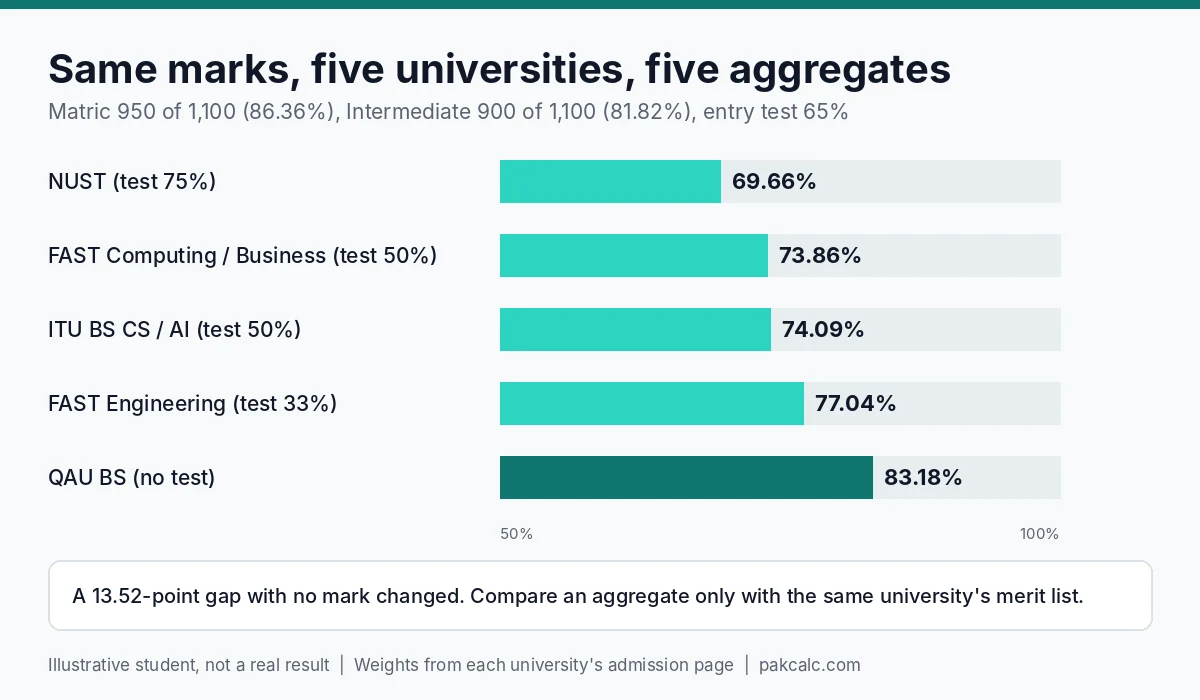
These marks are made up for illustration. QAU uses Part-I marks, and different tests are not equal, so the example compares formulas, not real chances. The calculator above builds this same table from your own marks.
ITU merit calculator: formula and 2026 merit lists
Information Technology University (ITU), Lahore, publishes different weights for different programmes on its norms and criteria page.
| Programme | Weights | Tests accepted |
|---|---|---|
| BS CS and BS AI (HSSC applicants) | Academic record 50% (Matric 15% + Inter 35%), test 50% | ITU test, SAT-I, USAT |
| BS CS and BS AI (O/A-Level result pending) | Academic record 35%, test 65% | ITU test, SAT-I, USAT |
| BS Electrical, Software and Computer Engineering | Academic record 50%, test 50% | ITU test, ECAT, USAT, NTS |
| BS Management & Technology, BS Financial Technology | Academic record 40%, test 60% | ITU test, SAT-I, NTS |
| BS Economics with Data Science | Academic record 50%, test 50% | ITU test, SAT-I, NTS, USAT |
ITU splits the academic record into Matric and Inter only for BS CS and BS AI, so the calculator above covers those two. For the other programmes, ITU’s page gives only the total academic weight. The ITU admission test needs at least 50% for most programmes, and SAT-I needs at least 550 in both Math and EBRW.
Where ITU’s 2026 lists ended
The table shows the lowest merit score printed on each ITU merit list we checked. The figures were read off ITU’s own list pages for this article.
| List | Names | Highest | Lowest |
|---|---|---|---|
| BS CS, 1st list | 375 | 95.84 | 81.01 |
| BS CS, 2nd list | 104 | 80.99 | 79.50 |
| BS AI, 1st list | 228 | 94.75 | 83.00 |
| BS AI, 3rd list | 71 | 80.83 | 79.74 |
| BS Computer Eng., 1st list | 203 | 96.25 | 76.00 |
| BS Computer Eng., 2nd list | 36 | 75.98 | 74.09 |
| BS Software Eng., 2nd list | 35 | 79.98 | 79.02 |
| BS Electrical Eng., 2nd list | 87 | 69.77 | 60.02 |
What the lists show. The BS CS cut-off fell by 1.51 points between the 1st list (81.01) and the 2nd (79.50). BS AI’s 1st list ended higher than BS CS’s (83.00 against 81.01). Electrical Engineering’s 2nd list went down to 60.02, far below the computing programmes. These comparisons are our own reading of ITU’s lists.
Limits. ITU marks every list “subject to verification”. This table shows a selection of lists, not all of them, and the lowest score on a list is not always the final closing merit. ITU also ran Round 2 lists. See every list on ITU’s merit lists page.
QAU merit calculator: BS and LLB
Quaid-i-Azam University (QAU), Islamabad, sets its undergraduate merit in the Fall 2026 admission notice and on its own merit calculator page.
- BS programmes: Intermediate Part-I 70% + Matric 30%. There is no entry test.
- Part-I only: QAU uses first-year marks for BS and LLB even if you have finished FA/FSc. Enter your Part-I marks and Part-I total, not your final result.
- LLB: Part-I 50% + HEC Law Admission Test (LAT) 30% + Matric 20%. You need at least 50 in LAT.
- Pharm-D: complete HSSC 70% + Matric 30%, so here the full Intermediate result counts.
- Eligibility: most BS programmes ask for at least 50% in Part-I. Pharm-D asks for 60% in FSc Pre-Medical.
Worked example (illustrative): Matric 900 of 1,100 and Part-I 400 of 550. Matric gives 900 ÷ 1,100 × 30 = 24.55. Part-I gives 400 ÷ 550 × 70 = 50.91. The BS aggregate is 75.45.
For Fall 2026, QAU’s BS and LLB merit lists were due on 15, 19 and 23 August 2026. Seats are split by regional quota, with a smaller pool of self-finance seats on open merit.
KMU aggregate calculator (MBBS and BDS in KP)
Khyber Medical University (KMU) runs central admissions for public medical and dental colleges in Khyber Pakhtunkhwa. Its 2025-26 admission policy sets these rules:
- Weights: MDCAT 50% + FSc 40% + Matric 10%.
- Rounding: final merit is rounded to five decimal places. The calculator shows the five-decimal breakdown when you pick KMU.
- Ties: the older candidate ranks higher, then higher Matric marks, then higher MDCAT marks.
- Policy example: Matric 880 of 1,100, FSc 880 of 1,100 and MDCAT 120 of 200 give exactly 70.00000.
For MDCAT pass marks, dates, the target-marks table and last year’s closing merit, use our MDCAT aggregate calculator. It covers KMU, UHS (Punjab) and Sindh in more detail.
Calculators for other universities
| University | Status on PakCalc |
|---|---|
| NUST (NET) | NUST aggregate calculator |
| MBBS / BDS (MDCAT) | MDCAT aggregate calculator |
| FAST-NUCES | FAST aggregate calculator (both formulas are also in the calculator above) |
| UET and ECAT | UET aggregate calculator |
| COMSATS | COMSATS merit calculator |
| NUMS (CMH, Wah, HITEC and other NUMS colleges) | NUMS aggregate calculator |
| Punjab University | PU merit calculator |
| UAF (already enrolled) | UAF GPA and CGPA calculator |
| Air University | Air University merit calculator |
For a university without its own page yet, pick “Another university” in the calculator and enter the weights from its own admission notice. You can also browse all education calculators on PakCalc.
Common mistakes that give a wrong aggregate
- Wrong Intermediate marks. QAU wants Part-I only. KMU wants the complete FSc result. FAST uses both parts, or Part-I if Part-II is not out. Check which one your university asks for.
- Typing O/A-Level grades. Universities use the percentage on your IBCC equivalence certificate, not grades. To estimate it from your grades, use the IBCC equivalence calculator.
- Wrong totals. Board totals differ, and so do test totals. NET is out of 200 and MDCAT 2026 was out of 180. Copy every total from the result card.
- Comparing across universities. As the same-marks table shows, the same marks can differ by more than 13 points between formulas.
- Treating the first list as the cut-off. ITU’s BS CS list fell from 81.01 to 79.50 between the 1st and 2nd lists. Wait for later lists before giving up.
Frequently asked questions
How do I calculate my aggregate?
Turn each result into a percentage (obtained ÷ total × 100). Multiply each percentage by the weight your university gives it, then add them. The calculator above does this with each university’s published weights.
Is a merit calculator the same as an aggregate calculator?
Yes, in practice. Both give the weighted score a university uses to rank applicants. Your merit position is a separate thing: your rank among all applicants.
Can I apply with only Part-I marks?
Often yes. QAU uses Part-I for BS and LLB, FAST uses Part-I if Part-II is not out, and NUST accepts Part-I applicants under its own rules, set out on our NUST page. KMU’s MBBS and BDS merit uses the complete FSc result.
Can SAT or NAT replace the university’s own test?
At some universities. FAST accepts SAT and NTS NAT. ITU accepts SAT-I, USAT, and for engineering ECAT and NTS. QAU’s BS programmes have no test at all. Check how your university converts the score.
Is PakCalc an official tool?
No. PakCalc is independent and not affiliated with any university. Results are estimates, and the university decides official merit.
Each university’s source page
All sources were checked on 22 October 2026. Weights change between sessions, so confirm with your university before you apply.
- NUST: weights from nust.edu.pk, as verified for our NUST page
- FAST-NUCES: eligibility criteria
- ITU: norms and criteria, merit lists 2026
- QAU: Fall 2026 admission notice, official merit calculator page
- KMU: KP Admission Policy 2025-26
The calculator reproduces KMU’s own worked example exactly (70.00000). How PakCalc keeps formulas current.
How this page was put together: AI tools helped gather each university’s published formula and draft the text. Every weight was then checked against that university’s own admission page before it went into the calculator.
Change log: 22 October 2026, first version. Same day: FAST Business programmes added to the FAST 50/40/10 formula, and the calculator now shows the test score you need before you take the test. 24 October 2026: COMSATS formula and calculator link added, and a code fix so the calculator keeps working.
About the author
Disclaimer: this page is for information only. Results are estimates, not official results or advice. See our Disclaimer. Spotted an error? Contact us.
Related calculators
- EducationAir Uni Aggregate Calculator 2027 (Air University Merit)Your Air University aggregate on both AU formulas, the AU-CBT score you need, and each campus’s exemption rules.Open calculator →
- EducationBahria University GPA Calculator and Grading System 2026GPA, CGPA and probation on Bahria’s Spring 2026 handbook, with the MS scale, a final-exam planner and repeat versus honours.Open calculator →
- EducationIIUI GPA Calculator for BS, MS and PhD StudentsGPA, CGPA and probation lines on IIU Islamabad’s rules for BS, MS and PhD, with a terminal-marks planner and repeat outcomes.Open calculator →
- EducationUET GPA Calculator for Lahore, Taxila and PeshawarGPA, CGPA, repeats and probation on UET Lahore, Taxila and Peshawar rules, tested on a real 140-credit-hour UET Lahore transcript.Open calculator →